
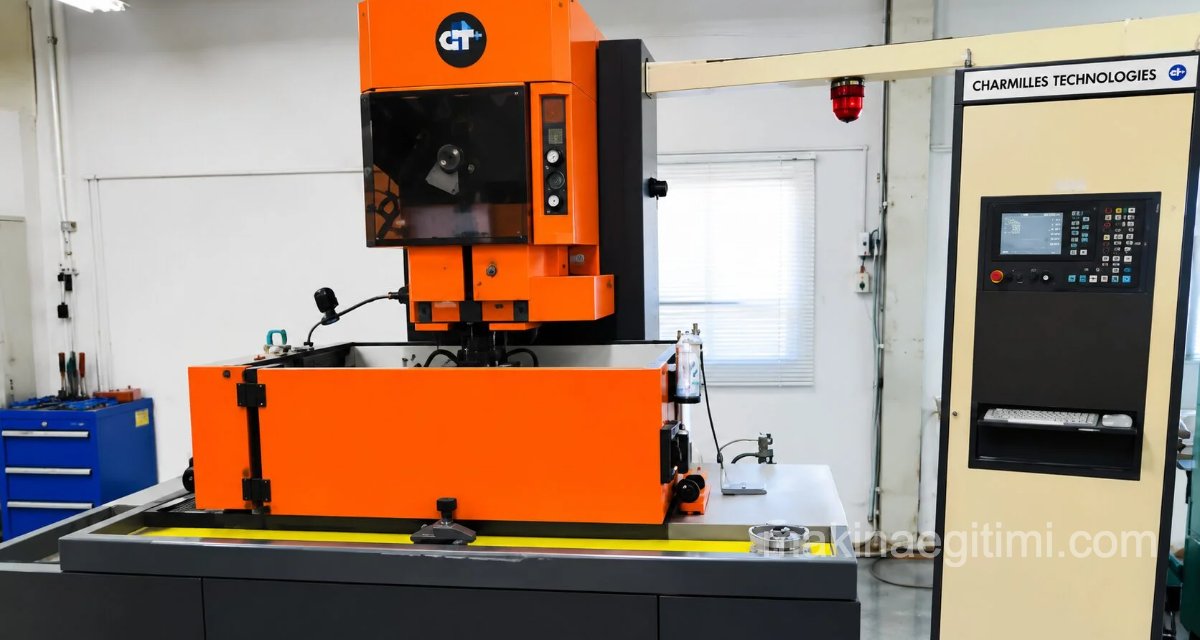
In this article on our Machine Education website, we’ll share information such as what Electrical Discharge Machining (EDM) machines are, what they’re used for, and what the operating principle of an EDM machine is.
What Is an Electrical Discharge Machining Machine
An EDM machine is a machine, especially preferred and frequently used in die-making, that works by creating point-like spark discharges (arcs) between the workpiece and electrodes fed with an oscillating direct current, leaving marks on the part in the shape of the electrode.
Machining by electrical discharge is also called EDM (Electric Discharge Machining).
The History of EDM Machines
The EDM method was discovered in 1943. With the development of electronic control systems at the end of the 1960s, this process was accepted as a reliable and precise material removal method, and EDM machines began to be manufactured.
In the early 1980s, domestic manufacturers began producing EDM machines to meet the needs of the local market. As a result, it became an increasingly widely used machine in the manufacturing industry over time

Electrode Material
Conductive materials such as copper or graphite are generally used as electrodes in EDM machines.
Precision Unaffected by Heat
Since EDM doesn’t apply mechanical cutting force, it doesn’t create a risk of deformation on thin and delicate parts.
Use in Die Manufacturing
EDM machines are widely used for machining the complex internal cavities of injection molds and forging dies.
What Are EDM Machines Used For
EDM machines are used especially heavily in die-making and are one of the indispensable machines for die makers.

EDM machines are machines with which we can give a material any shape we want and cut it into any form we want, regardless of the material’s hardness or machinability.

For this reason, it’s frequently used in manufacturing parts that are difficult to shape or have complex shapes. Because of how long it takes and its not-especially-economical nature, it’s preferred not for mass production itself, but rather for preparing the production dies used in mass production.
The Operating Principle of EDM Machines
In an EDM machine, material is removed with controlled electrical arcs. Each arc creates a small pit on the workpiece. As the arc continuously moves around, the shape of the template is transferred to the other side. Unlike conventional machines, hardened parts and carbide tips can easily be machined with this technique. This feature broadens the range of applications for EDM machines.
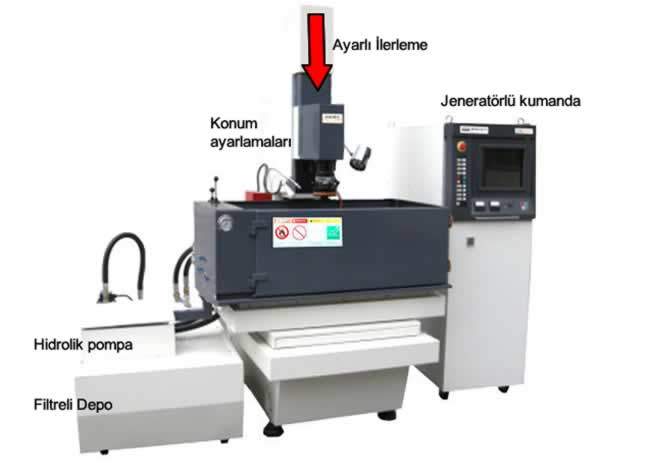
An EDM machine has a feed and positioning mechanism, a generator to produce the electric current, a pump for circulating flushing, and a filtered reservoir. Control is generally carried out through numerical control (NC).
The generator produces a direct current that ranges between 20 and 150 volts. The tool electrode is brought close to the workpiece until a small spark gap remains.
From the control panel the generator is connected to, the pulse duration and the wait time between pulses can be adjusted. Based on this, factors such as shape and dimensional accuracy, surface quality, and the rate of material removal are set from here.
A non-conductive liquid, that is, dielectric fluid, sits between the electrode and the part. At the narrowest point of the spark gap, ions and material particles collect, turning the dielectric substance into an electrical conductor and causing the spark discharge. This produces heat reaching up to 2000°C in this area, causing the material to melt and vaporize.
CNC EDM Machines
Today, CNC (Computer Numerical Control) machines offer more advanced features compared to conventional EDM machines.
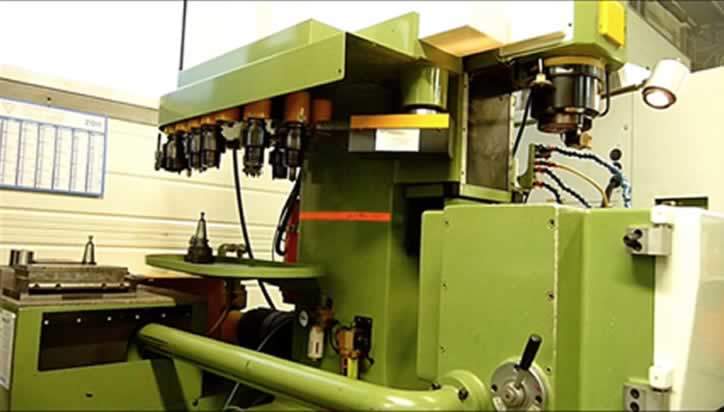
Many advanced CNC EDM machines include a magazine, just like CNC vertical milling machines, and the electrodes mounted in the magazine can be used in the desired order.
They offer features such as accurate, high machining quality above all else; the ability to comfortably machine deep holes, blind holes, and wide lateral areas; automatic tracking level; infrared flame detection; depth alarm and functions for finding the center point by cutting power; time-saving, more convenient dielectric fluid nozzles; and fast machining capability.
EDM machines come in two types based on their method of operation: wire EDM and sinker EDM. You can examine these methods in detail in the related articles section below.
Related Questions
For controlled, repeatable spark formation, the current needs to be stable and predictable. Direct current ensures these spark discharges occur at regular intervals and in a controlled way.
The electronic control systems developed during this period made it possible to manage spark formation and electrode movement much more precisely. This increase in precision made the method reliable and suitable for industrial use.
Related Posts
 Professional 3D Scanners and Their Applications
  The Best 3D Scanners of 2022 – Buying Guide
  What Determines the Color of Laser Beams?
  Applications of Lasers
  Properties of Laser Beams and Their Working Principle
  How Does an Intraoral 3D Scanner for Dentistry Work
  The Relationship Between Laser Cutting Quality and Material Composition
  Advantages and Disadvantages of Waterjet Cutting