
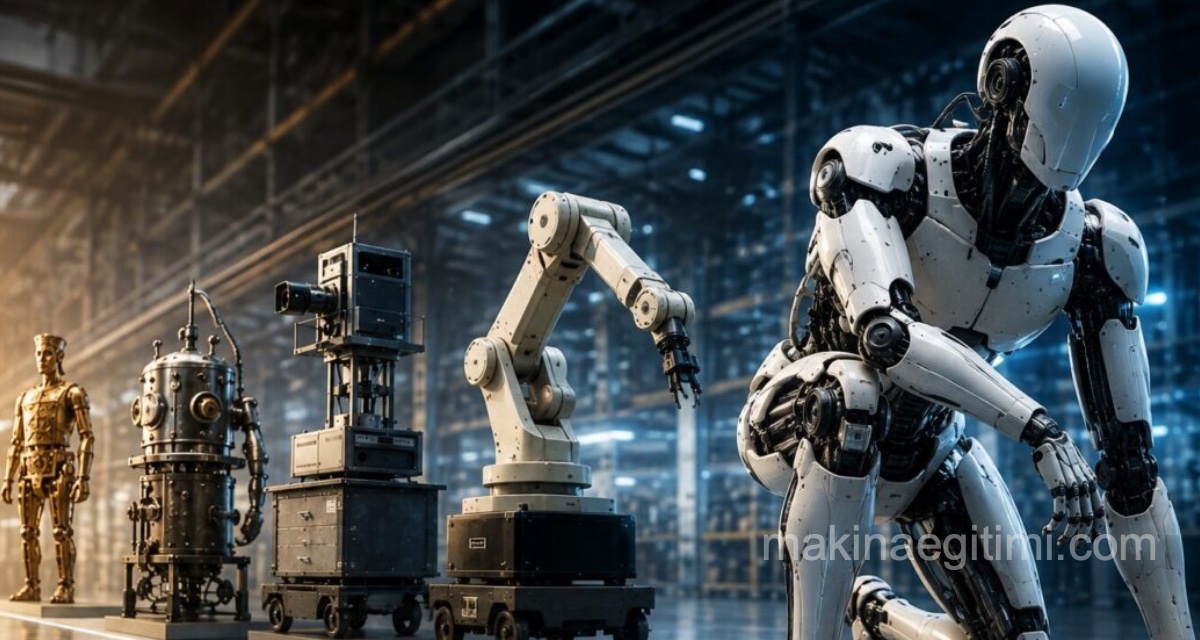
In this article, we take a technical look at the history of robots, their technological turning points, and where the field stands today.

The answer to what robot technology actually is stretches back much further than most people would guess. Robotics technology today spans everything from industrial arms manufacturing on factory floors to robot vacuum cleaners used in homes and humanoid robots exhibiting human-like movement — and it is, in fact, the product of centuries of accumulated progress in mechanics, electronics, and software.
The First Examples of Automata: Antiquity and the Early Period
The roots of robotics technology lie in self-moving mechanisms known as automata. In ancient Greece, Heron of Alexandria designed simple steam-powered mechanisms and automatically opening temple doors.

In the medieval Islamic world, Al-Jazari developed complex mechanical systems such as water clocks and automatic musical instruments. During the Renaissance, Leonardo da Vinci drew up a design for an armored knight capable of movement, inspired by the human skeletal structure. Although these early works do not qualify as robots in the modern sense, they laid the groundwork for the principles of automation and mechanical motion.
The Birth of the Terms “Robot” and “Robotics”
The origin of the word “robot” dates back to 1920, to Czech writer Karel Čapek’s play R.U.R. (Rossum’s Universal Robots). Derived from the Czech word “robota,” meaning “forced labor” or “drudgery,” the term was first used to describe human-like worker machines.
The term “robotics” is generally credited to science fiction writer Isaac Asimov, who coined it in 1942. In the same period, Asimov also formulated the Three Laws of Robotics, which govern robot behavior and are still cited as a reference point in ethical discussions today.
The Emergence of Industrial Robots: 1950-1970
Unimate, widely regarded as the first industrial robot, was patented by engineer George Devol in 1954 and put into service in 1961 at General Motors‘ factory in New Jersey to move hot metal die-cast parts. With this invention, Devol and his business partner Joseph Engelberger founded a company called Unimation, pioneering the commercialization of robotics technology.

Shakey the Robot, developed at the Stanford Research Institute in the late 1960s, represents the intersection of artificial intelligence and robotics as the first mobile robot capable of perceiving its surroundings and making decisions.
Widespread Adoption and Diversification: 1970-2000
WABOT-1, developed by Waseda University in Japan in the 1970s, is recognized as the first full-scale humanoid robot with vision, hearing, and speech capabilities. During the same period, programmable industrial arm designs such as PUMA (Programmable Universal Machine for Assembly) accelerated the adoption of robots in the automotive and electronics industries.
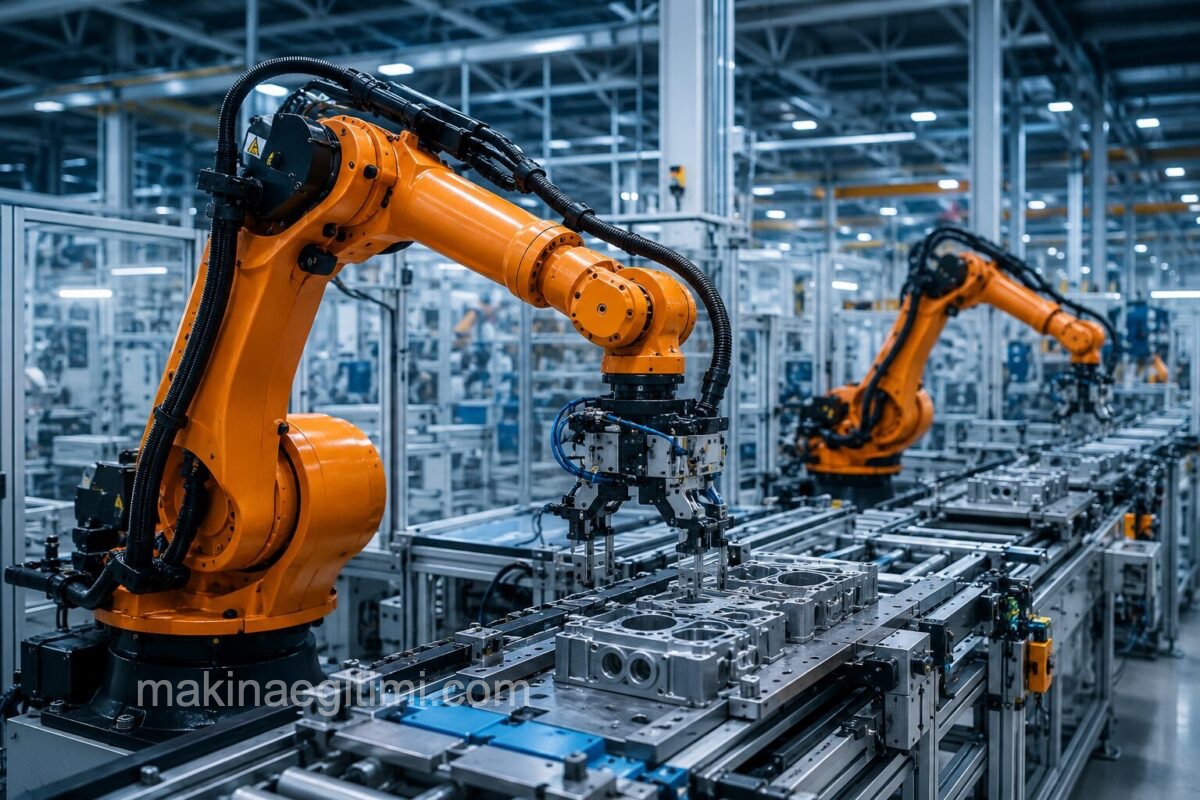
Throughout the 1980s and 1990s, robot technology became a standard component of large-scale mass production lines, and advances in sensor technologies increased the precision and reliability of robots.
Service Robots and Mobile Robotics: 2000-2020
With the 2000s, robotics technology began moving beyond the factory walls. Launched in 2002, the Roomba paved the way for the mass adoption of robot vacuum cleaners in home automation.

During the same period, Boston Dynamics pushed the boundaries of mechanical engineering with projects such as BigDog and Atlas, focused on dynamic balance and quadrupedal locomotion. Autonomous vehicle competitions organized by DARPA played a critical role in maturing autonomous navigation algorithms. This period also saw the proliferation of sector-specific robotics solutions such as surgical robots, agricultural robots, and warehouse automation systems.
AI Integration and Humanoid Robots: 2020 and Beyond
The most notable shift in robotics technology in recent years is the integration of deep-learning-based AI models with robot control systems. This approach is often referred to as “embodied AI” and enables robots to learn from human demonstrations, video examples, or verbal instructions.
Tesla‘s Optimus project, announced in 2021, aims for autonomous operation in industrial tasks with its third-generation prototype unveiled in early 2026. This version features a new hand design with 25 actuators per hand, aiming to deliver sub-millimeter precision and superior dexterity in repetitive industrial tasks.
Similarly, the electric Atlas model from Boston Dynamics, now part of Hyundai, and Figure AI‘s Figure 03 robot have notably intensified competition in this space during 2025 and 2026. That said, industry experts note that today’s humanoid robots still rely heavily on remote operator support (teleoperation) in many demonstrations, and that fully autonomous home use remains at an early stage.
Related Videos
Unimate (original archival news footage from 1967)
Shakey the Robot (SRI International, original 1972 documentary footage):
WABOT-2 (1980s, Waseda University, piano-playing robot)

UNIMATE – ROBOT

Shakey: Experiments in Robot Planning and Learning (1972)

WABOT-2 ROBOT 80's
All New Atlas | Boston Dynamics

Optimus – Gen 2 | Tesla

Introducing Figure 03 Figure
All New Atlas (Boston Dynamics, official announcement)
Gen 2 (Tesla, official announcement)
Introducing Figure 03 (Figure AI, official announcement)
Related Companies and Institutions (External Links)
- Tesla, Inc.: https://www.tesla.com
- General Motors: https://www.gm.com
- Boston Dynamics: https://bostondynamics.com
- Hyundai Motor Group: https://www.hyundaimotorgroup.com
- Figure AI: https://www.figure.ai
- Waseda University Humanoid Robotics Institute: https://www.takanishi.mech.waseda.ac.jp
- SRI International (Stanford Research Institute): https://www.sri.com
- DARPA: https://www.darpa.mil
Conclusion
The evolution of robotics technology is a continuous process of accumulated progress, stretching from mechanical automata to programmable industrial arms, and from there to AI-powered autonomous systems. Each era produced engineering solutions aimed at overcoming the limitations of the one before it.

Today, robotics technology continues to drive transformation across a wide range of fields, from manufacturing and logistics to healthcare, agriculture, and home automation.
Frequently Asked Questions
The word “robot” was first used in 1920 in Karel Čapek’s play R.U.R., derived from the Czech word “robota,” meaning “forced labor.”
The first industrial robot was Unimate, developed by George Devol and put into use at a General Motors factory in 1961.
The term “robotics” was coined by science fiction writer Isaac Asimov in 1942. Asimov also formulated the Three Laws of Robotics.
As of 2026, humanoid robots such as Tesla’s Optimus, Boston Dynamics’ Atlas, and Figure AI’s Figure 03 have entered pilot deployments in industrial settings, but many demonstrations still rely on partial teleoperation, and fully autonomous home use has not yet become widespread.
Robotics technology is used today across a broad range of fields, including automotive manufacturing, logistics and warehouse management, surgery, agriculture, defense, and home automation.
Related Posts
 The Story of the Tiger I Tank. The War Machine That Became a Legend
  Nazi Germany’s Mega Structures – Super Tanks
  The History of Electric Arc Welding
  The History of the Automobile. The Evolution of Vehicle Technology From Then to Now
  Leonardo da Vinci’s Machines: The Flying, Fighting and Walking Inventions of a Renaissance Genius
  The History of Weaving