
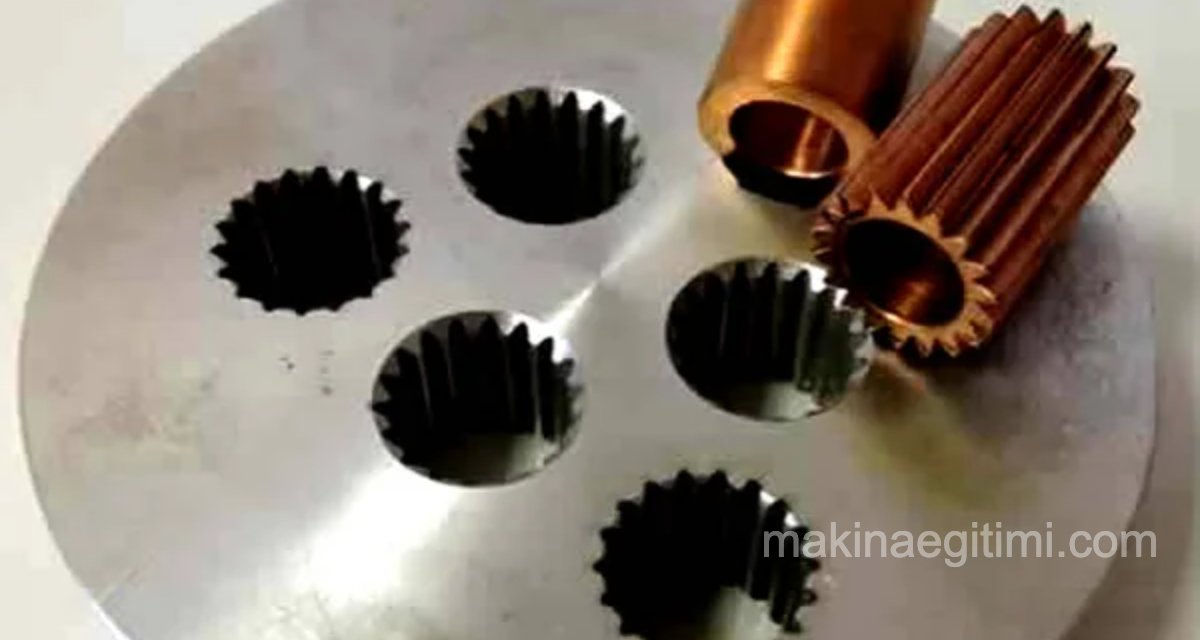
Especially preferred in mold making, Electrical Discharge Machining is a shaping method that removes material electro-thermally by causing localized melting and vaporization on the workpiece through sparks applied to its surface. EDM is done in two ways. One is the method called “sinker (die-sink).” The other is the wire EDM method.
For the article covering the other method, wire EDM, see: What Is Wire EDM, How Does It Work
What Is Sinker (Die-Sink) EDM?
Sinker EDM is the process in which an electrode shaped to a specific form is pressed into the workpiece, and, thanks to sparks generated by electric current, an area in the shape of the electrode is vaporized, creating a cavity in the workpiece.
This method makes it possible to create complex profiles that can’t be machined with other manufacturing methods. Also, since the electrode doesn’t need to be harder than the workpiece, very hard materials can also be machined.

It’s the best Electrical Discharge Machining method for creating parts with complex cavities. It’s also the method of choice for solving the sharp internal corner problem during CNC machining.
Transferring the Electrode’s Shape
In sinker EDM, the negative shape of the electrode is transferred onto the workpiece through spark erosion.
Graphite Electrode Preference
Graphite electrodes are frequently preferred for sinker EDM operations because they’re easy to machine and wear-resistant.
Deep Die Cavities
Sinker EDM is an indispensable method especially for machining deep and complex die cavities.
How Does Sinker EDM Work?
For an effective material removal process, the gap between the workpiece and the electrode needs to be kept constant.
For this reason, the electrode and the workpiece are never in contact with each other.

The distance (gap) between the electrode and the workpiece can be set to the desired amount depending on the voltage, but the recommended gap size is 0.050 mm.
For the electric arc discharge process to be carried out properly, it isn’t enough for the gap between the electrode and the workpiece to simply be the desired amount. The material removal process, and the area from which material is removed, need to be controlled in a stable environment. For this, dielectric fluid is used, and the area where material is removed is isolated.
The other EDM machining method is the cutting method. A wire electrode cuts the part with positioning directed by the EDM machine (technically it’s not accurate to call this a mechanical cut — “melting” would be more correct). With this method, it’s possible to make smooth, complex-shaped cuts, similar to laser cutting.
Sinker EDM Electrodes
In principle, any electrically conductive material can be used to make electrodes.
However, for low electrode wear, materials with a high melting point and good electrical and thermal conductivity should be preferred. These properties have a significant effect on the electrode’s material removal capacity.
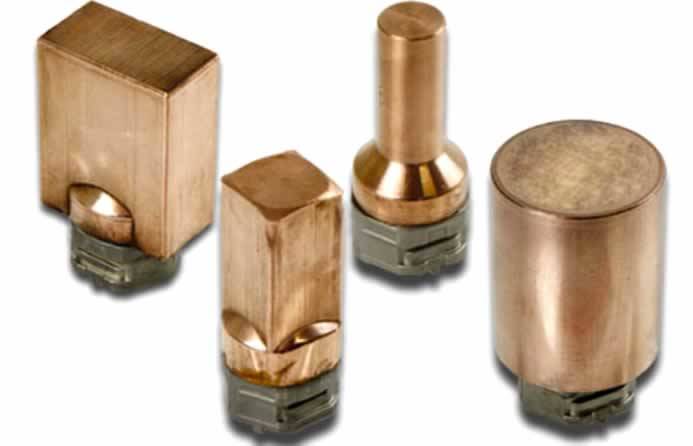
We can group electrode materials into three categories:
- Metals such as electrolytic copper, copper-tungsten, silver-tungsten, chromium-copper, aluminum alloy, brass, steel, tungsten
- Graphite (a non-metallic but conductive material)
- Copper-graphite (a combination of metal and non-metal)
Applications of Sinker EDM
Sinker EDM is used to make deep-drawing dies, forging dies, die-casting and injection molding dies, as well as cavities and engravings for cutting tools.
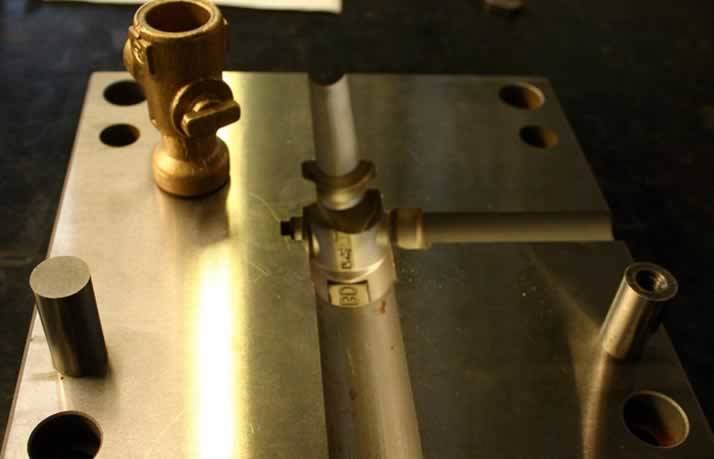
Numerically controlled sinker EDM machines allow the electrode to move along its axes. When electrodes are rotated with lateral or axial movements, various workpieces can be produced with a simple electrode shape.

Related Questions
Material removal happens through the heat created by the electric spark, not through the electrode’s physical contact or hardness. That’s why even a soft electrode can machine a material far harder than itself, through thermal effect.
A rotating milling tool always leaves a slight radius on internal corners because of its own radius. In sinker EDM, since the electrode is manufactured in the desired corner shape, it transfers that shape directly onto the part, achieving fully sharp corners.
Related Posts
 What Is Dielectric Fluid, What Does It Do, Where Is It Used?
 The Best 3D Scanning Apps
 What Is Wire EDM, How Does It Work?
 3D Printer Applications Today and in the Future
 3D Scanning – What Is 3D Scanning?
 Properties of Laser and Laser Devices Used in Medicine
 What Can a Waterjet Cut? What Can It Not Cut?
 Laser or Waterjet, Which Is Better?