Close Menu
  • MAKİNELER ve İMALAT
    • Tools & Equipment
    • Computer-Aided Drawing
    • CAD/CAM Education
    • CNC Machine Programming
    • Casting Technologies
    • Electrical & Electronics Technologies
    • Hydraulics & Pneumatics
    • Manufacturing Processes
    • Manufacturing Technologies
    • Occupational Safety
    • Mold & Die Design
    • Solid Modeling
    • Welding Technology
    • Machine Elements
    • Mechanical Trade Drawing
    • Materials Science
    • Automotive & Vehicle Technologies
    • Robotics Technologies
    • Health Technologies
    • Defense & Aerospace Technologies
    • Descriptive Geometry
    • Technical Drawing
    • Software & Hardware Technologies
    • Innovative Manufacturing Methods
  • TEKNOLOJİ ve YAŞAM
    • OTOMOBİLLER ve TAŞIT
      • Vehicle & Engine Knowledge
      • Safe Driving
      • Sürüş Destek Sistemleri
    • Genel Kültür
      • Movies & TV Shows
      • Görsel ve Grafik Sanat
      • Books & Literature
      • Music
      • Sports
      • History
      • History of Technology
    • GÜNDELİK YAŞAM TEKNOLOJİLERİ
    • Hobbies & Entertainment
    • Internet Technologies
    • Health
    • Mobile Technologies
Makine Eğitimi
  • Machines & Manufacturing
    Machine Elements
    Hydraulics & Pneumatics
    Technical Drawing
    Computer-Aided Design & Manufacturing
    Basic Manufacturing Processes
    Manufacturing Processes
    Industry Technologies
    Other Technical Courses
    Motion & Power Transmission
    Simple Machines
    Chains & Sprockets
    Shafts & Journals
    Gears
    Cams
    Couplings
    Belts & Pulleys
    Springs
    Bearings
    Keys
    Fastening Joining
    Retaining Rings
    Screws, Bolts & Nuts
    Cotter Pins
    Flanges
    Welding
    Rivets
    Pins & Bolts
    Washers
    Calculators
    Gear Ratio Calculator
    Spring Constant Calculator
    Belt Pulley Ratio Calculator
    Other Machine Elements
    Slides & Linear Guides
    Brakes
    Flywheels
    Clamps
    Shock Absorbers
    Gaskets & O-Rings
    Seals & Sealing Elements
    Hydraulics
    Introduction to Hydraulics & Principles
    Hydraulic Systems & Applications
    Accumulators
    Filters
    Motors
    Pumps
    Valves
    Pneumatics
    Introduction to Pneumatics & Principles
    Pneumatic Systems & Applications
    Pneumatic Circuit Components
    Valves
    Cylinders
    Silencers
    Motors
    Compressors
    Dryers
    Conditioning Units
    Common Topics & Maintenance
    Hydraulic & Pneumatic Maintenance
    Study Notes, Exams & Tests
    Technical Drawing
    Introduction to Technical Drawing
    Geometric Drawings
    Perspective & Projection
    Orthographic Views
    Dimensioning
    Sectioning
    Assembly & Detail Drawings
    Tolerances
    Surface Finish Symbols
    Mechanical Engineering Drawing
    Screws, Bolts & Nuts
    Pulley Drawings
    Gear Drawings
    Shafts & Journals
    Bearing Drawings
    Pins & Bolts
    Spring Drawings
    Welds in Technical Drawing
    Washers
    Cotter Pins
    Technical Drawing Exercises
    Mechanical Drawing Exercises
    Gear Exercises
    View Extraction Exercises
    Pulley Exercises
    Pin & Bolt Exercises
    Threaded Fastening Exercises
    Descriptive Geometry
    Computer-Aided Drawing
    AutoCAD Drawing Lessons
    Computer-Aided Drawing Exams
    Solid Modeling & Animation
    Solid Model Drawing Files
    Solid Model Assembly Examples
    Solid Model Drawing Lessons
    3D CAD Software Reviews
    Solid Modeling Exercises
    CNC Programming
    CAM
    Measurement & Inspection
    Dial Indicators
    Calipers
    Gauges
    Micrometers
    Materials Science
    Steels
    Cast Iron
    Aluminum
    Plastics
    Material Testing & Hardness Measurement
    Occupational Safety
    Workshop Safety
    Safety When Working With Electricity
    Machine Safety Rules
    Hand Operations
    Filing
    Marking
    Cutting Operations
    Reaming
    Tapping
    Threading With a Die
    Drill Bit Sharpening
    Working With Machines
    Basic Turning Operations
    Basic Milling Operations
    Shaper Machine
    Machining
    Turning
    Milling
    Grinding
    Innovative Manufacturing Methods
    EDM (Electrical Discharge Machining)
    Laser Machining
    Waterjet Machining
    3D Printing
    3D Scanners
    Welding
    Rolling
    Casting
    Mold & Die Design
    Mechanical & Hydraulic Presses
    Blanking & Piercing Dies
    Bending Dies
    Drawing Dies
    Plastic Injection Molds
    Extrusion Dies
    Compound Dies
    Progressive Dies
    Blow Molds
    Spinning Dies
    Spray Molds
    Manufacturing of Machine Parts
    Automotive & Vehicle Technologies
    Motor Vehicle Manufacturing
    Raw Material Production
    History of Technology
    Health & Medical Technologies
    Defense & Aerospace
    Robotics Technologies
    Software & Hardware Technologies
    Mechanics - Strength of Materials
    Physics Topics
  • Technology & Life
    Hobbies & Entertainment
    Sports
    Music
    Vehicle & Engine Knowledge
    Vehicle Maintenance & Repair
    Safe Driving
    Driver Assistance Systems
    History
    Movies & TV Shows
    Books & Literature
    Computers & Internet
    Computer Tips
    Software Reviews
    Hardware & Peripherals
    Practical & Safe Internet Use
    Visual & Graphic Art
    Mobile Technologies
    Travel
    Science
    Health
    First Aid Knowledge
    Everyday Technologies
Makine Eğitimi
Home»Manufacturing Technologies»What Is Electrical Discharge Machining (EDM). Machining with EDM
29 August 2026Updated:3 September 2026

What Is Electrical Discharge Machining (EDM). Machining with EDM

What Is EDM, How Does It Work

What Is Electrical Discharge Machining (EDM)?

Especially preferred in mold making, Electrical Discharge Machining is a shaping method that removes material electro-thermally by causing localized melting and vaporization on the workpiece through sparks applied to its surface.

  • What Is Electrical Discharge Machining (EDM)?
  • How EDM Works
    • Sinker (Die-Sink) EDM
    • Wire EDM
  • Applications of EDM
  • Questions About EDM
  • Related Questions

It’s also known as EDM (Electric Discharge Machining). It’s a non-traditional form of precision machining that uses thermal energy instead of mechanical force to remove material from a workpiece. Because it uses electrical sparks between 8000°C and 12000°C, it’s sometimes referred to as Spark Machining. Engineers often turn to EDM when machining processes like CNC milling and CNC turning can’t produce the desired cut, such as sharp internal corners.

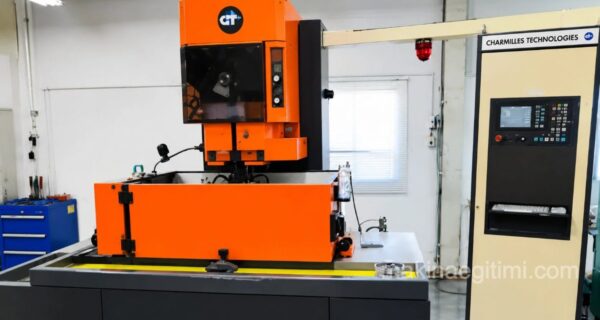
electrical discharge machining (EDM) machine
Electrical discharge machining (EDM) machine

Thanks to the EDM process, any electrically conductive material can be machined regardless of its hardness or machinability. Because of this, the method is especially suitable for hardened steels, hard metals, and fit/mating parts that are difficult to manufacture.

How EDM Works

In EDM, electricity is applied to the workpiece and to the material used as the electrode. The electrode acts as the cathode (- pole), while the workpiece is the anode (+ pole).

The electrode is brought close to the workpiece, but never touches it. An electric arc forms between the electrode and the workpiece. Because of this current, the area opposite the electrode heats up and melts or vaporizes.

This way, the workpiece is given the desired shape through melting and vaporization.
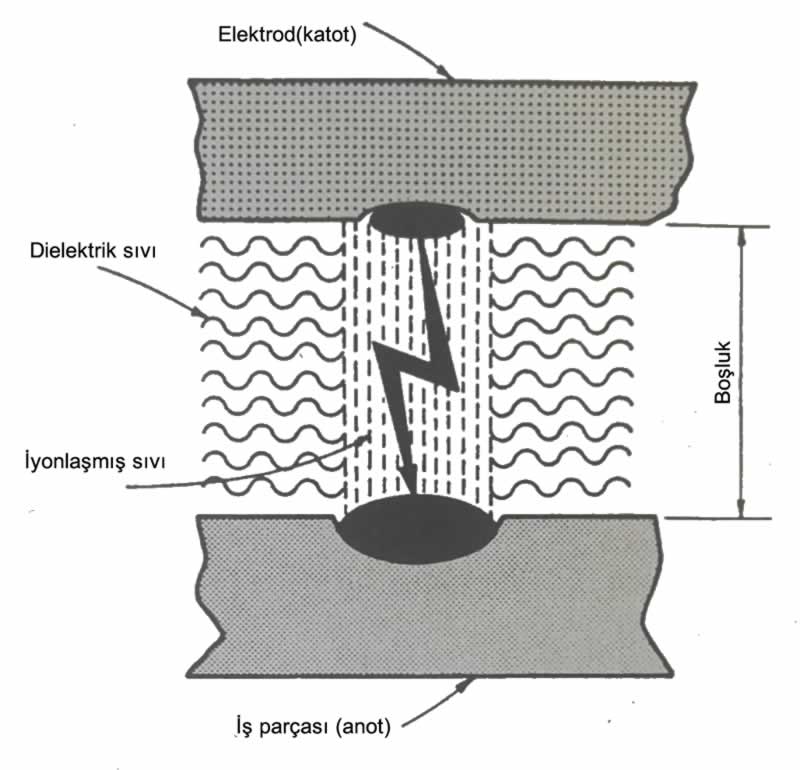
EDM process working principle

For the electric arc discharge process to be carried out properly, it isn’t enough for the gap between the electrode and the workpiece to simply be the desired amount. The material removal process, and the area from which material is removed, need to be controlled in a stable environment. For this, dielectric fluid is used, and the area where material is removed is isolated. For detailed information, see: What is dielectric fluid, what does it do?

Sinker (Die-Sink) EDM

EDM machining is done in two ways. One is called “sinker (die-sink) EDM,” a method in which an electrode shaped to a specific form is pressed into the workpiece, creating a cavity in the shape of the electrode in the workpiece.
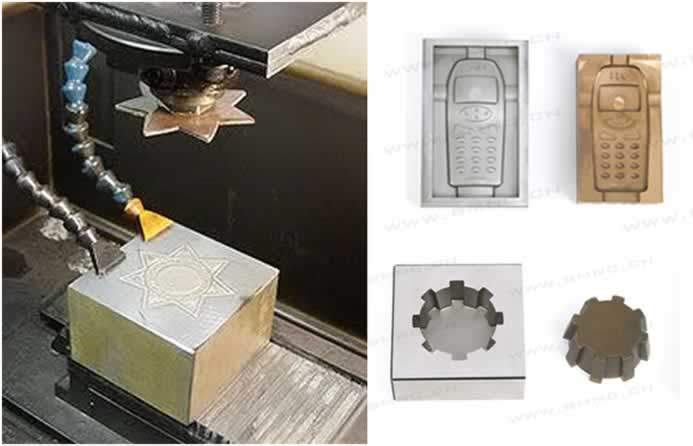
sinker EDM die and electrode

Wire EDM

The other EDM machining method is wire EDM. A wire electrode cuts the part with positioning directed by the machine (technically it’s not accurate to call this a mechanical cut — “melting” would be more correct). With this method, it’s possible to make smooth, complex-shaped cuts, similar to laser cutting.

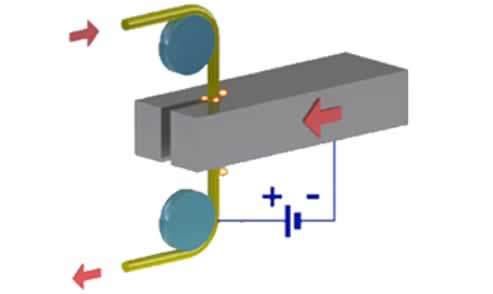
example of a part cut by EDM (wire EDM)
A part machined by wire EDM
EDM cutting principle
Wire EDM cutting principle
cutting on an EDM machine
Cutting on an EDM machine (wire EDM)
Video of the wire EDM operating system and wire EDM cutting

Spark Erosion Principle


EDM is a non-contact machining method that removes conductive material by melting it with electrical sparks.

Machining Hardened Steel


EDM can machine extremely hard or brittle materials that conventional cutting tools cannot machine.

Role of Dielectric Fluid


The dielectric fluid used during the process both cools the work zone and flushes away the melted metal particles.

Applications of EDM

  • Micro-hole drilling
  • Cutting sharp internal corners
  • Creating injection molding tools
  • Cutting extrusion dies
  • Cutting rotational forms
  • Drilling curved holes
  • Engraving on hard materials
  • Removing broken tools from workpieces

Questions About EDM

QUESTION: What is the precision of EDM?
ANSWER: EDM can work within very tight tolerances, such as +/- 0.012 mm. This is why the aerospace and medical industries benefit from this process.

QUESTION: Is EDM environmentally friendly?
ANSWER: Because of the amount of electricity required for Electrical Discharge Machining to take place, it doesn’t represent an environmentally friendly machining method. As more and more companies globally try to take measures to reduce their carbon footprint, other machining methods that require less electricity, and are therefore less harmful to the environment, are preferred over EDM.

QUESTION: Which materials can be machined with EDM?
ANSWER: The material must be electrically conductive. Any metal known to be conductive can be machined, even hard materials such as Inconel and tungsten carbide. Although the process is technically stress-free, it should also be kept in mind that machining is still a thermal process that can change the metallurgy of the workpiece.

Related Questions

This method removes material by melting and vaporizing it with the thermal energy created by an electric spark, not by mechanical cutting force. Because it relies on thermal effect, how hard the material is doesn’t limit the machining capability the way it would with mechanical methods.

Conventional cutting tools dull quickly or can break when machining hardened steel. Since EDM is a non-contact, thermal method, tool wear isn’t a problem with these kinds of hard materials.

Related Posts
Electrical Discharge Machining (EDM) Machines Electrical Discharge Machining (EDM) Machines Laser Cutting Working Principle Laser Cutting Working Principle, Advantages and Disadvantages Günümüzde ve Gelecekte 3b Yazıcı Uygulamaları 3D Printer Applications Today and in the Future En İyi 3D Tarayıcılar Satın alma rehberi The Best 3D Scanners of 2022 – Buying Guide Applications of Lasers Applications of Lasers laser cutting Laser or Waterjet, Which Is Better? Su Jeti Neyi Kesebilir Neyi Kesemez? What Can a Waterjet Cut? What Can It Not Cut? dental intraoral 3D scanner How Does an Intraoral 3D Scanner for Dentistry Work
EDM (Electrical Discharge Machining)
Share. Facebook Twitter WhatsApp Tumblr Email Telegram Copy Link

Leave A Reply Cancel Reply


When Fiction Becomes Reality: 6 Novels That Predicted the Future
Fuel Cell Electric Vehicles (FCEV)
  • Contact
  • Terms of Service
  • Privacy & Cookie Policy

Type above and press Enter to search. Press Esc to cancel.