

Definition and Importance of Cutting Speed on a Lathe
The distance the tool tip travels around the workpiece, in meters per minute, is called cutting speed. Cutting speed is of great importance for extending tool life and achieving the desired surface quality.
Factors Affecting Cutting Speed on a Lathe
The material’s hardness, depth of cut, and feed rate affect cutting speed inversely. The tool’s hardness and the machine’s capacity affect cutting speed directly.
In turning, as the workpiece’s hardness, depth of cut, and feed rate increase, cutting speed should be decreased; as the tool’s hardness increases, cutting speed should be increased.
Cutting Speed Formula
Cutting speed (Vc) is calculated using the workpiece diameter and RPM with the formula Vc = π x D x n / 1000.
Cutting Speed by Material
Soft materials like aluminum can withstand high cutting speeds, while hardened steels require low speeds.
Effect on Tool Life
Exceeding the optimal cutting speed can cause rapid wear and premature breakage of the tool tip.
Calculating Cutting Speed on a Lathe
Cutting speed is calculated based on the workpiece’s diameter and RPM.
d: workpiece diameter (mm)
n: workpiece speed per minute: (rev/minute)
v: cutting speed m/min (meters/minute)
with these; the circumferential distance the tool tip travels in one revolution of the workpiece = π . d.
The distance traveled per minute is then π . d . n. Converting the diameter measurement to mm:
Cutting Speed V = π . d . n / 1000 (m/min)
Example Problem: Calculating Cutting Speed on a Lathe
Find the tool’s cutting speed for machining a 20 mm diameter part at 500 rpm.
SOLUTION:
V = π . d . n / 1000
V= 3.14 . 20 . 500 / 1000
V= 31.4 m/min
NOTE:
Cutting speed is taken as V=20m/min for HSS cutting tips,
and V=40m/min for carbide-tipped tools.

Calculating RPM from Cutting Speed
To perform turning at the selected cutting speed, it’s important to set the machine to the correct RPM. Once the RPM that will give the required cutting speed is found, the necessary setting is made using the lathe’s speed-change levers. Since cutting speed is V = π . d . n / 1000:
RPM (n) = 1000 . V / π . d
This will be the result, with units of rev/min.
Example Problem: Calculating RPM from Cutting Speed
Find the RPM for machining a 100 mm diameter part at a cutting speed of 25 m/min.
SOLUTION:
n = 1000 . V / π . d
n = 1000. 25 / 3.14 . 100
n = 79.6, found, and the machine’s RPM is set to the nearest value, 80 rpm.

On a lathe of the type shown above, the nearest speed, 70 rpm, could be selected.
Related Questions
A hard material offers more resistance to the cutting tool and generates more heat during cutting. If speed isn’t reduced, this heat can rapidly wear or break the tool.
At the same RPM, a larger-diameter part has a longer circumference, so the tool tip covers more distance per unit time. This is why actual cutting speed depends not just on RPM but also on the workpiece’s diameter.
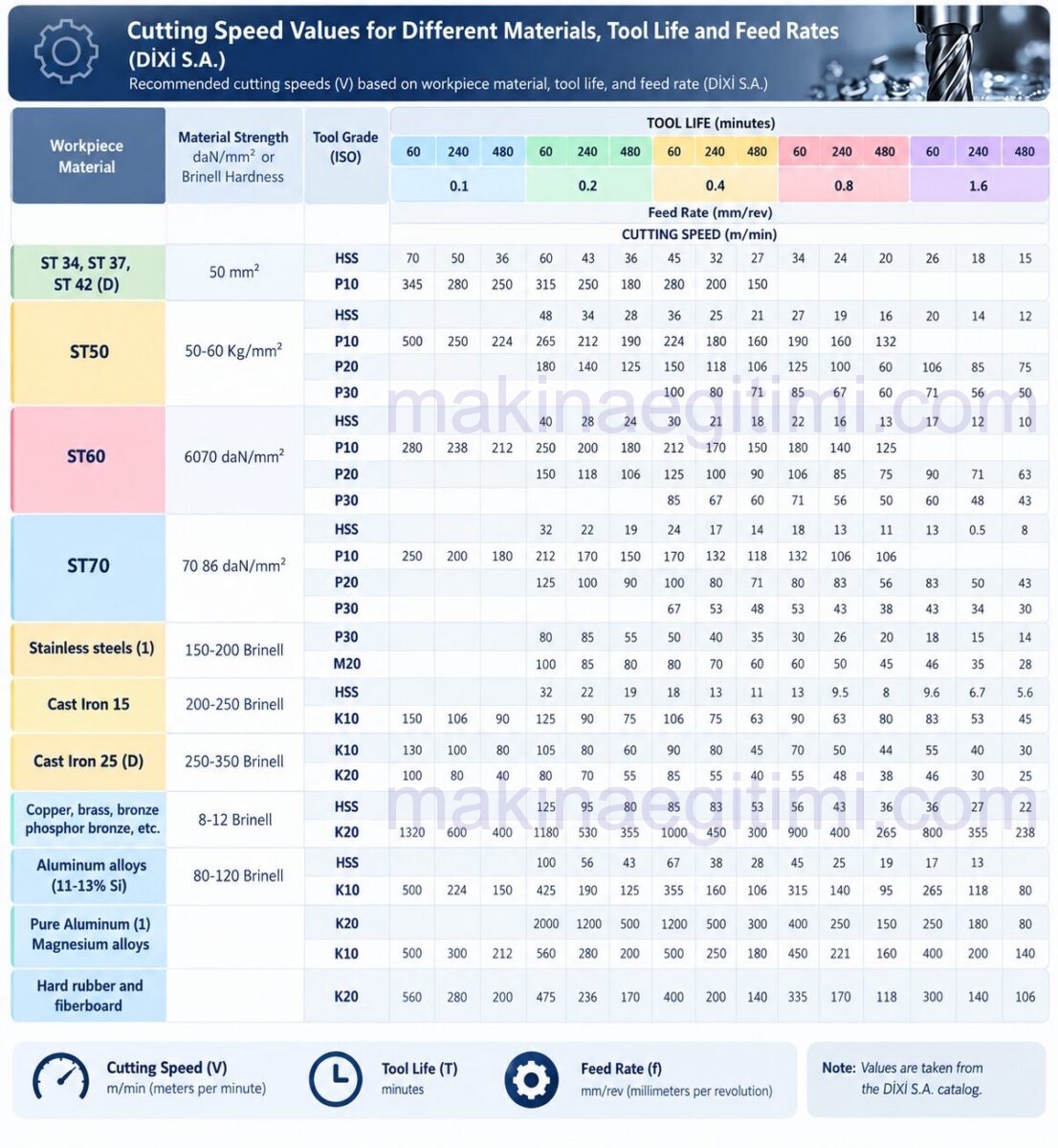
NOTE: In practice, precalculated cutting speed tables for various materials can be used to find the required RPM without needing to do the calculation.
Cutting Speed Values for Different Materials, Tool life and Feed Rates
Related Posts
 How Are End Mills Mounted
 Information About Cutting Fluids (Coolants)
 What Do Cooling / Cutting Fluids Do? Their Functions
 What Is Soldering? Soft Soldering and Brazing Methods
 How to Read a Caliper. Caliper Reading Explained
 Operations Performed on a Lathe
 Twist Drills
 Gear Calculation Formulas Table