
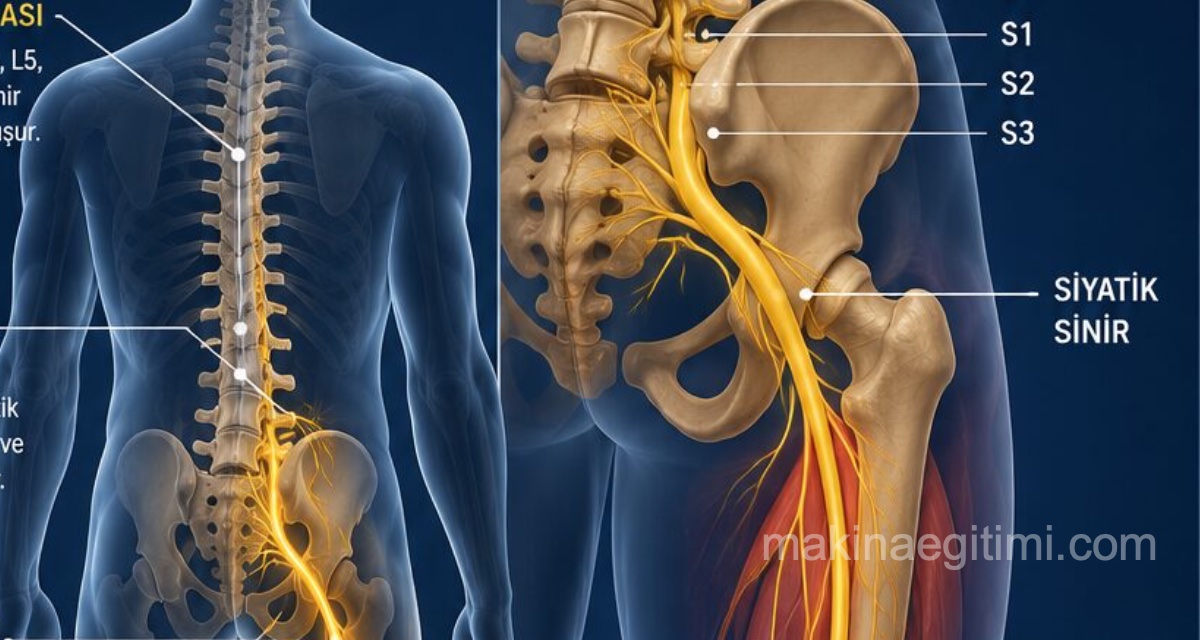
Sciatica is a pain condition that occurs when the sciatic nerve, which runs from the lower back through the hip and into the leg, becomes compressed. The pain is usually felt in one leg, accompanied by burning, tingling, and numbness. The most common cause is a herniated disc. In most cases, the pain improves significantly within 6–8 weeks with exercise and physical therapy, without any need for surgery.
Pain that starts in your lower back travels down into your hip, then spreads down the back of your leg. Sometimes it reaches all the way to your foot. It gets worse when you cough, and becomes unbearable after sitting for a long time.
What’s commonly called “sciatica” is exactly this. In fact, sciatica isn’t the name of a disease — it’s the name of a symptom pattern — there’s an underlying cause, and treatment is shaped around that cause.
In this article, we explain in plain language why sciatica occurs, how it’s diagnosed, the treatment approaches accepted in the medical community, and what you need to change in daily life.
What is sciatica?
The sciatic nerve is the thickest and longest nerve in our body. It emerges from the vertebrae in the lower back, passes deep through the hip, travels down the back of the thigh, and splits in two below the knee to reach the foot.
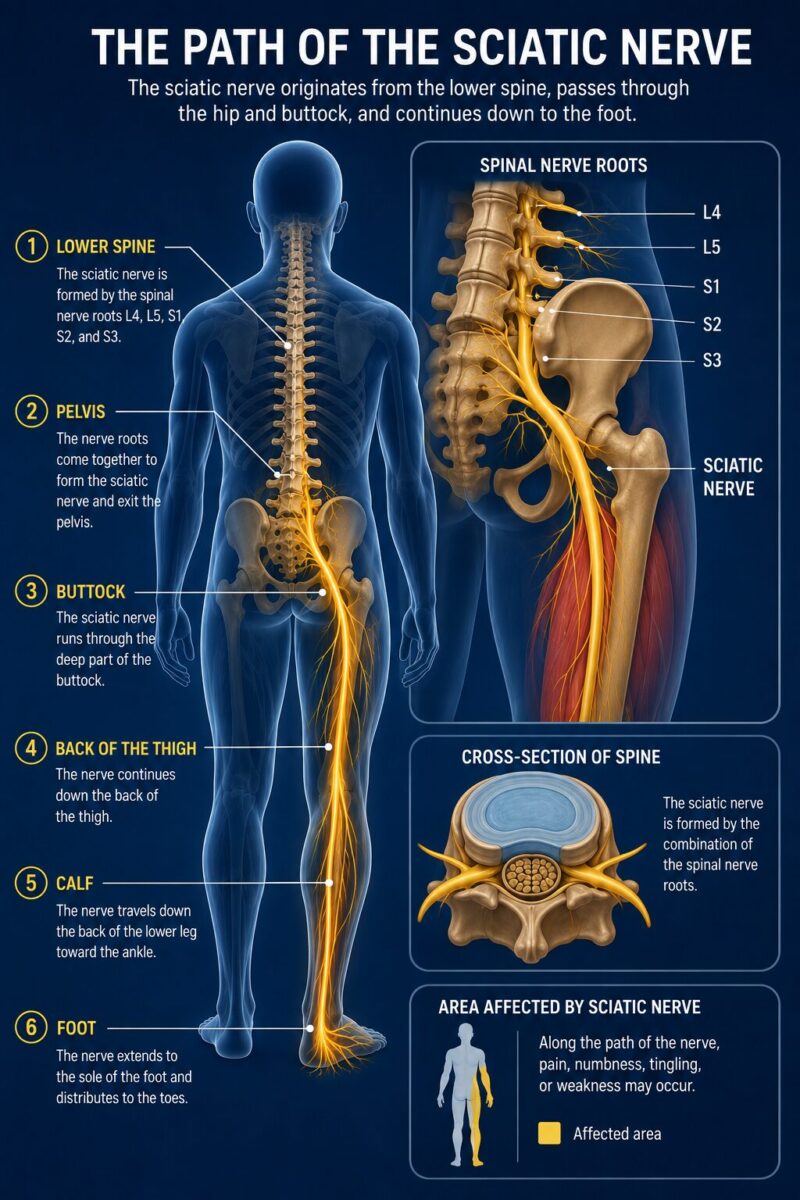
When compression, pinching, or irritation occurs anywhere along this nerve, the nerve transmits it to the brain as a pain signal. Here’s the interesting part: even if the compression is in your lower back, you feel the pain in your leg. The entire path the nerve travels is affected. In medical terms, this condition is also called sciatalgia.
Is sciatica the same thing as low back pain?
No, and this distinction matters:
- Low back pain is when the pain stays in the lower back. It’s usually muscular in origin.
- Sciatica, on the other hand, is when the pain spreads downward from the lower back through the hip and leg.
If the pain extends below knee level, the likelihood of nerve involvement increases significantly.
What causes sciatica?
Sciatica is a result; the real issue is what’s causing that result. The most common causes are as follows:
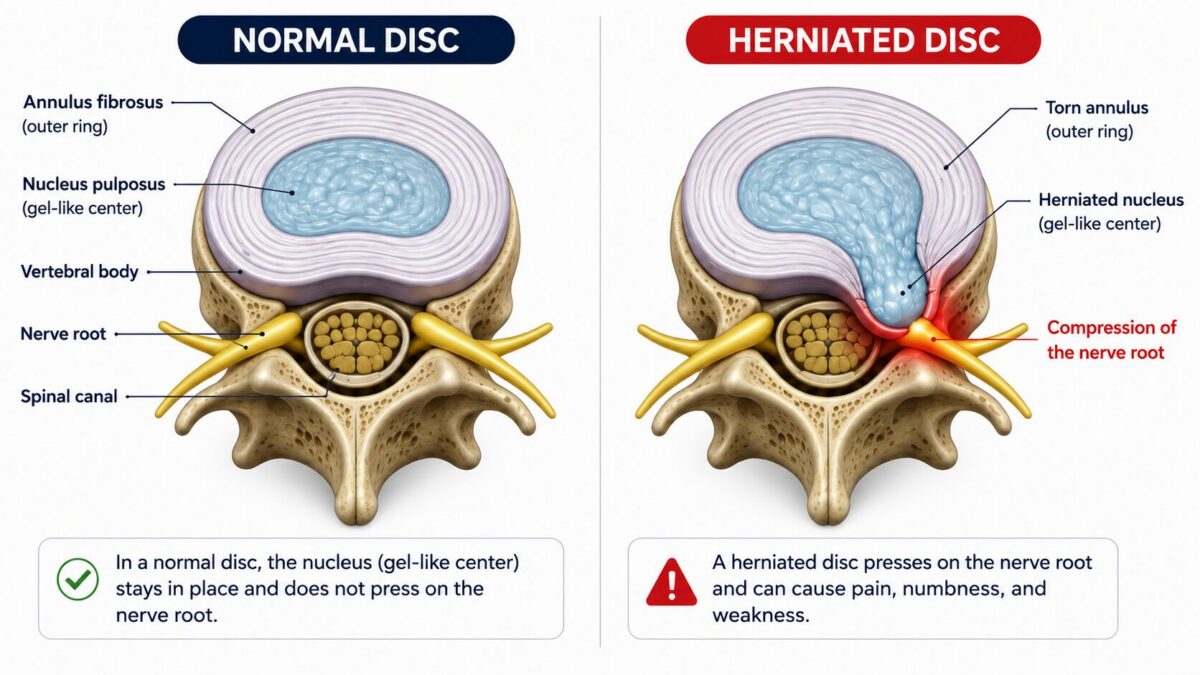
Herniated disc (the most common cause). When one of the discs that act as cushions between the vertebrae bulges outward and presses on a nerve root. This is behind the vast majority of sciatica cases.
Spinal canal narrowing (spinal stenosis). With age, the spinal canal narrows, leaving less room for the nerves. It’s more common over age 60. In these people, the pain usually increases while walking and eases when bending forward.
A hip muscle compressing the nerve (piriformis syndrome). When a muscle deep in the hip tightens, it can compress the sciatic nerve running right beneath it. This is seen in people who sit for long periods and in runners.
Spondylolisthesis (vertebral slippage). When one vertebra slips forward relative to the one below it, it narrows the openings where nerves exit.
Age-related disc degeneration. Discs lose water over time, thin out, and become unable to perform their cushioning function.
Rarer causes. Cysts or tumors on the spine, inflammatory conditions, or an incorrectly angled injection into the hip.
Risk-increasing factors
- Sitting still for long periods (desk jobs, long trips)
- Excess weight — directly increases the load on the spine
- Lifting heavy objects with incorrect technique (bending from the waist instead of the knees)
- Smoking — impairs disc nutrition and speeds up wear
- A sedentary lifestyle and weak core (abdominal-lower back) muscles
- Diabetes — makes nerves more vulnerable to damage
- Pregnancy — pressure from the growing uterus and hormonal changes
What are the symptoms of sciatica?
The most typical feature: the pain is usually one-sided. Pain affecting both legs at once could be a sign of a different problem and should definitely be evaluated. Common symptoms:
- Pain spreading from the lower back to the hip, then down the back of the thigh and calf
- Pain that sometimes extends down to the foot and toes
- A pain character described as burning, an electric shock, or a needle prick
- Numbness and tingling in the leg or foot
- Pain intensifying after sitting for a long time
- Pain suddenly increasing when coughing, sneezing, or straining
- Weakness in the leg, difficulty climbing stairs
- Difficulty standing or walking
The severity of the pain varies a great deal from person to person: for some it’s a mild discomfort, for others it’s pain severe enough to halt daily life.
How is sciatica diagnosed? Which department should you visit?
Departments you can consult: Physical Medicine and Rehabilitation, Orthopedics and Traumatology, Neurosurgery, or Neurology. Whichever you go to, you’ll be referred to the appropriate department if needed.
What happens during the exam? The doctor first asks where the pain starts and where it spreads to. Then they perform simple but highly informative tests; the best known is the straight leg raise test done while lying on your back. If this movement clearly triggers the pain, nerve involvement is suspected. Reflexes, muscle strength, and sensory loss are also checked.
What tests might be ordered?
- MRI (magnetic resonance imaging): The best method for visualizing discs, nerves, and soft tissue.
- X-ray: Shows bone structure, vertebral slippage, and calcification.
- CT scan: Preferred when bone detail is needed.
- EMG (nerve conduction study): Measures how much the nerve is affected.
Imaging isn’t required for every case of sciatica. If there are no red-flag symptoms, doctors generally try a few weeks of treatment first.
How is sciatica treated?
Here’s the most important thing to know: the vast majority of sciatica cases improve without surgery. Mild to moderate pain usually recedes significantly within 6–8 weeks.
Treatment generally proceeds step by step:
1. Early phase: getting the pain under control
In the acute phase, the goal is to make the pain manageable. At this stage, the doctor may prescribe pain- and inflammation-reducing treatments. We don’t name specific medications in this article — your doctor, who knows your other conditions and the medications you’re taking, decides which treatment is right for you.
The shift in thinking about bed rest matters: In the past, extended bed rest used to be recommended. Today the medical community’s consensus is the exact opposite — resting in bed for more than 1–2 days slows recovery. Staying as active as the pain allows produces better results.
2. Heat and cold application
In the first 48 hours, cold application (an ice pack wrapped in a thin cloth, 15–20 minutes) helps reduce inflammation and swelling. Later on, if muscle spasm is the dominant issue, heat application can be soothing. Both provide temporary relief; neither is a permanent solution.
3. Physical therapy and exercise — the backbone of treatment
The most lasting benefit comes from here. A program carried out with a physical therapist generally includes:
- Stretching exercises — reduce tension along the nerve’s path
- Strengthening the abdominal and lower back muscles (the core) — supports the spine like a natural brace
- Posture training — relearning proper sitting, standing, and lifting techniques
- Manual therapy — hands-on release and mobilization techniques
- Electrotherapy, TENS, and ultrasound — methods that help with pain control
⚠️ Consult your doctor before doing exercises on your own after watching them online. The location and type of your herniation determine which movements will help and which will harm. The wrong exercise can make things worse.
4. Interventional methods
If the pain doesn’t go away despite several weeks of treatment, the doctor may bring up injection treatments applied around the nerve root. These methods aim to relieve pain by reducing inflammation and are usually performed under imaging guidance. They aren’t a permanent solution, but an intermediate step that makes physical therapy possible.
5. Surgery
Surgery isn’t the first option for sciatica — it’s the last resort. It generally comes up in the following situations:
- Pain persisting despite 6–12 weeks of regular treatment
- Progressive muscle weakness (such as being unable to lift the foot)
- Loss of bladder or bowel control → this is an emergency
Most methods used today are microsurgical techniques performed through small incisions, and recovery time is shorter than it used to be.
⚠️ Go to the hospital without delay if you have these symptoms
The following can be signs of a rare but serious form of nerve compression (cauda equina syndrome). In this case, hours matter:
- Losing bladder or bowel control, being unable to urinate
- Numbness in the groin and inner-thigh area (not feeling anything when sitting down)
- Rapidly increasing weakness in both legs at once
- Being unable to lift the foot, the foot dragging while walking
- Pain accompanied by fever, night sweats, or unexplained weight loss
- Severe pain starting after a fall or accident
Don’t wait for an appointment with these symptoms — go directly to the emergency room.
What should you pay attention to during treatment?
Sitting arrangement. Sitting in the same position for a long time is sciatica’s biggest enemy. Get up and walk for a few minutes every 30–45 minutes. Your chair should support the curve of your lower back; if it doesn’t, put a small pillow behind it.
Heavy lifting technique. Don’t bend from the waist. Bend your knees, keep the load close to your body, and lift using your leg muscles. Don’t twist your torso while lifting.
Sleeping position. If you sleep on your side, put a pillow between your knees. If you sleep on your back, put a pillow under your knees. Your mattress shouldn’t be rock hard or so soft you sink into it; medium firmness suits most people.
Stay active. Avoiding all movement out of fear of pain weakens the muscles and delays recovery. Short daily walks on flat ground increase blood flow and support healing.
Weight control. Every kilogram lost directly reduces the load on the spine.
Quit smoking. Smoking impairs disc nutrition and slows healing. It’s one of the changes that produces the fastest return, in terms of spinal health.
Things to avoid: Forward-bending movements, heavy and sudden lifting, long car trips (without breaks), high-heeled shoes, and sitting for long periods on very soft sofas.
Be patient. Recovery from sciatica is measured in weeks. Giving up on treatment because it hasn’t resolved in two days is the most common mistake.
Nutrition, herbs, and lifestyle: what can be supportive?
The following don’t replace treatment, but they can support the recovery process.
Foods that may be helpful
- Omega-3 sources (salmon, mackerel, anchovy, walnuts, flaxseed) — help balance the body’s inflammatory response.
- Dark leafy green vegetables (spinach, broccoli, arugula) — rich in magnesium and vitamin K.
- Vitamin D and calcium sources (egg yolk, dairy products, sardines) — essential for bone and muscle health. Vitamin D deficiency is very common in our country; it’s wise to get your blood levels checked.
- Magnesium-rich foods (almonds, pumpkin seeds, dried legumes) — contribute to muscle relaxation.
- Turmeric and ginger — regular use in cooking is reported to have a positive effect on inflammation.
- Adequate water intake — discs are largely made of water; dehydration makes it harder for discs to do their cushioning job.
Things best avoided
Highly processed foods, sugary drinks, fried foods, and excess salt — all contribute both to weight gain and to the body’s tendency toward inflammation.
An honest note about herbal supplements
Herbs like nettle, willow bark, turmeric, and St. John’s wort oil are commonly recommended for sciatica. Some of these may have a mild supportive effect on pain, but:
- None of them eliminate the physical pressure on the nerve.
- Herbal products aren’t harmless. Willow bark interacts seriously with blood thinners, and St. John’s wort interacts with numerous medications.
- Always tell your doctor before using them — especially if you take medication for blood pressure, diabetes, or blood thinning.
Warming creams and massage can relax muscle spasm and provide temporary relief; however, deep massage should be avoided during the acute, severe phase.
What works best in the long run
It’s not a single food or herb, but regular movement. Swimming (especially backstroke), brisk walking, pilates, and yoga done under expert guidance are the most powerful tools for preventing sciatica from recurring. 150 minutes of moderate-intensity activity a week is a good target.
Frequently asked questions about sciatica
Most mild-to-moderate cases of sciatic pain improve significantly within 6–8 weeks; in some people it resolves completely within a few weeks. If the pain lasts longer than 3 months, it’s considered chronic and the treatment plan needs to be reviewed.
On the contrary, it’s beneficial. Short walks on flat ground in comfortable shoes increase blood flow and support recovery. If pain in your leg clearly increases while walking, shorten the distance and tell your doctor.
The vast majority of cases improve without surgery. Surgery generally comes up for patients who don’t respond to 6–12 weeks of treatment, who have progressive muscle weakness, or whose bladder-bowel control is impaired.
You can consult Physical Medicine and Rehabilitation, Orthopedics and Traumatology, Neurosurgery, or Neurology. After the initial examination, you’ll be referred to the appropriate department if needed.
Sleeping on your side with knees slightly bent and a pillow between them, or on your back with a pillow under your knees, preserves the natural curve of the lower back and reduces tension on the nerve. Sleeping on your stomach is generally not recommended.
Videos you can watch on this topic

The 4 Most Common Causes of Sciatica Explained

Sciatica: Causes, Symptoms, Diagnosis, and Treatment
![What’s Causing Your Sciatica? [Tests and Treatment At Home]](https://www.makinaegitimi.com/wp-content/uploads/2026/09/yt-JJj2hlBGDOk-scaled.jpg)
What’s Causing Your Sciatica? [Tests and Treatment At Home]

What is Sciatica?! | Expert Physio explains anatomy, diagnosis and key strategies for treatment!

Exercises for Sciatica Pain Relief
The ONE Exercise You MUST Do For Sciatica Pain Relief (WORKS FAST!)

Simple exercises for sciatica

18 Min Sciatica Exercises for Leg Pain Relief – Sciatica Relief & Treatment for Sciatic Nerve Pain
Consult your doctor before doing the exercises shown in these videos.
Medical disclaimer: This article is for general informational purposes only; it does not replace examination, diagnosis, or treatment. Be sure to consult a physician about your symptoms. Do not stop or change your medications without consulting your doctor.
Related Posts
 Thyroid Disorders: Symptoms of Hypothyroidism and Hyperthyroidism
  High Blood Pressure (Hypertension): Causes, Symptoms and Treatment
  What Is Reflux? Symptoms, Causes, and Treatment Methods
  Femur Fracture: Symptoms, Treatment, and Recovery Process
  What Is a Herniated Cervical Disc? Symptoms, Causes and Treatment
  Rheumatoid Arthritis: What Is It? Symptoms and Treatment
  What Is Arteriosclerosis? Symptoms, Causes, and Treatment
  What Is Myopia? Symptoms, Causes and Treatment Options