

A herniated lumbar disc is when one of the cushion-like discs between the lower back vertebrae bulges outward and presses on a nerve. Its most typical sign is pain that spreads from the lower back to the hip and leg, along with numbness and tingling in the leg. About 90% of patients recover without needing surgery, through exercise and physical therapy. Recovery generally takes weeks.
You heard a “click” in your lower back while lifting something. Or your back locked up getting out of bed in the morning. Now the pain isn’t just in your lower back — it’s traveling down into your hip and leg, sometimes all the way to your foot.
This condition, commonly called a herniated lumbar disc (or slipped disc), is one of the leading causes of lost workdays in Turkey. The good news: it’s not as frightening as it sounds, and the vast majority of patients recover without surgery.
In this article, we explain in plain language how a herniated lumbar disc develops, which symptoms should be taken seriously, treatment approaches accepted in the medical community, and the daily habits you need to change.
What is a herniated lumbar disc?
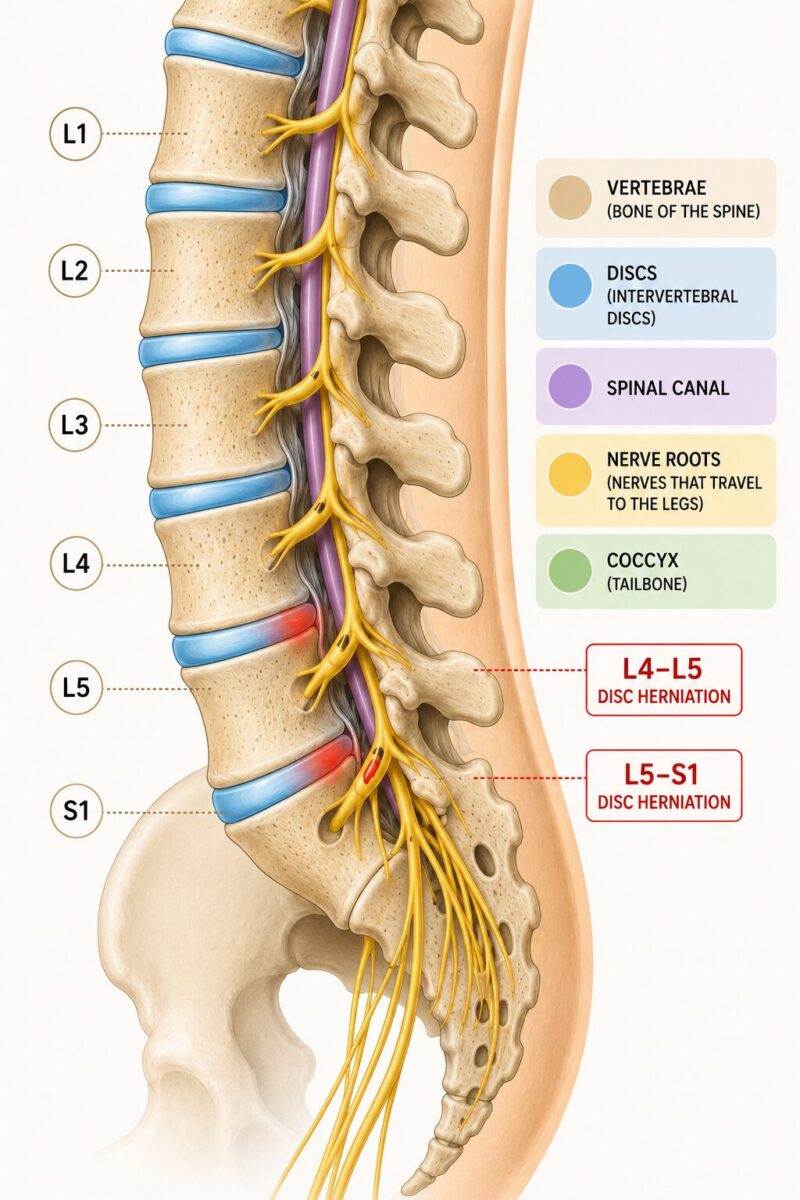
Your lower back contains five vertebrae stacked on top of each other. Between these vertebrae are discs that act as cushions.
The outside of a disc is a tough, fibrous shell; the inside is a soft, gel-like core. Its job is to absorb the shock placed on the vertebrae while walking and moving, and to let the lower back bend and twist comfortably.
Over time, or as the result of a strain, the outer shell weakens and tears, and the gel-like inner material bulges outward. If this bulging material presses on the nerve root right behind it, a herniated lumbar disc results.
Herniations occur most often at the lowest two levels of the spine, where the most load falls on the lower back.
Not every herniation causes pain
This is the most confusing point for most people. A significant number of people who get an MRI show a herniation but have no complaints at all. Pain only starts once the bulging material presses on a nerve.

The difference between a herniated lumbar disc and sciatica
Sciatica isn’t a separate disease — it’s a set of symptoms: nerve pain that radiates from the lower back into the leg. A herniated lumbar disc is the most common cause of that pain. In other words, most cases of sciatica have a herniated disc behind them, but not every herniated disc causes sciatica.
What causes a herniated lumbar disc?
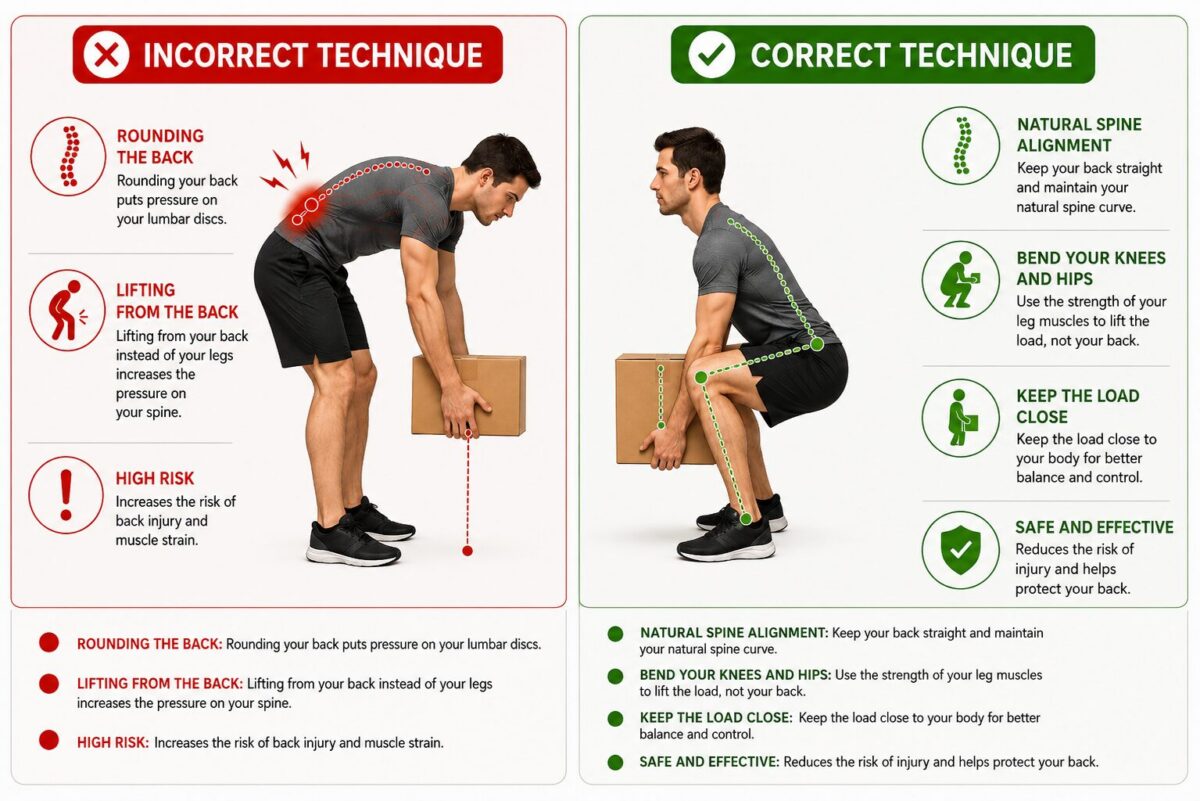
Lifting heavy objects with the wrong technique. The classic cause. Bending from the waist, without bending the knees, and holding the load away from the body multiplies the pressure on the disc. Twisting the torso at the same time while lifting makes it even riskier.
Weak abdominal and lower back muscles. These muscles are the spine’s natural corset. When they weaken, the full load falls onto the discs.
Age-related wear. Discs lose water over time, thin out, and lose their flexibility. This starts in your thirties.
Excess weight. Every extra pound around the abdomen directly increases the load on the spine and disrupts the lower back’s natural curve.
Sudden movements and trauma. Falls, accidents, sudden twisting movements.
Exposure to vibration. Driving heavy vehicles or operating machinery for long periods.
Sitting still for long periods. The load on the lower back while sitting is noticeably greater than while standing. This is why herniated lumbar discs are so common among desk workers.
Smoking. Disrupts the discs’ nutrient supply, speeding up wear. A well-established factor known to increase the risk of a herniated lumbar disc.
Heredity. If it’s common in the family, disc structure may be hereditarily weaker.
Pregnancy. Increased weight, a changing posture, and hormones loosening the ligaments increase the risk.
What are the symptoms of a herniated lumbar disc?
Symptoms vary depending on the size of the herniation and how much it presses on the nerve:
- Lower back pain and a feeling of stiffness
- Muscle spasm, or even the back “locking up” — the patient becoming unable to move
- Difficulty bending forward or straightening up
Pain radiating into the leg
- Pain traveling from the lower back to the hip, then down the back of the thigh and calf
- Pain sometimes reaching down to the foot and toes
- Numbness, tingling in the leg or foot
- Pain usually being one-sided
- Weakness in the leg — struggling on stairs, the foot dragging
Situations that make the pain worse:
- Sitting for a long time
- Coughing, sneezing, straining
- Bending forward
- Long car rides
If the pain travels below the knee, the likelihood of nerve involvement rises significantly.
How is a herniated lumbar disc diagnosed? Which department should you see?
Departments you can see: Physical Medicine and Rehabilitation, Neurosurgery, Orthopedics and Traumatology, or Neurology.
What happens during the exam? The physician asks where the pain starts and where it spreads, evaluates your lower back movements, and tests the strength and reflexes of your leg muscles. The best-known test is raising the leg straight up while lying on your back; if this movement noticeably triggers leg pain, nerve involvement is suspected.
What tests might be ordered?
- MRI: The method that shows the discs and nerves most clearly; the gold standard for diagnosing a herniated lumbar disc.
- X-ray: Shows bone structure, vertebral slippage, and calcification. It doesn’t show the disc itself.
- CT scan: Used when bone detail is needed.
- EMG: Measures how much the nerve is affected.
Not every case of lower back pain requires an immediate MRI. If there are no red-flag symptoms, physicians generally try a few weeks of treatment first; a significant portion of pain eases during this process.
How is a herniated lumbar disc treated?
The most important thing to know: the vast majority of patients with a herniated lumbar disc recover without surgery. What’s more, part of the herniated material can be reabsorbed by the body over time — meaning that when managed correctly, the herniation can shrink on its own.
The early phase: getting pain and spasm under control
In the acute phase, the goal is to make the pain manageable. The physician may prescribe pain-relieving and anti-inflammatory treatments. This article doesn’t provide drug names or dosages — that decision belongs to your doctor, who knows your other conditions and the medications you take.
The shift in thinking about bed rest is important: Weeks of bed rest used to be recommended. Today’s consensus is the exact opposite. More than 1–2 days of bed rest weakens the muscles and delays recovery. Staying as active as the pain allows produces better outcomes.
Heat and cold application
In the first 48 hours, cold application (an ice pack wrapped in a thin cloth, 15–20 minutes) can reduce swelling. Later on, if muscle spasm becomes the dominant issue, heat application is soothing. Both provide temporary relief, not a permanent solution.
Physical therapy and exercise — the backbone of treatment
Lasting recovery comes from this. A program run with a physiotherapist includes:
- Strengthening the abdominal and lower back muscles (the core) — rebuilds the spine’s natural support
- Stretching exercises — reduce tightness in the hips and the back of the legs
- Posture and movement training — relearning proper technique for sitting, standing up, bending, and lifting
- Manual therapy — hands-on release and mobilization techniques
- Electrotherapy, TENS, ultrasound — methods that help with pain control
- Traction (lower back stretching) — used in suitable patients to reduce pressure on the nerve


⚠️ Consult your doctor before doing exercises on your own just from watching them online. The location and type of the herniation completely changes which movements will help you and which will hurt you. For example, forward-bending movements are usually harmful for most herniated discs, but can be relieving in spinal stenosis. Also, pushing through the pain is not the right approach; if a movement sends pain down your leg, stop.
4. Interventional methods
If pain doesn’t ease despite several weeks of treatment, image-guided injection therapies around the nerve root may be considered. The goal is to reduce inflammation enough for the patient to continue with physical therapy. It’s not a permanent solution, but a bridging step that makes the process possible.
5. Surgery
Surgery isn’t the first option for a herniated lumbar disc — it’s the last option. It’s generally considered in the following situations:
- Pain that doesn’t ease despite 6–12 weeks of regular treatment
- Progressive muscle weakness — being unable to lift the foot, foot drop
- Impaired bladder or bowel control → this is an emergency
Most methods used today are microsurgical techniques performed through small incisions. Even after surgery, exercise and posture training continue — surgery alone isn’t sufficient.
⚠️ Go to the hospital immediately if you notice these symptoms
The following can be signs of a rare but serious nerve compression (cauda equina syndrome):
- Losing bladder or bowel control, being unable to urinate
- Numbness in the perianal area and inner thighs (no sensation while sitting)
- Rapidly worsening weakness in both legs at once
- Being unable to lift the foot, the foot dragging while walking
- Lower back pain accompanied by fever, night sweats, or unexplained weight loss
- Severe pain that starts after a fall or an accident
Don’t wait for an appointment if you notice these symptoms — go straight to the emergency room. Early intervention in these situations can prevent permanent damage.
What should you watch out for during treatment?
Sitting habits. Prolonged sitting is the biggest enemy of a herniated lumbar disc. Get up every 30–45 minutes and walk for a few minutes. Your chair should support the curve of your lower back; if it doesn’t, use a small cushion. Your feet should rest fully on the floor.
Heavy lifting technique. Don’t bend from the waist — bend your knees. Keep the load close to your body. Don’t twist your torso while lifting — if you need to turn, step your feet around instead.
Sleeping position. If you sleep on your side, put a pillow between your knees; if you sleep on your back, put one under your knees. Your mattress should be medium-firm — neither as hard as a board nor so soft you sink into it.
Stay active. Staying still out of fear of pain weakens the muscles and delays recovery. Short daily walks on flat ground are the simplest and most effective step.
Be careful with back braces. A brace should only be used when and for as long as your physician recommends. Prolonged use weakens the lower back muscles and creates dependency.
Weight management. Every pound you lose directly reduces the load on your spine.
Quit smoking. This directly improves the discs’ nutrient supply.
Be patient. Recovery from a herniated lumbar disc is measured in weeks. Giving up on treatment because it hasn’t resolved in a few days is one of the most common mistakes.
Diet, herbal supplements, and lifestyle: what can help?
The following don’t replace treatment — they support recovery.
Foods that may help
- Omega-3 sources (salmon, mackerel, anchovy, walnuts, flaxseed) — help balance the inflammatory response.
- Calcium and vitamin D sources (dairy products, egg yolk, sardines, dark leafy greens) — the foundation of spinal and bone health. Vitamin D deficiency is very common in our country; it’s worth having your blood levels checked.
- Magnesium-rich foods (almonds, pumpkin seeds, dried legumes) — help with muscle relaxation.
- Protein (eggs, meat, legumes) — necessary for strengthening exercises to pay off.
- Vitamin C sources (citrus fruits, red peppers, rosehip) — play a role in connective tissue repair.
- Enough water — discs are made up largely of water and thin out as they lose water during the day.
What’s good to limit
Heavily processed foods, sugary drinks, fried foods, and excess salt. These contribute both to weight gain and to the body’s tendency toward inflammation.
An honest note on herbal supplements
Turmeric, ginger, nettle, willow bark, and St. John’s Wort oil are frequently recommended for lower back pain. Some may offer a mild supportive effect, but:
- None of them move the disc back into place or relieve pressure on the nerve.
- Herbal products aren’t harmless. Willow bark interacts seriously with blood thinners, and St. John’s Wort interacts seriously with a large number of medications.
- Always tell your doctor before using them.
Warming creams and massage can provide temporary relief by relaxing muscle spasm; however, deep massage should be avoided during the acute, severe phase.
What works best in the long run
Not a single food or herb, but regular activity and strong core muscles. Swimming (backstroke especially), brisk walking, pilates, and yoga done under expert guidance — these both reduce existing pain and prevent recurrence. 150 minutes of moderate-intensity activity per week is a good target.
Frequently asked questions about herniated lumbar discs
Yes. The vast majority of patients recover without surgery, through exercise and physical therapy. Part of the herniated material can be reabsorbed by the body over time. Surgery generally comes up in cases of progressive muscle weakness, loss of bladder/bowel control, or pain that doesn’t respond to long-term treatment.
In mild-to-moderate cases, pain generally eases significantly within 6–8 weeks. For some people a few weeks is enough, while for others the process can stretch over months. Pain lasting longer than 3 months is considered chronic, and the treatment plan should be reassessed.
It’s not harmful — it’s beneficial. Short walks on flat ground in comfortable shoes increase blood flow and support recovery. If the pain noticeably spreads down your leg while walking, shorten the walk and let your doctor know.
Sleeping on your side with knees slightly bent and a pillow between them, or on your back with a pillow under your knees, helps preserve the natural curve of the lower back. Sleeping on your stomach is generally not recommended, since it pushes the lower back into excessive arching.
You can go to Physical Medicine and Rehabilitation, Neurosurgery, Orthopedics and Traumatology, or Neurology. After the initial exam, you’ll be referred to the appropriate department if needed.
Videos you can watch on this topic
Consult your physician before doing the exercises shown in these videos.

Bel Fıtığı Nedir, Belirtileri ve Tedavi Yöntemleri Nelerdir? – Doktorlar Konuşuyor

Bel Fıtığının Nedenleri ve Tedavi Yöntemleri Nelerdir?

BEL FITIĞI EGZERSİZLERİ. FİZYOTERAPİST HÜRKAN AKKUZU İLE.

BEL FITIĞI EGZERSİZLERİ #belfıtığıtedavisi #fizyoterapi #fizyoterapistmacide
Medical disclaimer: This article is for general informational purposes only; it does not replace examination, diagnosis, or treatment. Always consult a physician about your symptoms. Do not stop or change any medication you are taking without consulting your doctor.
Related Posts
 What Is Myopia? Symptoms, Causes and Treatment Options
  What Is a Herniated Cervical Disc? Symptoms, Causes and Treatment
  What Is Reflux? Symptoms, Causes, and Treatment Methods
  What Is Sinusitis? Symptoms, Causes, and Treatment
  Thyroid Disorders: Symptoms of Hypothyroidism and Hyperthyroidism
  Femur Fracture: Symptoms, Treatment, and Recovery Process
  Rheumatoid Arthritis: What Is It? Symptoms and Treatment
  High Blood Pressure (Hypertension): Causes, Symptoms and Treatment