

High blood pressure is when the pressure blood puts on the artery walls stays consistently above normal. It usually progresses without any symptoms; that’s why it’s called the “silent killer.” Readings of 140/90 mmHg or higher taken on different days confirm a diagnosis of hypertension. The basis of treatment is salt restriction, weight control, regular physical activity, and medication planned by a physician.
How do you know if your blood pressure is high? Most of the time, you don’t.
High blood pressure is a condition that can progress for years without causing any complaints. During this time, the blood vessels, heart, kidneys, eyes, and brain are silently damaged. Many people learn they have hypertension when their blood pressure is measured during a doctor visit for an unrelated reason — some, unfortunately, only after a stroke or heart attack.
The good news is: hypertension is a condition that can be brought under control, and its complications can largely be prevented.Moreover, the impact of lifestyle changes here is very significant.
What is high blood pressure?
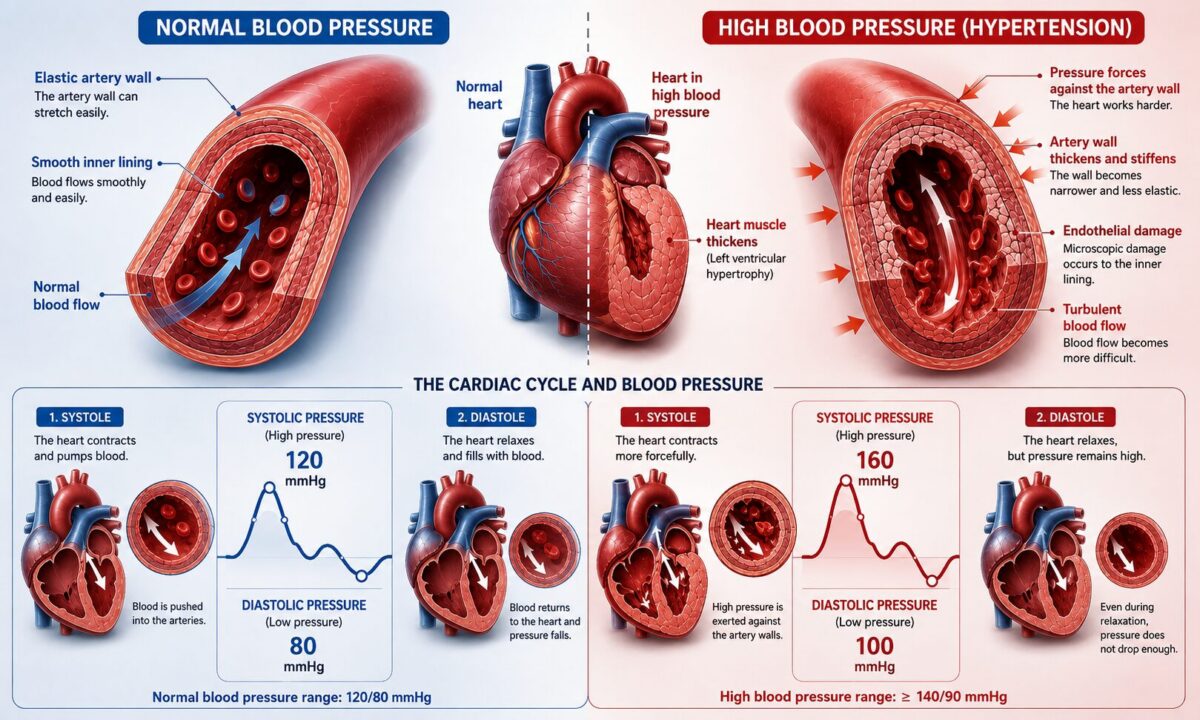
Every time the heart beats, it pumps blood into the blood vessels. The pressure this blood exerts on the vessel wall is called blood pressure. Without a certain amount of pressure, blood cannot reach the body — so blood pressure is necessary. The problem is when this pressure remains consistently high.
Blood pressure is expressed as two numbers:
- Systolic (upper) pressure: The pressure at the moment the heart contracts and pumps blood. It is the first and higher number.
- Diastolic (lower) pressure: The pressure remaining in the vessels when the heart relaxes between beats. It is the second number.
When we say “120 over 80,” we mean 120/80 mmHg.
Why is high blood pressure so important?
Continuous high pressure on the artery wall wears down its inner surface. This wear lays the groundwork for arterial stiffness. As a result:
- Heart: The heart muscle, forced to pump against high pressure, thickens and eventually tires → heart failure
- Brain: Blood vessel blockage or rupture → stroke
- Kidneys: Damage to the small vessels responsible for filtration → kidney failure
- Eyes: Damage to the retinal vessels → vision loss
- Blood vessels: Risk of enlargement (aneurysm) in the main artery
High blood pressure is one of the most important preventable causes of stroke and heart disease worldwide.
How are blood pressure values interpreted?
| Category | Systolic (upper) | Diastolic (lower) | |
|---|---|---|---|
| Normal | Below 120 | and | Below 80 |
| Elevated | 120–139 | or | 80–89 |
| Stage 1 hypertension | 140–159 | or | 90–99 |
| Stage 2 hypertension | 160 and above | or | 100 and above |
| Hypertensive emergency | Above 180 | or | Above 110 |
Important: Diagnosis is not made from a single reading. Blood pressure can rise temporarily due to excitement, pain, coffee, or smoking. Diagnosis requires multiple measurements taken on different days.
What causes high blood pressure?
In the vast majority of patients, no single clear cause is found; this is called primary (essential) hypertension and arises from a combination of genetic predisposition and lifestyle.
Risk factors:
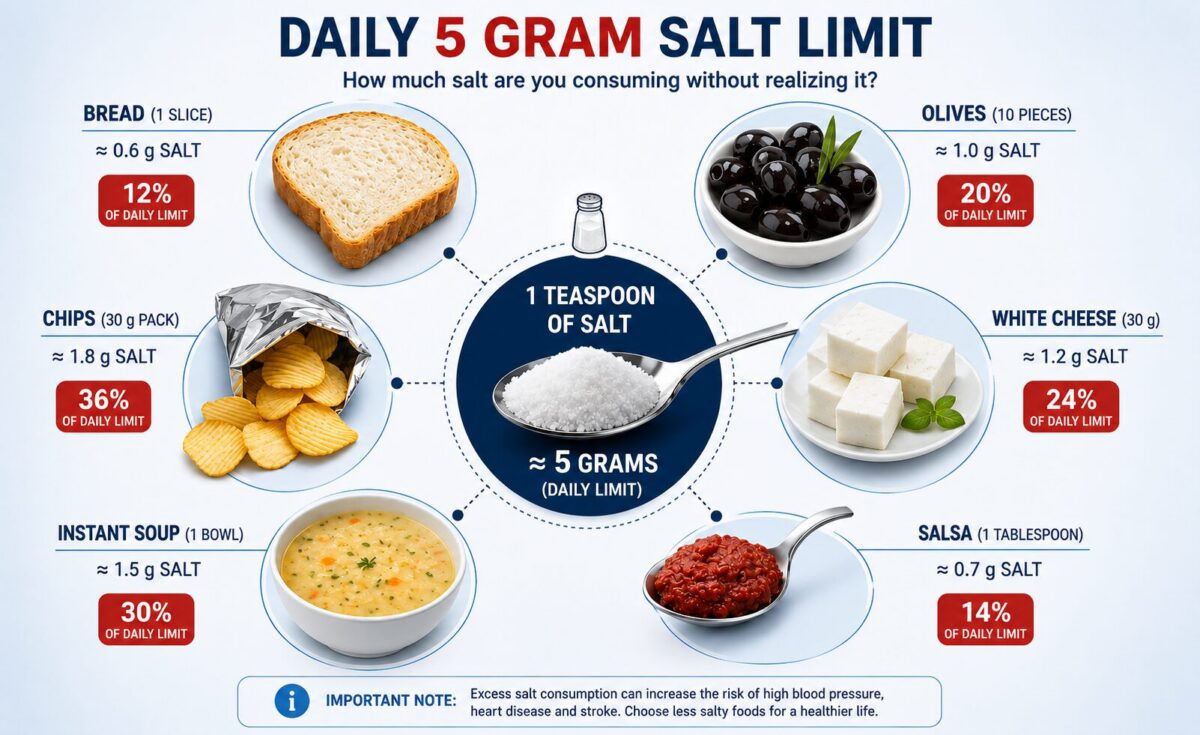
1. Excessive salt intake. Turkey is one of the countries where salt consumption is noticeably above the world average. While the World Health Organization recommends staying under 5 grams a day (about one teaspoon), consumption in our country is many times higher than this.
2. Excess weight.
3. Sedentary lifestyle.
4. Family history and age. With age, the elasticity of the blood vessels decreases, and risk increases.
5. Smoking. Every cigarette temporarily raises blood pressure; over the long term it damages the vessel wall.
6. Excessive alcohol.
7. Chronic stress and lack of sleep.
8. Sleep apnea. Snoring and nighttime breathing pauses are among the frequently overlooked causes of resistant high blood pressure.
9. Certain diseases and medications. Kidney diseases, thyroid disorders, hormonal conditions, and certain medications can raise blood pressure. This is called secondary hypertension, and blood pressure can improve once the underlying cause is treated. This possibility is investigated especially when high blood pressure appears at a young age or suddenly.
What are the symptoms of high blood pressure?
The most critical fact: high blood pressure usually causes no symptoms at all. The idea that “I’d know if my blood pressure went up” is wrong and dangerous. That’s why regular measurement is far more reliable than waiting for symptoms.
When symptoms do occur, they may include:
- Headache — especially at the back of the head and in the morning
- Dizziness
- Ringing in the ears
- Heart palpitations
- Shortness of breath
- Nosebleeds
- Blurred vision
- Fatigue, weakness
- Facial flushing
These symptoms are not specific to high blood pressure and can occur for other reasons too. The only reliable method is measurement.
How is blood pressure measured correctly?
This section is the most practical information anyone measuring their blood pressure at home needs to know. Incorrect measurement leads to both unnecessary anxiety and wrong treatment decisions.
Before measuring:
- Avoid tea, coffee, cigarettes, and alcohol for at least 30 minutes beforehand
- Sit and rest for 5 minutes
- Empty your bladder — a full bladder raises blood pressure
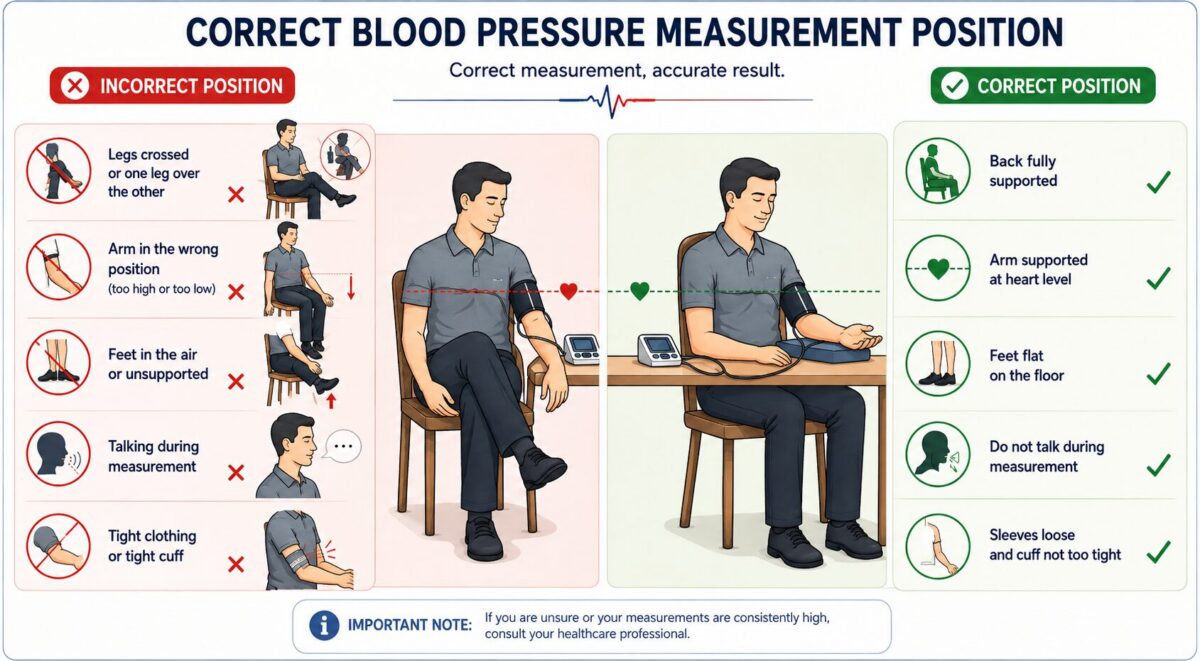
- Don’t talk during the measurement
During the measurement:
- Sit with your back supported
- Keep both feet flat on the floor; don’t cross your legs
- Keep your arm at heart level and supported (on a table)
- Place the cuff on bare skin, not over rolled-up sleeves — a rolled-up sleeve creates a tourniquet effect
- The cuff must be the right size; larger arms need a wider cuff
Which device? Upper-arm digital devices generally give more reliable results than wrist devices. Periodically compare your device’s readings with a measurement taken at your doctor’s office.
How often? As recommended by your doctor. The general approach is to measure twice a day — in the morning before taking medication and in the evening — taking two readings 1–2 minutes apart each time and averaging them.
Keep a record. Note your readings with the date and time in a notebook or on your phone. This record is the most valuable information for your doctor to plan your treatment correctly.
White coat hypertension: In some people, blood pressure rises only at the hospital and is normal at home. The opposite also exists: masked hypertension — normal at the hospital, high at home. A 24-hour blood pressure monitor (Holter) is used to tell the two apart.
Is high blood pressure contagious?
No. Hypertension is not a contagious disease; it is not caused by a germ. It results from a disorder in the vascular system and blood pressure regulation. It is not passed to anyone through contact, living in the same household, or sharing belongings.
The reason it’s common within the same family is not transmission, but strong hereditary predisposition and shared lifestyle — especially salty meals coming from the same kitchen, shared activity habits, and smoking at home.
How is high blood pressure diagnosed? Which specialist should I see?
The specialty you should see: Cardiology. For initial evaluation and follow-up, Internal Medicine or your family doctor is also appropriate.
Evaluations performed:
- Repeated blood pressure measurements — on different days, in both arms
- 24-hour blood pressure monitoring (Holter) — shows the real blood pressure profile
- ECG — evaluates thickening of the heart muscle and rhythm disturbances
- Echocardiography — ultrasound imaging of the heart
- Blood tests — kidney function, blood sugar, cholesterol, electrolytes
- Urine test — for early signs of kidney damage
- Eye fundus exam — changes in the retinal vessels provide information about how long the condition has been present
Secondary causes are investigated in blood pressure that starts at a young age, appears suddenly, or resists treatment.
How is high blood pressure treated?
The goal of treatment is not just to lower the number; it is to reduce the risk of heart attack, stroke, and kidney failure.
Lifestyle changes
These steps can be sufficient on their own for mildly elevated blood pressure; in those taking medication, they increase the medication’s effectiveness.
a) Reduce salt — the single most effective step.
- The daily target is under 5 grams (about one teaspoon)
- Don’t put a salt shaker on the table — this one change alone makes a difference
- Most salt comes not from visible salt but from hidden salt: bread, tomato paste, instant soup, pickles, brined foods, olives, cheese, sausage/salami/sujuk, chips, ready-made sauces, soda
- Read labels: multiplying the sodium amount by 2.5 gives you the approximate salt amount
- Use spices, lemon, garlic, and fresh herbs instead of salt
- Your palate adjusts in about 2–3 weeks; foods that seem bland at first quickly taste normal
b) Lose weight. Every few kilograms lost produces a measurable drop in blood pressure.
c) Exercise regularly. At least 150 minutes of moderate-intensity activity per week. Brisk walking, swimming, cycling. Avoid heavy weightlifting and straining-type exercises — these cause sudden spikes in blood pressure. Ask your doctor about your exercise program.
d) Quit smoking.
e) Limit or stop alcohol.
f) Get your sleep in order. If you snore and feel excessively sleepy during the day, get evaluated for sleep apnea.
g) Manage stress. Breathing exercises, walking, hobbies.
h) Organize your diet. A diet centered on vegetables, fruit, whole grains, and low-fat dairy products, with reduced salt, has been shown to have a significant effect on blood pressure.
Medication
When lifestyle changes aren’t enough, or when blood pressure is high to begin with, the doctor plans drug treatment. Medications from different classes are used; some patients need to use more than one medication together.
This article does not give drug names or doses. Your doctor decides which medication is right for you by evaluating your age, kidney status, whether you have diabetes, your heart condition, and your other illnesses.
The most critical warnings in this section:
- Don’t stop your medication on your own decision. This is the most common and most dangerous mistake made in hypertension. People who say “my blood pressure is fine now, so I stopped taking it” had normal readings precisely because of the medication. Stopping abruptly can cause blood pressure to rise dangerously.
- Take your medication every day regularly, not just “when my blood pressure goes up.” Blood pressure medications are not like painkillers taken as needed.
- Take it at the same time each day. Ask your doctor what to do if you miss a dose.
- If you experience a side effect, tell your doctor instead of stopping the medication. Alternative options exist.
- Don’t use your neighbor’s medication. The same condition doesn’t mean the same medication.
⚠️ EMERGENCY: Call emergency services immediately if you have these symptoms
A very high blood pressure reading (usually above 180/110) accompanied by signs of organ damage is an emergency:
- Severe, sudden-onset headache — described as “the worst headache of my life”
- Chest pain, a feeling of pressure in the chest
- Shortness of breath
- Sudden vision loss or blurring
- Slurred speech, trouble finding words
- Drooping on one side of the face
- Sudden weakness or numbness in an arm or leg
- Confusion, seizure
- Blood in the urine
- Severe tearing-type pain in the back
What to do and what not to do?
- Call emergency services.
- Do not take extra medication on your own. The habit of taking a “sublingual pill” was common in the past but is not recommended today; an uncontrolled, sudden drop in blood pressure poses a separate risk to the brain and heart.
- Have the person sit in a calm setting and loosen any tight clothing.
- If there are signs of stroke (facial drooping, arm weakness, slurred speech), minutes matter. Don’t wait.
What should you pay attention to during treatment?
Measure your blood pressure regularly and keep a record. Bring these records with you when you visit your doctor.
Don’t skip your check-ups. Feeling fine doesn’t mean your blood pressure is normal.
Watch out for over-the-counter medications. Some painkillers and decongestant nasal sprays can raise blood pressure. Mention that you have hypertension before buying anything at the pharmacy.
Tell your doctor about any herbal products you use. In particular, licorice root can significantly raise blood pressure.
Be careful when standing up suddenly. Some blood pressure medications can cause dizziness when standing up. Sit up before getting out of bed, wait a few seconds, then stand. This especially reduces the risk of falls in older adults.
Avoid extreme heat and cold. In hot weather, medication effects combined with heat can cause blood pressure to drop too much; in cold weather, blood vessels constrict and blood pressure rises. Avoid sudden, strenuous exertion in the cold (like shoveling snow).
Tell your dentist and other doctors that you have hypertension.
Have your family members’ blood pressure checked too. Hereditary predisposition is strong.
Nutrition, herbs, and lifestyle: what can help?
In hypertension, nutrition is a direct part of treatment.
Foods that may be beneficial
- Potassium-rich foods — bananas, apricots, avocado, spinach, potatoes, dried legumes. Potassium helps offset the effect of sodium.⚠️ Important exception: If you have kidney disease or take potassium-sparing medication, be sure to consult your doctor before increasing potassium intake. Excess potassium can be dangerous for this group.
- Vegetables and fruit — at least 5 servings a day
- Whole grains — oats, bulgur, whole wheat
- Low-fat dairy products
- Fatty fish — 2 servings per week
- Unsalted nuts — a handful per day
- Olive oil
- Garlic — regular use in cooking
- Beetroot — its nitrate content is thought to have a vessel-relaxing effect
- Adequate water
Things to limit
- Salt and foods containing hidden salt (the most important)
- Processed meat products, pickles, brined foods, instant soups and sauces
- Sugary drinks and energy drinks
- Excess caffeine
- Alcohol
- Licorice root and products containing licorice root (including some candies and herbal teas)
An honest note about herbal supplements
- No herb replaces blood pressure medication. The approach of “I’m using herbal remedies, so I stopped my medication” directly increases the risk of stroke and heart attack.
- Licorice root raises blood pressure and can cause low potassium levels — it should be avoided in hypertension.
- Ginkgo biloba, garlic supplements, and high-dose turmeric can interact with blood thinners and increase bleeding risk.
- Grapefruit and grapefruit juice can raise the blood levels of some blood pressure medications, increasing the risk of side effects. If you take blood pressure medication, ask your doctor about this.
- Tell your doctor about any supplement you want to use.
What works best in the long run
Reducing salt and walking regularly. These two habits do the most to change both blood pressure readings and long-term risk in hypertension. And both are free, with no side effects.
Videos you can watch on this topic

Understanding Hypertension: Symptoms, Management, and Treatments
Hypertension – Yale Medicine Explains
High Blood Pressure Explained: Evidence-Based Answers From a Cardiologist
WHAT CAUSES HIGH BLOOD PRESSURE🩸? A Doctor Explains

Cardiologist explains why you should stop worrying about blood pressure | Dr Sanjay Gupta
The REAL Cause of High Blood Pressure (and How to Fix It)

What Doctors Rarely Explain About Blood Pressure
Hypertension – Overview (causes, pathophysiology, investigations, treatment
Frequently asked questions about high blood pressure
A value is considered normal when the systolic (upper) reading is below 120 and the diastolic (lower) reading is below 80. Readings of 140/90 mmHg or higher taken on different days are considered hypertension. Diagnosis is not made from a single measurement.
In most patients, treatment is long-term or lifelong, because medication does not cure the condition, it keeps it under control. However, with significant weight loss and salt restriction and other lifestyle changes, the dose can sometimes be reduced in some patients. This decision is made only by a doctor; medication should never be stopped on your own.
Avoid tea, coffee, and cigarettes for 30 minutes before measuring, and rest sitting down for 5 minutes. Sit with your back supported, feet flat on the floor, arm at heart level and supported. The cuff should be placed on bare skin and you should not talk during the measurement.
It usually causes no symptoms at all; that’s why it’s called the “silent killer.” When symptoms do occur, they can include headache at the back of the head, dizziness, ringing in the ears, and nosebleeds. However, these symptoms are not specific to blood pressure; the only reliable method is regular measurement.
You should see a Cardiology specialist. For initial evaluation and routine follow-up, Internal Medicine or your family doctor is also appropriate. Further evaluation may be needed to investigate secondary causes in blood pressure that starts at a young age or resists treatment.
Medical disclaimer: This article is for general informational purposes only; it does not replace a medical examination, diagnosis, or treatment. Please consult a doctor for your concerns. Do not stop or change any medication you are taking without consulting your doctor.
Related Posts
 What Is Myopia? Symptoms, Causes and Treatment Options
 What Is Sinusitis? Symptoms, Causes, and Treatment
 What Is Arteriosclerosis? Symptoms, Causes, and Treatment
 Rheumatoid Arthritis: What Is It? Symptoms and Treatment
 What Is a Herniated Lumbar Disc? Symptoms, Causes and Treatment
 What Is Sciatica? Symptoms, Causes and Treatment Options
 Cataract: Symptoms, Causes and Surgery
 Thyroid Disorders: Symptoms of Hypothyroidism and Hyperthyroidism