Close Menu
  • MAKİNELER ve İMALAT
    • Tools & Equipment
    • Computer-Aided Drawing
    • CAD/CAM Education
    • CNC Machine Programming
    • Casting Technologies
    • Electrical & Electronics Technologies
    • Hydraulics & Pneumatics
    • Manufacturing Processes
    • Manufacturing Technologies
    • Occupational Safety
    • Mold & Die Design
    • Solid Modeling
    • Welding Technology
    • Machine Elements
    • Mechanical Trade Drawing
    • Materials Science
    • Automotive & Vehicle Technologies
    • Robotics Technologies
    • Health Technologies
    • Defense & Aerospace Technologies
    • Descriptive Geometry
    • Technical Drawing
    • Software & Hardware Technologies
    • Innovative Manufacturing Methods
  • TEKNOLOJİ ve YAŞAM
    • OTOMOBİLLER ve TAŞIT
      • Vehicle & Engine Knowledge
      • Safe Driving
      • Sürüş Destek Sistemleri
    • Genel Kültür
      • Movies & TV Shows
      • Görsel ve Grafik Sanat
      • Books & Literature
      • Music
      • Sports
      • History
      • History of Technology
    • GÜNDELİK YAŞAM TEKNOLOJİLERİ
    • Hobbies & Entertainment
    • Internet Technologies
    • Health
    • Mobile Technologies
Makine Eğitimi
  • Machines & Manufacturing
    Machine Elements
    Hydraulics & Pneumatics
    Technical Drawing
    Computer-Aided Design & Manufacturing
    Basic Manufacturing Processes
    Manufacturing Processes
    Industry Technologies
    Other Technical Courses
    Motion & Power Transmission
    Simple Machines
    Chains & Sprockets
    Shafts & Journals
    Gears
    Cams
    Couplings
    Belts & Pulleys
    Springs
    Bearings
    Keys
    Fastening Joining
    Retaining Rings
    Screws, Bolts & Nuts
    Cotter Pins
    Flanges
    Welding
    Rivets
    Pins & Bolts
    Washers
    Calculators
    Gear Ratio Calculator
    Spring Constant Calculator
    Belt Pulley Ratio Calculator
    Other Machine Elements
    Slides & Linear Guides
    Brakes
    Flywheels
    Clamps
    Shock Absorbers
    Gaskets & O-Rings
    Seals & Sealing Elements
    Hydraulics
    Introduction to Hydraulics & Principles
    Hydraulic Systems & Applications
    Accumulators
    Filters
    Motors
    Pumps
    Valves
    Pneumatics
    Introduction to Pneumatics & Principles
    Pneumatic Systems & Applications
    Pneumatic Circuit Components
    Valves
    Cylinders
    Silencers
    Motors
    Compressors
    Dryers
    Conditioning Units
    Common Topics & Maintenance
    Hydraulic & Pneumatic Maintenance
    Study Notes, Exams & Tests
    Technical Drawing
    Introduction to Technical Drawing
    Geometric Drawings
    Perspective & Projection
    Orthographic Views
    Dimensioning
    Sectioning
    Assembly & Detail Drawings
    Tolerances
    Surface Finish Symbols
    Mechanical Engineering Drawing
    Screws, Bolts & Nuts
    Pulley Drawings
    Gear Drawings
    Shafts & Journals
    Bearing Drawings
    Pins & Bolts
    Spring Drawings
    Welds in Technical Drawing
    Washers
    Cotter Pins
    Technical Drawing Exercises
    Mechanical Drawing Exercises
    Gear Exercises
    View Extraction Exercises
    Pulley Exercises
    Pin & Bolt Exercises
    Threaded Fastening Exercises
    Descriptive Geometry
    Computer-Aided Drawing
    AutoCAD Drawing Lessons
    Solid Modeling & Animation
    Solid Model Drawing Files
    Solid Model Assembly Examples
    Solid Model Drawing Lessons
    3D CAD Software Reviews
    Solid Modeling Exercises
    CNC Programming
    CAM
    Measurement & Inspection
    Dial Indicators
    Calipers
    Gauges
    Micrometers
    Materials Science
    Steels
    Cast Iron
    Aluminum
    Plastics
    Material Testing & Hardness Measurement
    Occupational Safety
    Workshop Safety
    Safety When Working With Electricity
    Machine Safety Rules
    Hand Operations
    Filing
    Marking
    Cutting Operations
    Reaming
    Tapping
    Threading With a Die
    Drill Bit Sharpening
    Working With Machines
    Basic Turning Operations
    Basic Milling Operations
    Shaper Machine
    Machining
    Turning
    Milling
    Grinding
    Innovative Manufacturing Methods
    EDM (Electrical Discharge Machining)
    Laser Machining
    Waterjet Machining
    3D Printing
    3D Scanners
    Welding
    Rolling
    Casting
    Mold & Die Design
    Mechanical & Hydraulic Presses
    Blanking & Piercing Dies
    Bending Dies
    Drawing Dies
    Plastic Injection Molds
    Extrusion Dies
    Compound Dies
    Progressive Dies
    Blow Molds
    Spinning Dies
    Spray Molds
    Manufacturing of Machine Parts
    Automotive & Vehicle Technologies
    Motor Vehicle Manufacturing
    Raw Material Production
    History of Technology
    Health & Medical Technologies
    Defense & Aerospace
    Robotics Technologies
    Software & Hardware Technologies
    Mechanics - Strength of Materials
    Physics Topics
  • Technology & Life
    Hobbies & Entertainment
    Sports
    Music
    Vehicle & Engine Knowledge
    Vehicle Maintenance & Repair
    Safe Driving
    Driver Assistance Systems
    History
    Movies & TV Shows
    Books & Literature
    Computers & Internet
    Computer Tips
    Software Reviews
    Hardware & Peripherals
    Practical & Safe Internet Use
    Visual & Graphic Art
    Mobile Technologies
    Travel
    Science
    Health
    First Aid Knowledge
    Everyday Technologies
Makine Eğitimi
Home»Manufacturing Processes»What Is Riveting. How Is It Done?
29 August 2026

What Is Riveting. How Is It Done?

What Is Riveting. How Is It Done?

In our machine technology manufacturing processes – machine elements lessons, we’ve dedicated this article to riveting.

  • What Is Riveting
  • How Is Riveting Done
    • Blind Rivets (Pop Rivets)
    • Explosive Rivets
  • Rivet Types Used in Riveting
  • Calculating Rivet Diameter and Length
    • The Riveting Process

What Is Riveting

A rivet is a cylindrical element with one end already formed and the other end shaped during assembly, used for permanently joining machine parts, sheet metal, and machine elements such as belts and brake linings.

The process of joining parts with elements called rivets is called riveting. The purpose of riveting is to create a permanent joint.

We especially encounter rivets in steel construction buildings and ships.
They’re used in machine tool manufacturing, the maritime industry, the construction industry (especially steel structures), the locomotive industry, the apparel sector (jeans, belt manufacturing, etc.), and kitchenware (such as handle attachments on household items like kettles and pots).

applications of rivets

In fact, we encounter riveted joints in many areas of everyday life.

gemilerde perçin kullanımı

Before the development of welding technology, rivets were used to join large sheet metal components—particularly in the construction and shipbuilding industries. Early 20th-century vessels, such as the Titanic (1912), were entirely riveted (it is estimated that approximately 3 million rivets were used on the Titanic).

Observations from that era also noted that riveted hulls behaved somewhat more “flexibly” in rough seas compared to modern welded hulls. As welding technology began to advance in the late 1930s and its advantages over riveting became apparent, the use of rivets in these structures was gradually phased out.

How Is Riveting Done

Blind Rivets (Pop Rivets)

This is the process done with special-type rivets whose head isn’t shaped by hammering.

pop rivets

Pop rivets in various sizes (above)

pop rivet gun

Rivet gun

This is riveting done using a blind rivet. It consists of two parts called the rivet mandrel (pin) and the rivet body. The body is made of a soft material, and the mandrel is made of steel. Used in places where there’s only access from one side.

riveting with a pop rivet gun

The rivet mandrel sits inside the body. The mandrel’s end that’s mounted in the hole and remains outside is pulled with the pulling tool. As a result of pulling, the end of the mandrel that snaps off at the notched section is discarded. The head of the mandrel remains inside the body. This is how the rivet’s second head is formed. (video above)

Related Post How Is a Rivet Gun Used

Explosive Rivets

A rivet with an explosive capsule placed inside its body. A hot punch pressed onto the rivet head detonates the capsule. As a result of the explosion, the rivet head is formed. Used for joining aluminum and aluminum alloys.
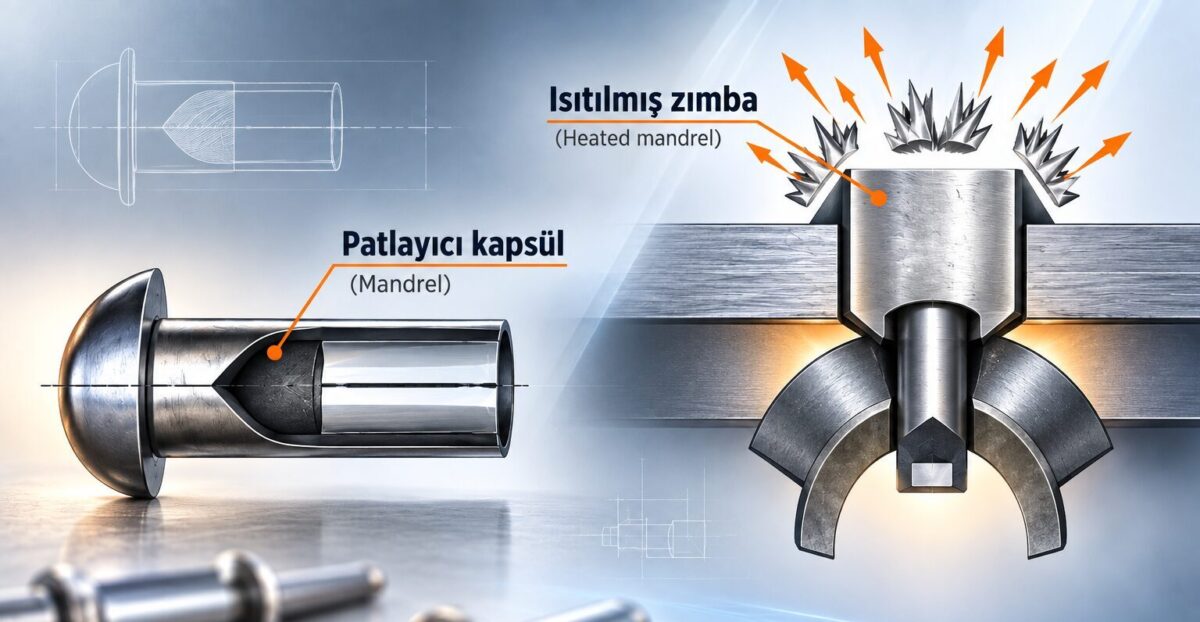
explosive riveting

Rivet Types Used in Riveting

Various rivet types are used depending on the nature of the riveting to be done. These are:

Round-head rivet
Countersunk-head rivet
Lentil-head rivet
Cylindrical-head rivet
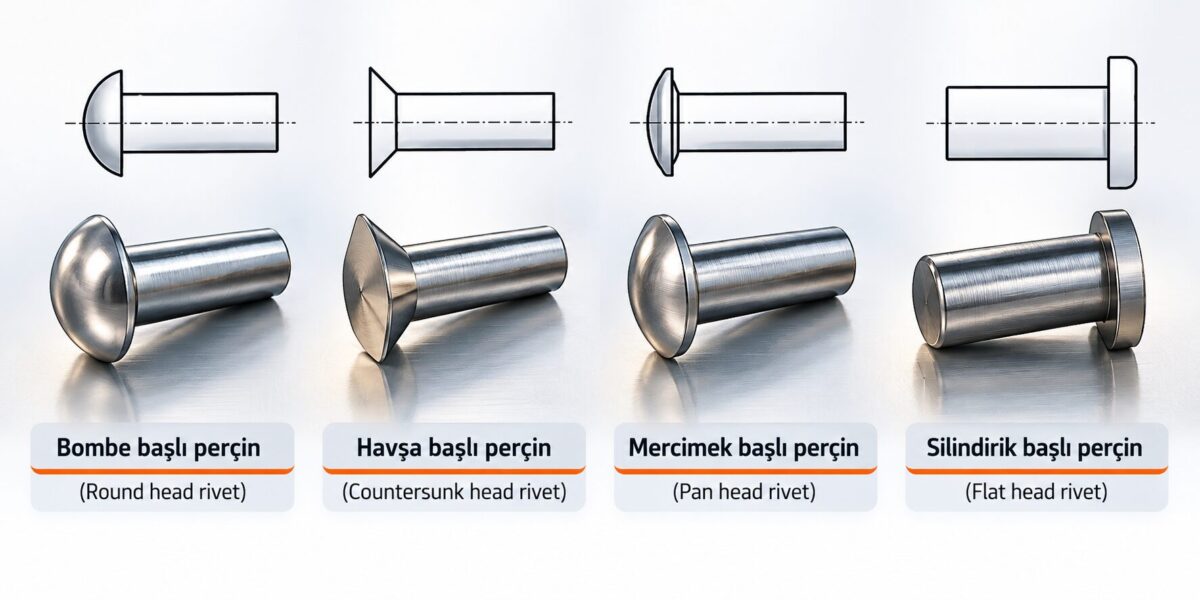
types of rivets

Rivet materials: Rivet materials generally match the type of the parts to be joined. The main rivet materials are steel, iron, aluminum, copper, and brass.

Calculating Rivet Diameter and Length

For thin sheets, the rivet diameter is taken as 2 times the sheet thickness (S).
For thick sheets, rivet diameter d = sheet thickness + 8 mm.
The rivet length to form the driven head is taken as ……………… l = 1.5 d. To prevent the rivet holes from misaligning, the parts should be clamped together and drilled together.

For countersunk-head (flush) riveting, the rivet length to form the hidden driven head should be at least twice the countersink depth (h), h = 2 h.

To prevent the rivet holes from misaligning, the parts should be clamped together and drilled together.

The Riveting Process

Drilling rivet holes and countersinks:

Rivet holes are drilled 0.1-0.2 mm larger than the rivet diameter (d), and the hole edges are countersunk with a 90° countersink drill. This ensures the rivet seats well and easily.
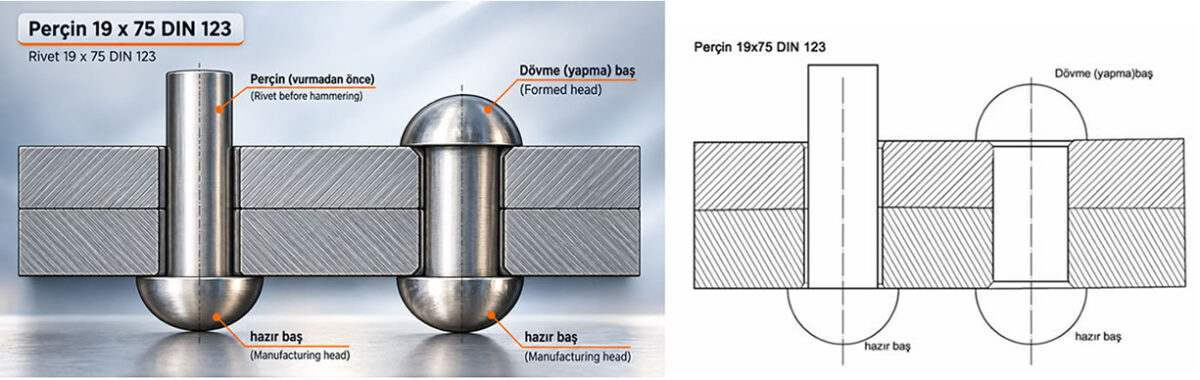
double-strap riveting

2 — Cold and hot riveting:  Applied to small-diameter rivets (generally up to 8 mm diameter). If necessary, the materials are annealed before riveting.
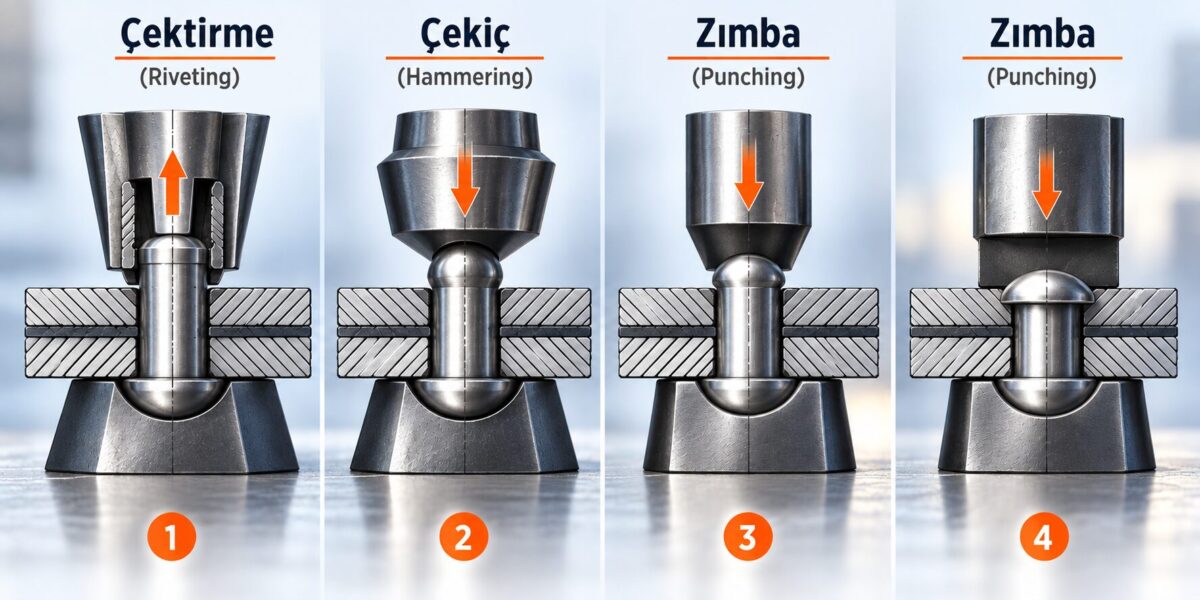
As rivet diameter grows, the forming (hammering) process becomes more difficult, so large-diameter rivets and rivets in places requiring sealing are formed using the hot riveting process.

Related Posts

How Is a Rivet Gun Used How Is a Rivet Gun Used Dişli Oranı - Devir ve Tork Hesaplayıcı Gear Ratio Calculator Structure and properties of rolling bearings Rolling-Element Bearings Information About Pipe Threads Information About Pipe Threads Belt Splicing, Belt Lacing Methods Belt Splicing – Belt Lacing Methods Muylular ve Çeşitleri Journals and Their Types Spur, Helical, and Bevel Gear Cutting Exercises Spur, Helical, and Bevel Gear Cutting Exercises Pins and Pinned Joint Technical Drawings Pins and Pinned Joint Technical Drawings
Hand Operations Rivets
Share. Facebook Twitter WhatsApp Tumblr Email Telegram Copy Link

Leave A Reply Cancel Reply

From Book to Big Screen: How Was The Lord of the Rings Adapted?
What Is a Turbocharger? How Does It Work? Advantages and Disadvantages
  • Contact
  • Terms of Service
  • Privacy & Cookie Policy

Type above and press Enter to search. Press Esc to cancel.