Close Menu
  • MAKİNELER ve İMALAT
    • Tools & Equipment
    • Computer-Aided Drawing
    • CAD/CAM Education
    • CNC Machine Programming
    • Casting Technologies
    • Electrical & Electronics Technologies
    • Hydraulics & Pneumatics
    • Manufacturing Processes
    • Manufacturing Technologies
    • Occupational Safety
    • Mold & Die Design
    • Solid Modeling
    • Welding Technology
    • Machine Elements
    • Mechanical Trade Drawing
    • Materials Science
    • Automotive & Vehicle Technologies
    • Robotics Technologies
    • Health Technologies
    • Defense & Aerospace Technologies
    • Descriptive Geometry
    • Technical Drawing
    • Software & Hardware Technologies
    • Innovative Manufacturing Methods
  • TEKNOLOJİ ve YAŞAM
    • OTOMOBİLLER ve TAŞIT
      • Vehicle & Engine Knowledge
      • Safe Driving
      • Sürüş Destek Sistemleri
    • Genel Kültür
      • Movies & TV Shows
      • Görsel ve Grafik Sanat
      • Books & Literature
      • Music
      • Sports
      • History
      • History of Technology
    • GÜNDELİK YAŞAM TEKNOLOJİLERİ
    • Hobbies & Entertainment
    • Internet Technologies
    • Health
    • Mobile Technologies
Makine Eğitimi
  • Machines & Manufacturing
    Machine Elements
    Hydraulics & Pneumatics
    Technical Drawing
    Computer-Aided Design & Manufacturing
    Basic Manufacturing Processes
    Manufacturing Processes
    Industry Technologies
    Other Technical Courses
    Motion & Power Transmission
    Simple Machines
    Chains & Sprockets
    Shafts & Journals
    Gears
    Cams
    Couplings
    Belts & Pulleys
    Springs
    Bearings
    Keys
    Fastening Joining
    Retaining Rings
    Screws, Bolts & Nuts
    Cotter Pins
    Flanges
    Welding
    Rivets
    Pins & Bolts
    Washers
    Calculators
    Gear Ratio Calculator
    Spring Constant Calculator
    Belt Pulley Ratio Calculator
    Other Machine Elements
    Slides & Linear Guides
    Brakes
    Flywheels
    Clamps
    Shock Absorbers
    Gaskets & O-Rings
    Seals & Sealing Elements
    Hydraulics
    Introduction to Hydraulics & Principles
    Hydraulic Systems & Applications
    Accumulators
    Filters
    Motors
    Pumps
    Valves
    Pneumatics
    Introduction to Pneumatics & Principles
    Pneumatic Systems & Applications
    Pneumatic Circuit Components
    Valves
    Cylinders
    Silencers
    Motors
    Compressors
    Dryers
    Conditioning Units
    Common Topics & Maintenance
    Hydraulic & Pneumatic Maintenance
    Study Notes, Exams & Tests
    Technical Drawing
    Introduction to Technical Drawing
    Geometric Drawings
    Perspective & Projection
    Orthographic Views
    Dimensioning
    Sectioning
    Assembly & Detail Drawings
    Tolerances
    Surface Finish Symbols
    Mechanical Engineering Drawing
    Screws, Bolts & Nuts
    Pulley Drawings
    Gear Drawings
    Shafts & Journals
    Bearing Drawings
    Pins & Bolts
    Spring Drawings
    Welds in Technical Drawing
    Washers
    Cotter Pins
    Technical Drawing Exercises
    Mechanical Drawing Exercises
    Gear Exercises
    View Extraction Exercises
    Pulley Exercises
    Pin & Bolt Exercises
    Threaded Fastening Exercises
    Descriptive Geometry
    Computer-Aided Drawing
    AutoCAD Drawing Lessons
    Solid Modeling & Animation
    Solid Model Drawing Files
    Solid Model Assembly Examples
    Solid Model Drawing Lessons
    3D CAD Software Reviews
    Solid Modeling Exercises
    CNC Programming
    CAM
    Measurement & Inspection
    Dial Indicators
    Calipers
    Gauges
    Micrometers
    Materials Science
    Steels
    Cast Iron
    Aluminum
    Plastics
    Material Testing & Hardness Measurement
    Occupational Safety
    Workshop Safety
    Safety When Working With Electricity
    Machine Safety Rules
    Hand Operations
    Filing
    Marking
    Cutting Operations
    Reaming
    Tapping
    Threading With a Die
    Drill Bit Sharpening
    Working With Machines
    Basic Turning Operations
    Basic Milling Operations
    Shaper Machine
    Machining
    Turning
    Milling
    Grinding
    Innovative Manufacturing Methods
    EDM (Electrical Discharge Machining)
    Laser Machining
    Waterjet Machining
    3D Printing
    3D Scanners
    Welding
    Rolling
    Casting
    Mold & Die Design
    Mechanical & Hydraulic Presses
    Blanking & Piercing Dies
    Bending Dies
    Drawing Dies
    Plastic Injection Molds
    Extrusion Dies
    Compound Dies
    Progressive Dies
    Blow Molds
    Spinning Dies
    Spray Molds
    Manufacturing of Machine Parts
    Automotive & Vehicle Technologies
    Motor Vehicle Manufacturing
    Raw Material Production
    History of Technology
    Health & Medical Technologies
    Defense & Aerospace
    Robotics Technologies
    Software & Hardware Technologies
    Mechanics - Strength of Materials
    Physics Topics
  • Technology & Life
    Hobbies & Entertainment
    Sports
    Music
    Vehicle & Engine Knowledge
    Vehicle Maintenance & Repair
    Safe Driving
    Driver Assistance Systems
    History
    Movies & TV Shows
    Books & Literature
    Computers & Internet
    Computer Tips
    Software Reviews
    Hardware & Peripherals
    Practical & Safe Internet Use
    Visual & Graphic Art
    Mobile Technologies
    Travel
    Science
    Health
    First Aid Knowledge
    Everyday Technologies
Makine Eğitimi
Home»Machine Elements»What Is a Pulley? Where Are Pulleys Used?
11 September 2026

What Is a Pulley? Where Are Pulleys Used?

Kasnak Nedir. Kasnaklar Nerelerde Kullanılır

From engines to industrial machinery, from washing machines to car engines, pulleys play an important role in a great many systems. Simple as these parts look from the outside, they are among the most economical and reliable mechanical elements for transmitting power.

  • How Does a Pulley System Work?
  • Types of Pulley
  • Where Are Pulleys Used?
    • Cars
    • Industrial Machinery
    • Agricultural Machinery
    • Household Appliances
    • Ventilation Systems
    • Compressors
    • Generators
  • Advantages of Using Pulleys
  • How Is Pulley Maintenance Done?

So what is a pulley, how does it work and where is it used?

What Is a Pulley?

A pulley is a machine element mounted on a shaft, usually circular in shape, that transmits motion and power from one shaft to another by means of a belt.

The rotary motion produced by a motor is carried to another shaft through the pulley and belt system. The machine or equipment on that second shaft is thereby driven.

Pulleys make it possible to:

  • Transmit motion.
  • Transfer power.
  • Change the speed of rotation.
  • Change the direction of rotation.
  • Let a single motor drive more than one system at the same time.

How Does a Pulley System Work?

The pulley system rests on a very simple principle. When the driving pulley attached to a motor starts to turn, the belt fitted around it moves as well. The belt then transfers that motion to the driven pulley on the other shaft. As a result, the second shaft begins to rotate too.

In this system, power transmission happens entirely thanks to the friction force between the belt and the pulley.

Types of Pulley

There are different pulley types depending on the intended use.
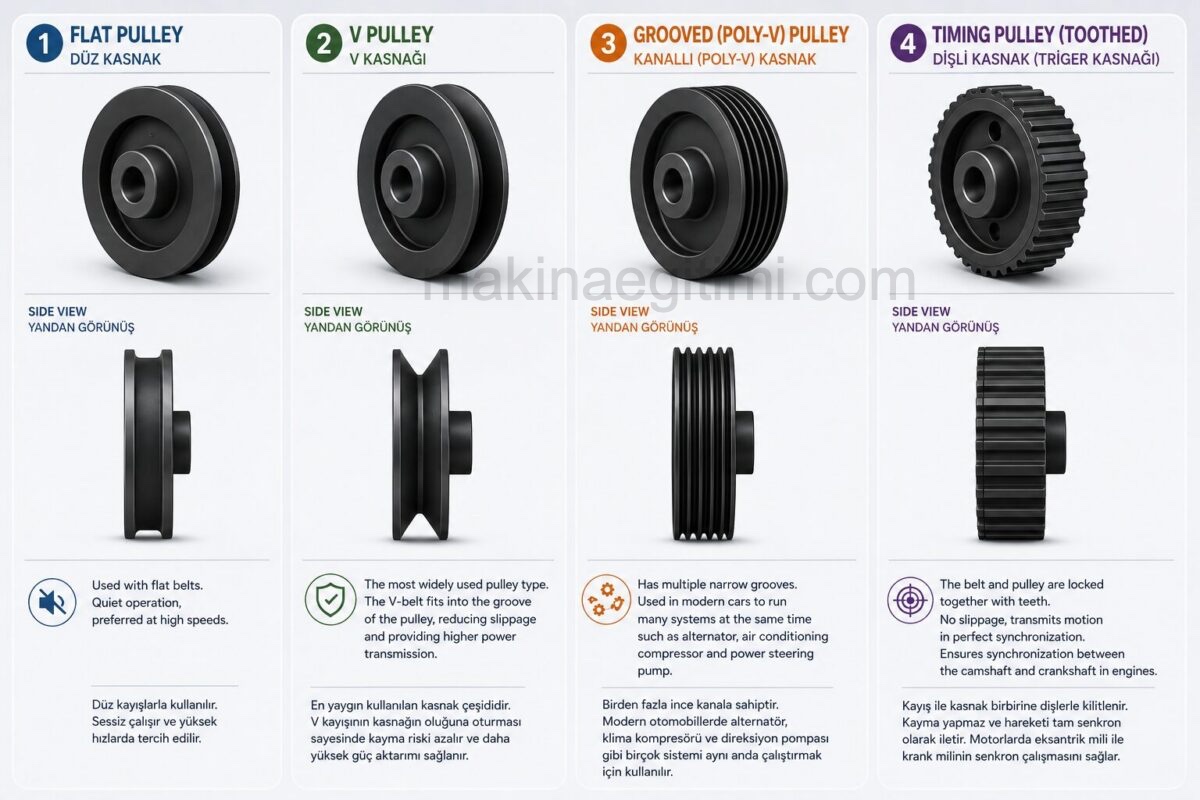
types of pulley
  • Flat pulley: Used with flat belts. It runs quietly and is preferred at high speeds.
  • V-pulley: The most widely used type of pulley. Because the V-belt seats itself in the pulley groove, the risk of slipping is reduced and higher power transmission is achieved.
  • Grooved (poly-V) pulley: Has several fine grooves. It is used in modern cars to drive many systems at once, such as the alternator, air conditioning compressor and power steering pump.
  • Toothed pulley (timing pulley): The belt and pulley lock together with teeth. It does not slip and transmits motion in exact synchronisation. In engines it keeps the camshaft and the crankshaft running in sync.

Where Are Pulleys Used?

Pulley systems turn up in many areas of our lives.

Cars

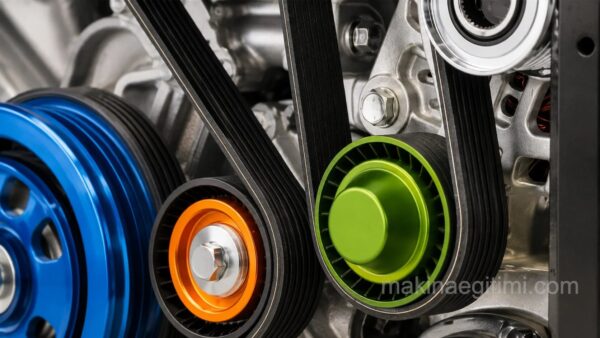
Cars are among the vehicles in which pulleys are most widely used. When the engine runs, the crankshaft pulley turns and drives many components by means of a belt.
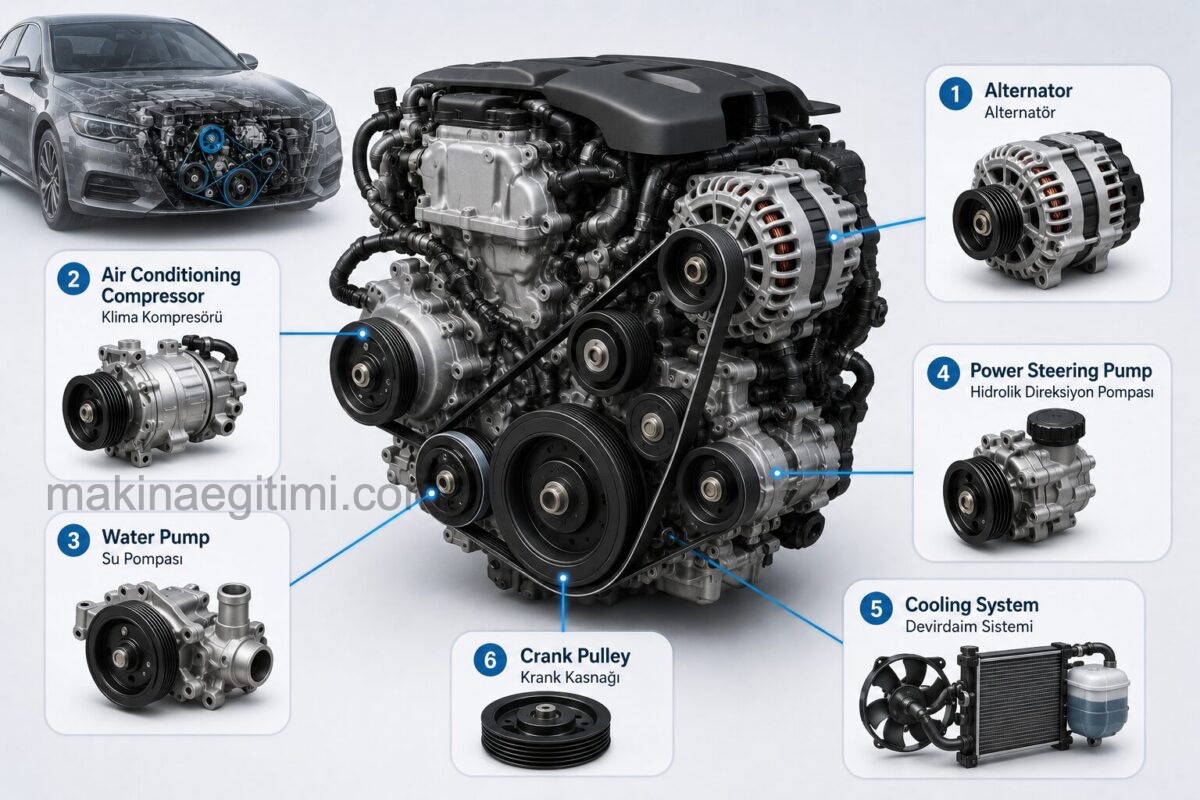
use of pulleys in vehicles

The alternator, air conditioning compressor, water pump, power steering pump and circulation system, for example, all run thanks to the belt and pulley system.

Industrial Machinery

parts of a lathe, headstock, belt and pulley
Use of pulleys on a lathe

Machines found in factories, such as lathes, milling machines, drilling machines, grinding machines and conveyor systems, can transmit power with pulleys.

cutaway of the internal mechanism of a pillar drill: pulleys and V-belt
Use of pulleys on a pillar drilling machine

Agricultural Machinery

Pulley systems are widely used in:

  • Water pumps
  • Threshing machines
  • Feed grinders
  • Mowers

and similar equipment.

Household Appliances

Many of the appliances we use at home contain pulleys as well. Washing machines, tumble dryers, sewing machines, vacuum cleaners and some kitchen appliances (such as mixers and beaters) work with a belt and pulley system.
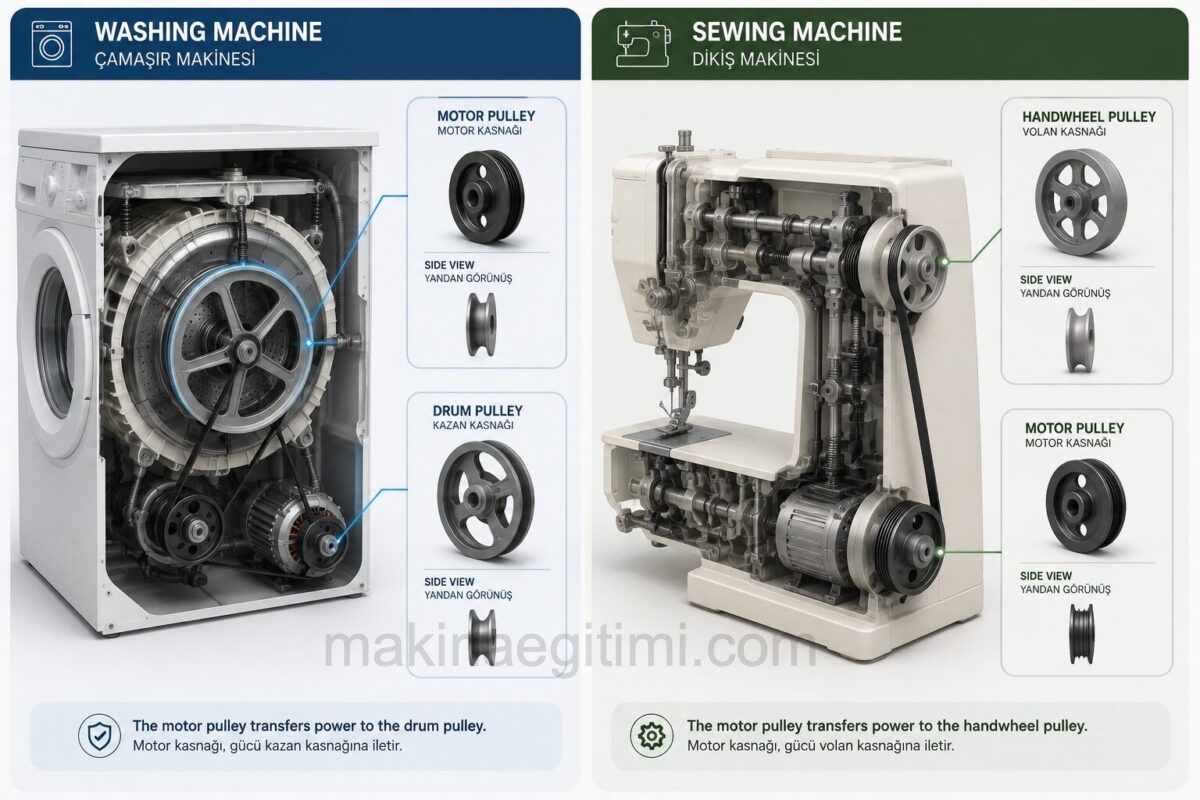
pulleys in a washing machine and a sewing machine

Ventilation Systems

In the large fans and ventilation systems found in factories, power transmission between the motor and the fan is usually handled by pulleys. This method makes it easy to adjust the fan speed.

Compressors

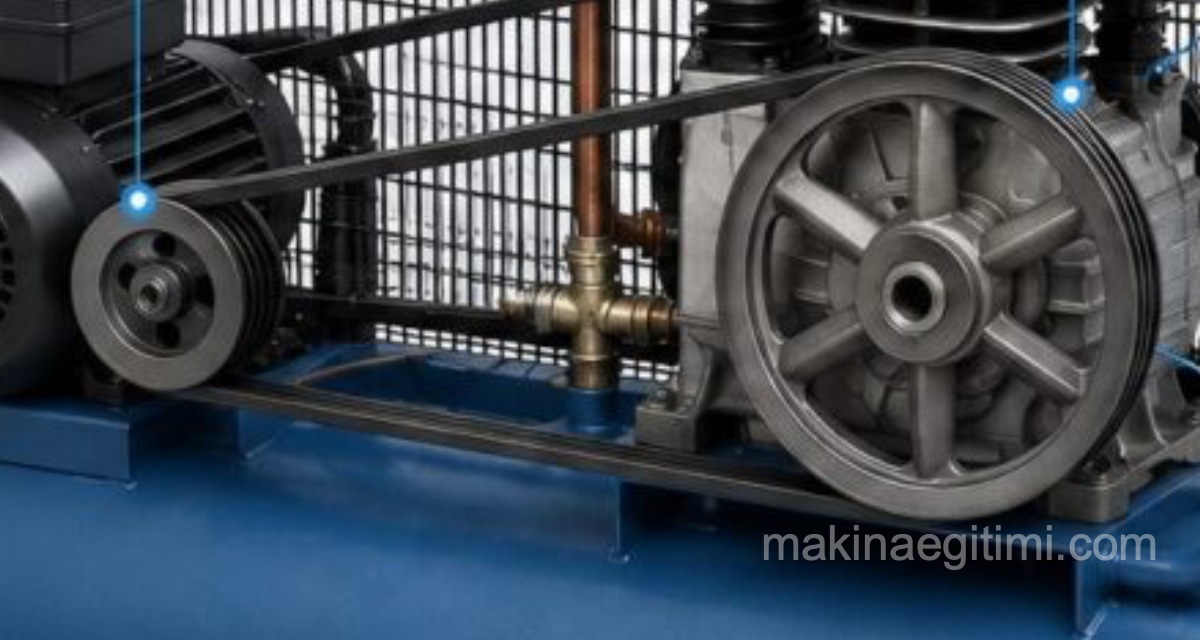
In the air compressors used in workshops, the motion of the electric motor is carried to the compressor unit by a belt and pulley system.
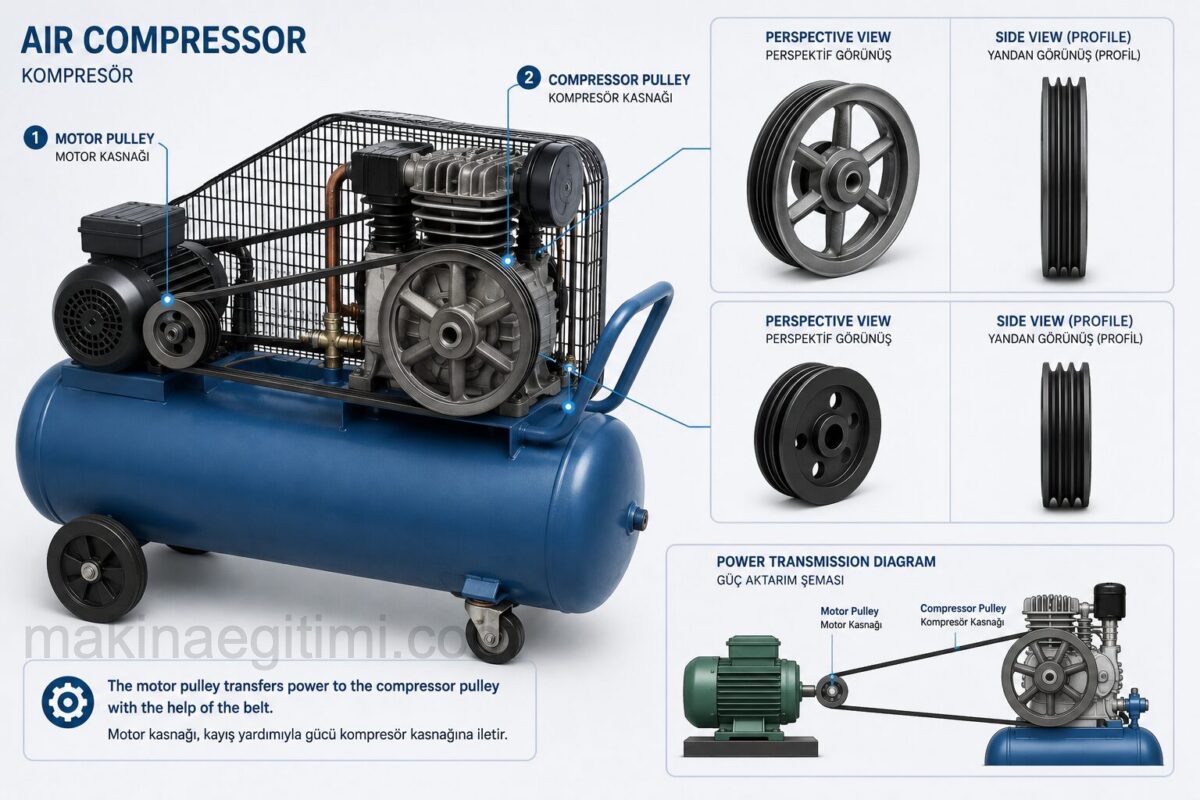
use of a pulley on an air compressor

Generators

In some generators, power transmission between the engine and the alternator is carried out with a pulley system.

Advantages of Using Pulleys

Pulley systems are preferred for many reasons. Their main advantages are:

  • They have a simple structure.
  • Manufacturing cost is low.
  • They run quietly.
  • They are easy to maintain.
  • They can transmit power over long distances.
  • They reduce shocks and vibration.
  • The speed ratio can be changed easily.
  • The belt can protect the system under excessive loads.

Disadvantages of Pulley Systems

As with every mechanical system, pulleys have some disadvantages too.

  • The belt can slacken over time.
  • The belt can wear and snap.
  • Slipping can occur at very high torques.
  • Regular tension adjustment may be required.
  • Oil or dirt can reduce the belt’s grip.

How Is Pulley Maintenance Done?

Pulley systems need to be checked regularly if they are to have a long service life.

The following points should be watched:

  • The belt should be checked for cracks or breaks.
  • There should be no wear on the pulley surface.
  • Belt tension should be within the manufacturer’s values.
  • The pulleys should be in line with one another.
  • No oil or grease should be allowed onto the belt.
  • Worn pulleys and belts should be replaced together.

Pulleys are one of the most economical and reliable methods of mechanical power transmission. They have a very wide field of use, from cars to industrial machinery and from household appliances to agricultural equipment. A correctly selected and regularly maintained pulley system can run efficiently and safely for years. That is why pulleys remain among the indispensable power transmission elements of modern machines and engines.

Related Posts

Types of Keys What Is a Key? Where Is It Used? Kam Mekanizmalı Yaratıcı Otomatlar Creative Cam-Mechanism Automatons What Is a Piston Ring, What Does It Do? What Is a Piston Ring, What Does It Do? Its Job and Installation. Belt Splicing, Belt Lacing Methods Belt Splicing – Belt Lacing Methods Information About Helical Gears Helical Gears friction materials in clutches - sintered bronze Friction Materials Used in Clutches Types of Belts Belt Types Used in Industry Shaft Diameter Calculation Shaft Diameter Calculation
Belts & Pulleys
Share. Facebook Twitter WhatsApp Tumblr Email Telegram Copy Link

Leave A Reply Cancel Reply

Master of the Short Sentence: The Life Story of Ernest Hemingway
Ways to Tell If Your Car Battery Is Dead
  • Contact
  • Terms of Service
  • Privacy & Cookie Policy

Type above and press Enter to search. Press Esc to cancel.