Close Menu
  • MAKİNELER ve İMALAT
    • Tools & Equipment
    • Computer-Aided Drawing
    • CAD/CAM Education
    • CNC Machine Programming
    • Casting Technologies
    • Electrical & Electronics Technologies
    • Hydraulics & Pneumatics
    • Manufacturing Processes
    • Manufacturing Technologies
    • Occupational Safety
    • Mold & Die Design
    • Solid Modeling
    • Welding Technology
    • Machine Elements
    • Mechanical Trade Drawing
    • Materials Science
    • Automotive & Vehicle Technologies
    • Robotics Technologies
    • Health Technologies
    • Defense & Aerospace Technologies
    • Descriptive Geometry
    • Technical Drawing
    • Software & Hardware Technologies
    • Innovative Manufacturing Methods
  • TEKNOLOJİ ve YAŞAM
    • OTOMOBİLLER ve TAŞIT
      • Vehicle & Engine Knowledge
      • Safe Driving
      • Sürüş Destek Sistemleri
    • Genel Kültür
      • Movies & TV Shows
      • Görsel ve Grafik Sanat
      • Books & Literature
      • Music
      • Sports
      • History
      • History of Technology
    • GÜNDELİK YAŞAM TEKNOLOJİLERİ
    • Hobbies & Entertainment
    • Internet Technologies
    • Health
    • Mobile Technologies
Makine Eğitimi
  • Machines & Manufacturing
    Machine Elements
    Hydraulics & Pneumatics
    Technical Drawing
    Computer-Aided Design & Manufacturing
    Basic Manufacturing Processes
    Manufacturing Processes
    Industry Technologies
    Other Technical Courses
    Motion & Power Transmission
    Simple Machines
    Chains & Sprockets
    Shafts & Journals
    Gears
    Cams
    Couplings
    Belts & Pulleys
    Springs
    Bearings
    Keys
    Fastening Joining
    Retaining Rings
    Screws, Bolts & Nuts
    Cotter Pins
    Flanges
    Welding
    Rivets
    Pins & Bolts
    Washers
    Calculators
    Gear Ratio Calculator
    Spring Constant Calculator
    Belt Pulley Ratio Calculator
    Other Machine Elements
    Slides & Linear Guides
    Brakes
    Flywheels
    Clamps
    Shock Absorbers
    Gaskets & O-Rings
    Seals & Sealing Elements
    Hydraulics
    Introduction to Hydraulics & Principles
    Hydraulic Systems & Applications
    Accumulators
    Filters
    Motors
    Pumps
    Valves
    Pneumatics
    Introduction to Pneumatics & Principles
    Pneumatic Systems & Applications
    Pneumatic Circuit Components
    Valves
    Cylinders
    Silencers
    Motors
    Compressors
    Dryers
    Conditioning Units
    Common Topics & Maintenance
    Hydraulic & Pneumatic Maintenance
    Study Notes, Exams & Tests
    Technical Drawing
    Introduction to Technical Drawing
    Geometric Drawings
    Perspective & Projection
    Orthographic Views
    Dimensioning
    Sectioning
    Assembly & Detail Drawings
    Tolerances
    Surface Finish Symbols
    Mechanical Engineering Drawing
    Screws, Bolts & Nuts
    Pulley Drawings
    Gear Drawings
    Shafts & Journals
    Bearing Drawings
    Pins & Bolts
    Spring Drawings
    Welds in Technical Drawing
    Washers
    Cotter Pins
    Technical Drawing Exercises
    Mechanical Drawing Exercises
    Gear Exercises
    View Extraction Exercises
    Pulley Exercises
    Pin & Bolt Exercises
    Threaded Fastening Exercises
    Descriptive Geometry
    Computer-Aided Drawing
    AutoCAD Drawing Lessons
    Computer-Aided Drawing Exams
    Solid Modeling & Animation
    Solid Model Drawing Files
    Solid Model Assembly Examples
    Solid Model Drawing Lessons
    3D CAD Software Reviews
    Solid Modeling Exercises
    CNC Programming
    CAM
    Measurement & Inspection
    Dial Indicators
    Calipers
    Gauges
    Micrometers
    Materials Science
    Steels
    Cast Iron
    Aluminum
    Plastics
    Material Testing & Hardness Measurement
    Occupational Safety
    Workshop Safety
    Safety When Working With Electricity
    Machine Safety Rules
    Hand Operations
    Filing
    Marking
    Cutting Operations
    Reaming
    Tapping
    Threading With a Die
    Drill Bit Sharpening
    Working With Machines
    Basic Turning Operations
    Basic Milling Operations
    Shaper Machine
    Machining
    Turning
    Milling
    Grinding
    Innovative Manufacturing Methods
    EDM (Electrical Discharge Machining)
    Laser Machining
    Waterjet Machining
    3D Printing
    3D Scanners
    Welding
    Rolling
    Casting
    Mold & Die Design
    Mechanical & Hydraulic Presses
    Blanking & Piercing Dies
    Bending Dies
    Drawing Dies
    Plastic Injection Molds
    Extrusion Dies
    Compound Dies
    Progressive Dies
    Blow Molds
    Spinning Dies
    Spray Molds
    Manufacturing of Machine Parts
    Automotive & Vehicle Technologies
    Motor Vehicle Manufacturing
    Raw Material Production
    History of Technology
    Health & Medical Technologies
    Defense & Aerospace
    Robotics Technologies
    Software & Hardware Technologies
    Mechanics - Strength of Materials
    Physics Topics
  • Technology & Life
    Hobbies & Entertainment
    Sports
    Music
    Vehicle & Engine Knowledge
    Vehicle Maintenance & Repair
    Safe Driving
    Driver Assistance Systems
    History
    Movies & TV Shows
    Books & Literature
    Computers & Internet
    Computer Tips
    Software Reviews
    Hardware & Peripherals
    Practical & Safe Internet Use
    Visual & Graphic Art
    Mobile Technologies
    Travel
    Science
    Health
    First Aid Knowledge
    Everyday Technologies
Makine Eğitimi
Home»Manufacturing Processes»Types of Files – Lesson
29 August 2026

Types of Files – Lesson

Types of Files - Lesson

A file is a tool used to remove material from parts using the many cutting teeth on its surface. Learning to use a file correctly is a basic prerequisite for fitting work. It’s one of the first topics in the Basic Manufacturing Processes lesson. The types of files are as follows:

  • Types of Files
    • File Types by Tooth Pattern
      • Single-cut files (for soft materials)
      • Double-cut files (for hard materials)
      • Rasp-cut files (for wood and leather)
    •  File Types by Cross-Section and Shape
    •  File Types by Application
      • Fitter’s files
      • Watchmaker’s files
      • Chainsaw file
      • Point file (feeler-gauge file)
      • Saw-sharpening files
  • Choosing a File
    • Choosing a File by Size
    • Choosing the Right File by Operation and Material Type
  • Related Questions

Types of Files

File Types by Tooth Pattern

Single-cut files (for soft materials)

The teeth are arranged in a single row on the file. Single-cut files are suitable for removing material from soft materials (like aluminum).

Double-cut files (for hard materials)

The teeth are arranged in two crossing rows on the file. This way, the cutting effect is multiplied proportionally to the increase in the number of teeth. Double-cut files are suitable for removing material from hard materials like steel and cast iron.

file types by tooth pattern - cross-cut, rasp-cut
Single-cut, double-cut, and rasp-cut files

Rasp-cut files (for wood and leather)

The teeth are individual pointed tips scattered in a certain pattern on the file. These files are suitable for rough material removal from wood and some plastic materials.

 File Types by Cross-Section and Shape

Flat file

Triangular file

Barrette file (fish-back file)

Round file
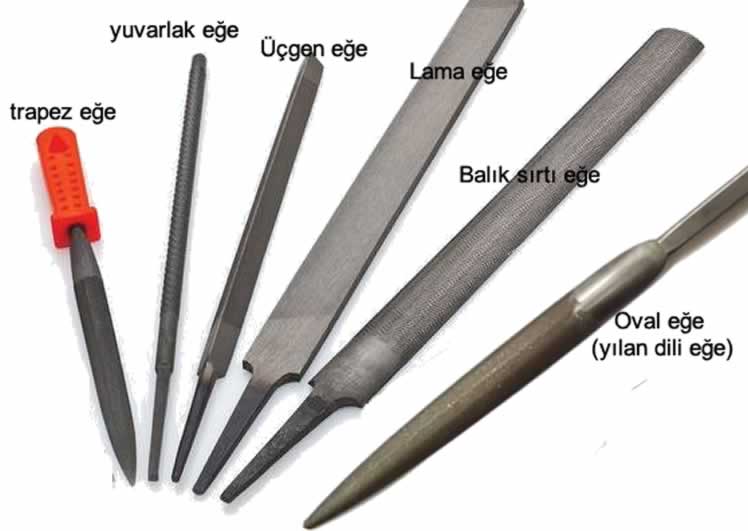
file types by cross-section and shape
Some file types by cross-section and shape

 File Types by Application

Fitter’s files

Workshop files are used for filing operations in fitting and machining work. Files specified under TS 375 (Turkish Standard) are workshop files. These files are 100-350 mm long.

fitter's files
Fitter’s files

Watchmaker’s files

Watchmaker’s files: this is the file type with the greatest variety of cross-sections. Since watchmaker’s files are small and thin, they’re used in work like watchmaking and mold-making. These files are 50-100 mm long.

Watchmaker’s files are made for fine work.

Chainsaw file

These have a round cross-section and are used for sharpening band saws. These files are 100-350 mm long.

Point file (feeler-gauge file)

A 0.8×8 mm rectangular-cross-section file, 90 mm long, either with or without an integral handle.

Saw-sharpening files

These have a triangular or flat cross-section, and are used for sharpening saw blade teeth. These files range from 100-350 mm long.

Tooth Cut Direction


Files can have a single-cut or double-cut tooth pattern; a double cut gives a smoother surface.

Effect of Tooth Coarseness


Coarse-tooth files remove material quickly, while fine-tooth files leave a more precise, smoother surface.

Variety of Cross-Section Shapes


Files are made in different cross-section shapes, such as flat, half-round, and triangular, to suit various surface and edge work.

Choosing a File

What should we pay attention to when choosing a file? There are certain criteria to consider when buying a file.
First, a file suited to the job at hand — meaning the file’s profile (square file, triangular file, etc.)
The file’s dimensions.
The type of material to be filed — considering properties like these is how a file is chosen.

Choosing a File by Size

Files are made in lengths of 4″ — 6″ … 16″, based on the length of their toothed section, or 80 mm – 450 mm. Tooth pitches (t) range from 2.5 mm to 0.25 mm, from the coarsest to the finest file. Files are selected from what’s on the market based on the specified dimensions, tooth pattern, and cross-section.

Choosing the Right File by Operation and Material Type

A fine-pitch file should be chosen for fine work or hard materials, and a coarse-pitch file for rough work or soft materials. For example, a coarse-pitch file is used for working brass, aluminum, or wood, while a fine-pitch file can be used when working steel.

Related Questions

Flat, half-round, and triangular cross-section files are the most commonly used file types.

Tooth cut direction, tooth coarseness, and cross-section shape are the main properties to consider when choosing a file.

Fine-tooth files are used to achieve a more precise and smoother surface.

Related Posts
Types of Inspection Equipment and Their Use Types of Inspection Equipment and Their Use Parts of a Lathe Parts of a Lathe, Illustrated How to Read a Caliper How to Read a Caliper. Caliper Reading Explained How Is Tapping Done? How to Tap a Hole? How Is Tapping Done? Mastar Nedir Neden Kullanılır? What Is a Gauge. Why Is It Used? cutting fluids and their characteristics The Effect of Cutting Oils on Turning Making a Worm Wheel Making a Worm Wheel Supporting a Workpiece on a Lathe Steady Rests on a Lathe. Supporting a Workpiece on a Lathe
Filing Hand Operations
Share. Facebook Twitter WhatsApp Tumblr Email Telegram Copy Link

Leave A Reply Cancel Reply


How Are Robotic Welding Cells Used in Automotive Production?
The Financial Origins of the French Revolution: How a Kingdom Collapsed Into Bankruptcy
  • Contact
  • Terms of Service
  • Privacy & Cookie Policy

Type above and press Enter to search. Press Esc to cancel.