
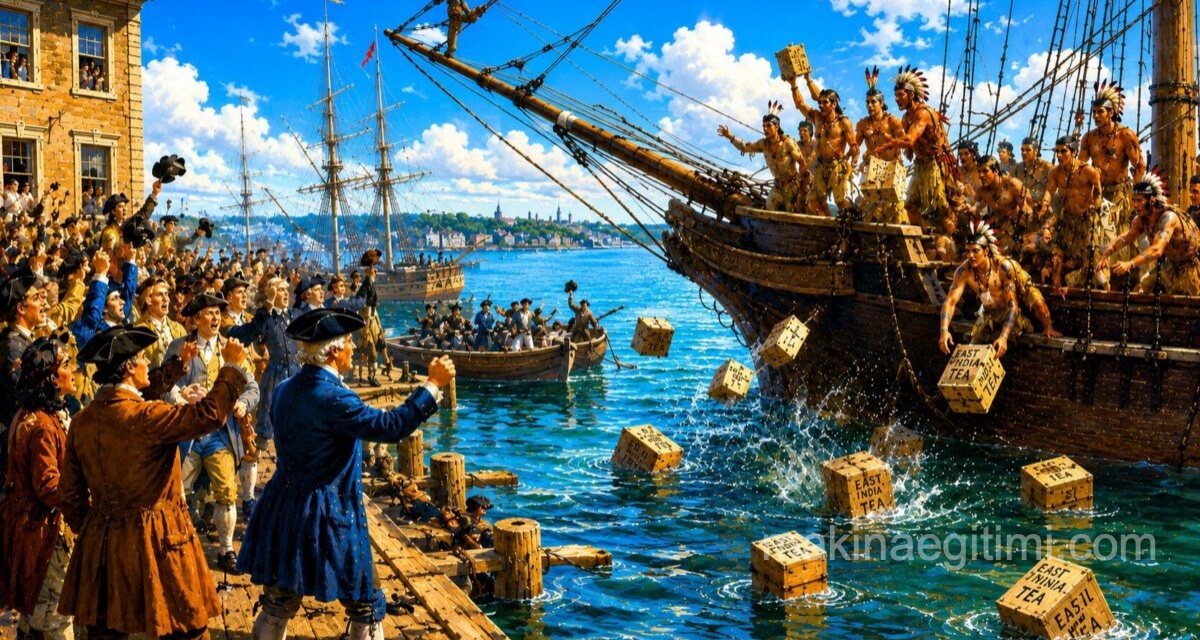
Hello, today we’re going to tell you the story of how a handful of tea lit the fuse of a rebellion against an entire empire. What’s more, the people who started this rebellion were so angry not because they hated tea, but quite the opposite — because they loved it so much.
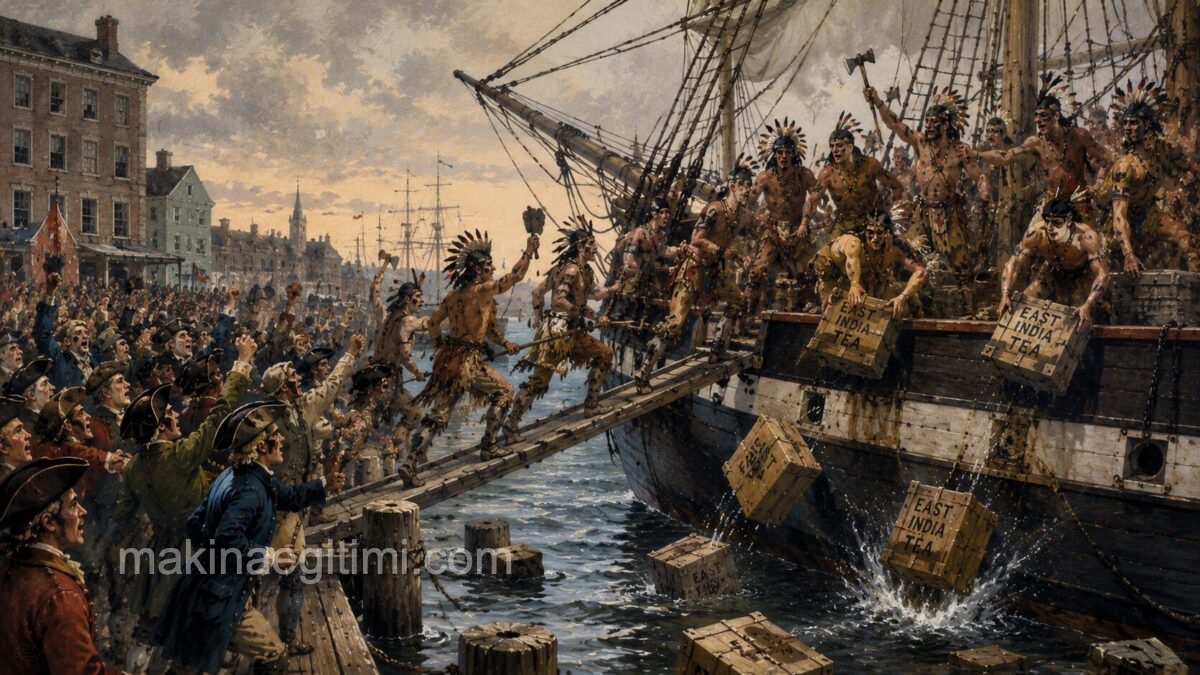
On the evening of December 16, 1773, on a cold winter night, a protest that took place in Boston Harbor became the first spark of a country that would declare its independence three years later.
The Story Behind a Tax
The beginning of the story actually had to do with a financial crisis far from Boston, in London. England had emerged from the Seven Years’ War (1756-1763) against France with an enormous debt. A significant part of this war had been fought to protect the British colonies in North America from French influence. London’s logic was simple: “This war was fought for you too, so you should also contribute to its cost.”
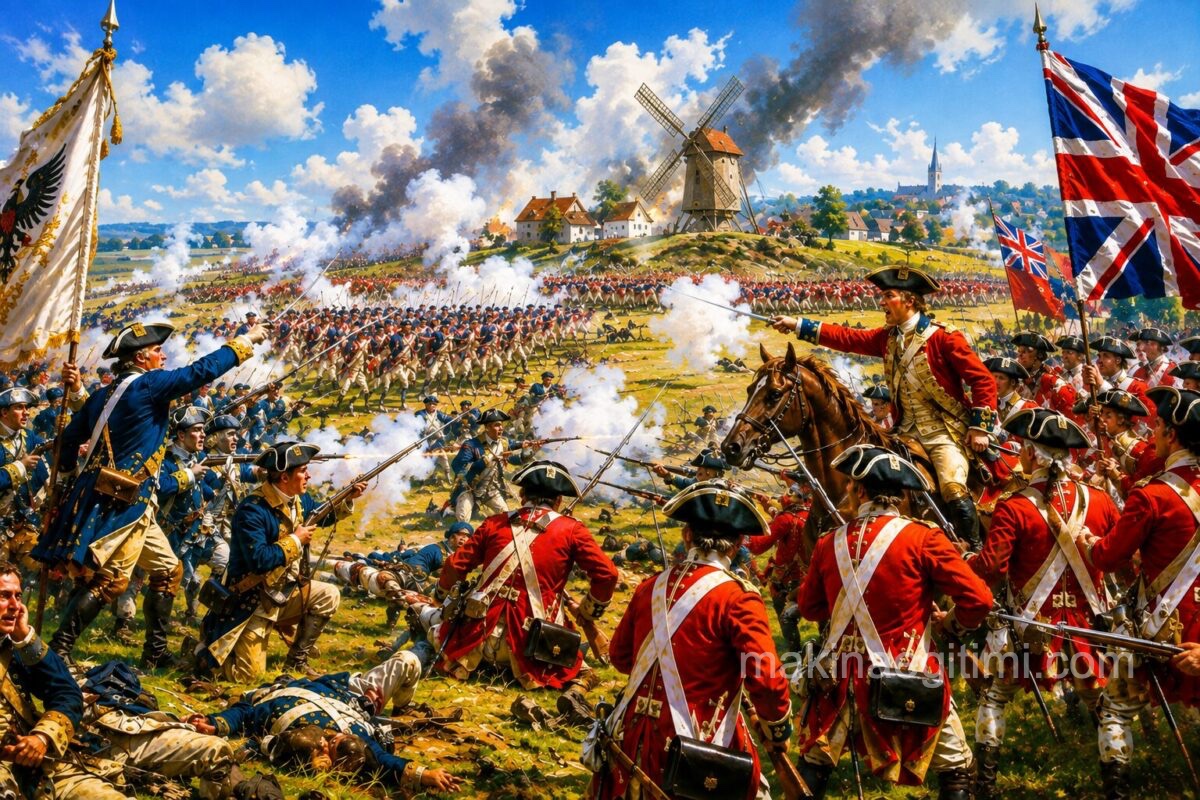
With this thinking, the British Parliament imposed a series of new taxes on the colonies one after another: the Stamp Act, the Townshend Acts, and many other regulations. The colonists strongly opposed these taxes. Their slogan was clear: “No taxation without representation.” In other words, they believed that since they had no representatives in Parliament in London, Parliament had no right to tax them.
The Tea Act: An Unexpected Move
In 1773, the British Parliament passed the “Tea Act.” What was interesting was this: the act actually lowered the tax on tea. But its real purpose was to grant the financially struggling East India Company a monopoly on selling tea in the colonies. In other words, London was actually offering the colonists “cheaper tea.”
But the colonists read this move differently. To the colonists, this was a trap: first establish a cheap monopoly, then impose whatever tax they wanted afterward. Moreover, more than the amount of the tax, the principle of “being taxed without consent” was still being violated. The issue was no longer about money, but about principle.
What If Britain Had Never Imposed This Tax?
Let’s stop and think for a moment. If London had never demanded taxes from the colonies, perhaps the independence movement wouldn’t have organized so quickly. But Britain’s war debt was real, and it had to be paid off somehow. The problem was less the existence of the tax itself than the fact that it was imposed on the colonists without ever consulting them, without giving them any say.
If London had granted the colonies even a symbolic right of representation in Parliament, perhaps tensions wouldn’t have escalated so much. But Britain still viewed the lands on the other side of the Atlantic strictly as “colonies,” not as equal partners. Sometimes what brings about the end of an empire isn’t the tax it collects, but the arrogance it shows while collecting it.
What Happened That Night at the Harbor?
On the evening of December 16, 1773, a group called the “Sons of Liberty,” some of whose members disguised themselves as Native Americans, boarded three ships anchored in Boston Harbor. They opened 342 chests of tea aboard the ships one by one and dumped them into the waters of Boston Harbor. The value of the tea dumped that night would amount to millions of dollars today.
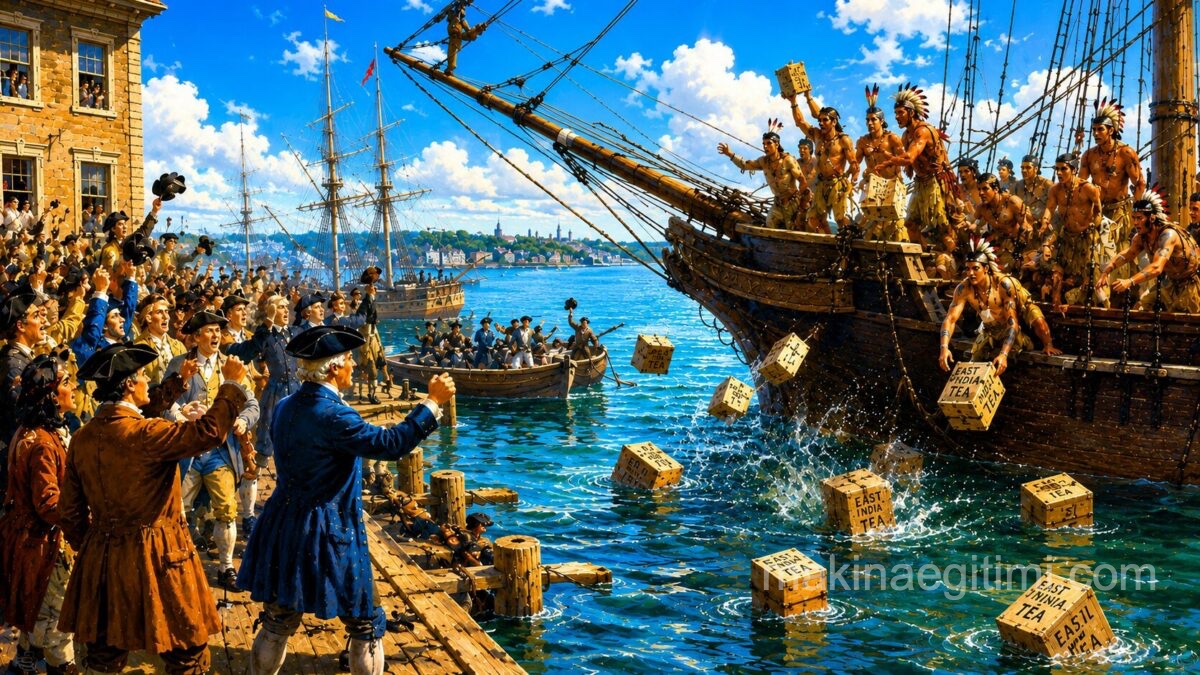
This action was a non-violent but highly symbolic protest. No one was harmed; only property was destroyed. But Britain’s response to this protest would completely change the course of events.
London’s Harsh Response: The Breaking Point
Britain did not forgive this protest. Parliament passed a series of harsh punitive laws known as the “Coercive Acts.” Boston Harbor was completely closed until compensation was paid; Massachusetts’s rights to self-government were severely restricted.
But this harsh response had the exact opposite effect of what London expected. The other colonies united in support of Massachusetts. In 1774, the first Continental Congress convened, marking the first step toward the colonies forming a common front. A year later, armed conflict began, and independence was declared in 1776.
The Join, or Die Snake
First published in 1754 by Benjamin Franklin in the Pennsylvania Gazette newspaper. The segments of the divided snake represented the British North American colonies.
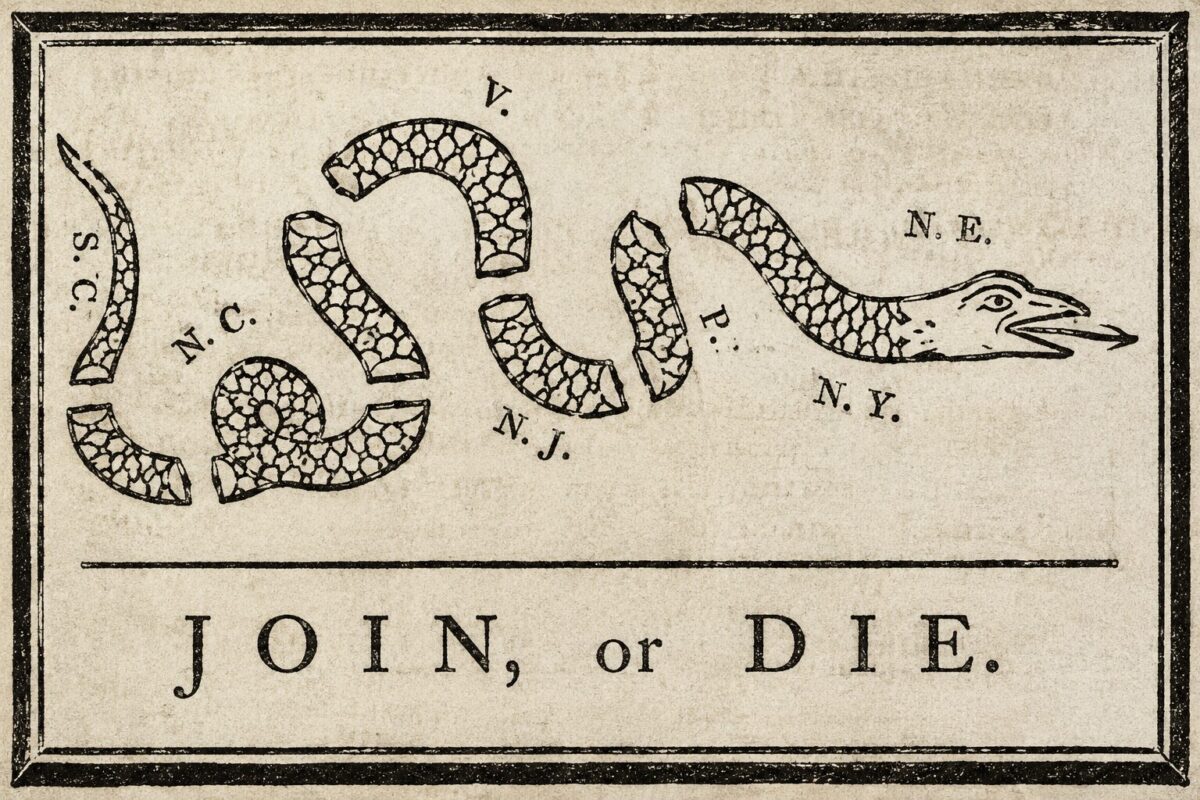
The message was for the colonies to act together against the French and their native allies. The cartoon was soon reprinted in other newspapers and became one of the symbols of the idea of unity among the colonies.
During the American Revolution, however, its meaning changed: “Join, or Die” this time became a powerful propaganda symbol used for the colonies to unite against Britain. It is documented as having been republished from 1765 onward, with different versions used in the 1770s.
The “JOIN, or DIE.” phrase and the divided snake in the image above are a symbol quite faithful to the historical original. The original can be viewed via the record of the May 9, 1754 edition of the Pennsylvania Gazette.
Chain of Cause and Effect: From a Tea Chest to a Nation
- The Seven Years’ War left Britain with an enormous debt.
- To pay off this debt, taxes were imposed on the colonies one after another.
- The principle of “no taxation without representation” fueled the colonists’ anger.
- The Tea Act imposed a new monopoly and tax under the guise of cheap tea.
- The Boston Tea Party became a symbolic but effective protest against this imposition.
- Britain’s harsh response with the “Coercive Acts” brought the colonies even closer together.
- Unity among the colonies strengthened, armed conflict began, and independence was declared in 1776.
A Little-Known Fact
One of the people who took part in the protest that night took off his shoes before boarding the ship so that no tea leaves would get into them, and after it was over, he put his shoes back on and quietly went home. According to records from the period, participants avoided even giving each other names afterward in order to conceal their identities, which is why even today the full list of those who took part that night is not known for certain.
Related Videos

Boston Çay Partisi (Amerika Bağımsızlık Savaşının Hikayesi)
Çay Zammıyla Özgürleşen Amerika'nın O An'ı
Boston Çay Partisi: Tarihte Bir Dönüm Noktası
Frequently Asked Questions
The issue wasn’t the price, but the principle. The colonists refused to accept being taxed without their consent and representation; they were also bothered by the fact that this act granted a monopoly to the East India Company.
It passed a series of harsh punitive laws known as the “Coercive Acts,” closed Boston Harbor, and restricted Massachusetts’s rights to self-government.
The event took place in 1773, armed conflict began in 1775, and independence was declared in 1776.
Britain did not forgive the protests, and Parliament responded by passing the “Coercive Acts.” Under these laws, Boston Harbor was completely closed until compensation was paid, and Massachusetts’s rights to self-government were severely restricted.
Related Posts
 The Public Debt Administration: How an Empire Became a Foreigner in Its Own Country
 The Trojan War: Legend or Reality? The Startling Traces Found by Archaeologists
 The October Revolution: How a Tsardom Fell Overnight
 The Black Death: How Did a Pandemic Bring About the End of the Middle Ages?
 Genghis Khan: From an Abandoned Child to History’s Greatest Emperor
 The Tulip Mania: The Story of History’s First Financial Bubble and Manipulative Scheme
 The History of Hagia Sophia: One of the Most Enduring and Controversial Structures in Human History
 The Battle of Waterloo: The Afternoon That Decided Europe’s Fate