

Dear readers, today we’re going to tell you the story of how a kingdom was turned upside down in just five years — one of the most famous revolutions in the world. It’s a story that ends with the king himself being sent to the guillotine in front of his own people.
In our previous article, we told you how France’s treasury was emptied and how its tax system became increasingly unjust. Now let’s trace, step by step, how that empty treasury turned into a revolution.
From the Estates-General to the National Assembly
In May 1789, King Louis XVI convened the Estates-General, which had not met in 175 years. The goal was simple: find a solution to the tax crisis. But the assembly took a turn the monarchy never expected.
The Estates-General consisted of three orders: the clergy, the nobility, and the commoners. The voting procedure caused controversy; the representatives of the commoners realized that although they made up the majority of the population, they did not have equal voting power.
On 17 June 1789, the Third Estate declared itself the “National Assembly.” A few days later, the representatives, gathered on a tennis court, took the famous “Tennis Court Oath”: they would not disband until France had a constitution.
 Fransız Devrimi
The Storming of the Bastille: The Fall of a Symbol
When the king prepared to suppress the assembly by military force, the people of Paris took action. On 14 July 1789, a large crowd, searching for weapons and gunpowder, stormed the Bastille prison. In truth, the Bastille was not strategically all that important at the time — it held only a handful of prisoners. But its symbolic meaning was enormous: it stood for royal oppression and arbitrary imprisonment.
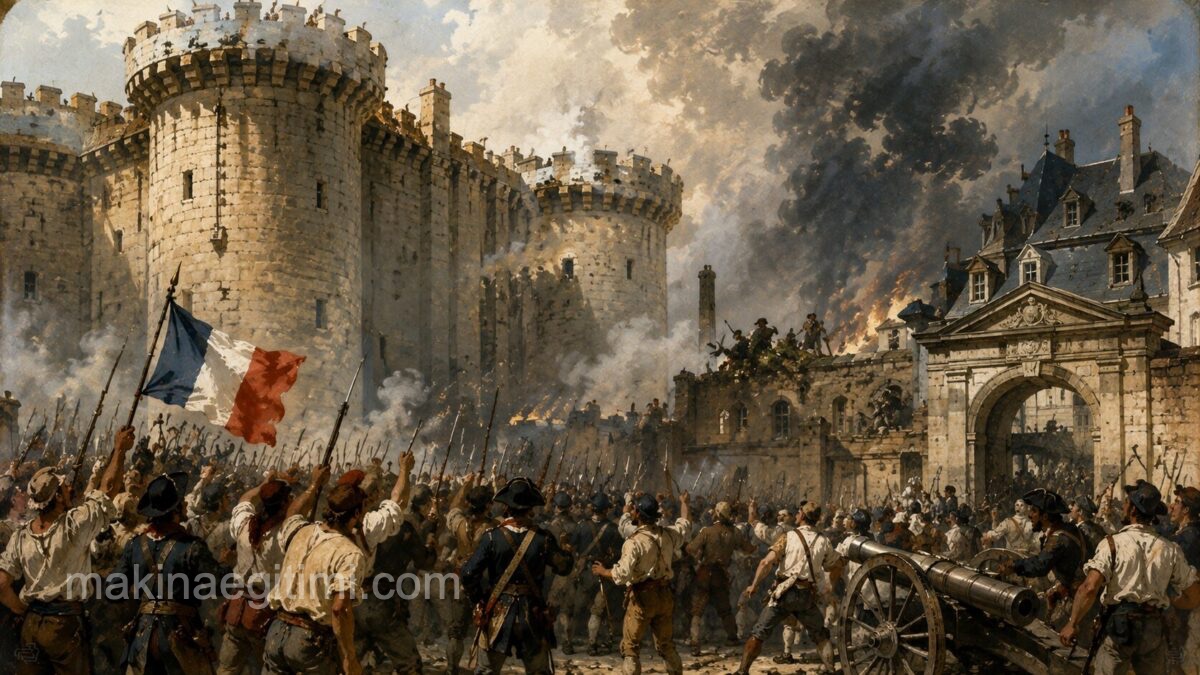
The fall of the Bastille spread the spark of revolution across the whole country. Soon, a wave of uprisings known as the “Great Fear” began in the countryside as well, with peasants attacking the châteaux of the nobility and burning feudal documents.
The Declaration of the Rights of Man and of the Citizen
In August 1789, the National Assembly adopted one of the most influential political texts in history: the Declaration of the Rights of Man and of the Citizen.
This declaration established the principle that “men are born and remain free and equal in rights.” This idea would go on to deeply influence not only France but constitutions and human rights documents around the world for the next two centuries.
But the king was still on the throne, and where the revolution was headed remained uncertain.
 Kanlı Bir Burjuva Devrimi – 1789 Fransız İhtilali
The King’s Flight — And What If It Had Succeeded?
In 1791, King Louis XVI and his family decided to flee the country in secret and seek support from Austria, to which he was related by marriage. But the king was recognized and captured in the town of Varennes and brought back to Paris.
Now let’s imagine for a moment. What would have happened if the king’s escape had succeeded? He could likely have raised an army against the revolution with the support of Austria and Prussia, pushing the country toward civil war much earlier and far more bloodily. But because the escape attempt failed, the king came to be seen by the people as a traitor. This single event became one of the most critical turning points that hastened the end of the monarchy.
The Proclamation of the Republic and the Reign of Terror

In 1792, the monarchy was formally abolished, and France declared itself a republic. In 1793, King Louis XVI was executed by guillotine on charges of treason. Shortly afterward, Queen Marie Antoinette met the same fate.
But the revolution did not stop there. The radical Jacobins, led by Robespierre, launched what became known as the “Reign of Terror.”
Thousands of people deemed enemies of the revolution were sent to the guillotine, often without any evidence at all. Ironically, Robespierre himself, the man who had set this terror in motion, lost his own life on that same guillotine in 1794.
Related video alongside: The French Revolution (Part 1): The 1789 Declaration of the Rights of Man and of the Citizen (World History)
 Fransız Devrimi (1. Bölüm): 1789 İnsan ve Yurttaş Hakları Bildirisi (Dünya Tarihi)
The Chain of Cause and Effect: From an Assembly to a Republic
- The unjust voting procedure of the Estates-General pushed the Third Estate to declare itself the National Assembly.
- The king’s attempt to suppress the assembly by force triggered the storming of the Bastille.
- The fall of the Bastille spread the revolution across the entire country.
- The Declaration of the Rights of Man and of the Citizen formed the ideological foundation of the revolution.
- The king’s failed escape attempt destroyed the legitimacy of the monarchy in the eyes of the people.
- The monarchy was abolished, the republic was proclaimed, and the king was executed.
- The increasingly radicalized revolution turned into a Reign of Terror that devoured even its own leaders.
The final link in this chain was an artillery officer who would step onto the stage a few years later: Napoleon Bonaparte. The vacuum left by the chaos of the revolution paved the way for his rise.
Some Lesser-Known Facts
During the Reign of Terror, an estimated 16,000 to 40,000 people were officially executed in just 10 months. And that figure doesn’t even include those killed without trial or those who died in prison.
The most striking fact of all: Robespierre, the man who set the revolution in motion and declared that “terror is the virtue of the state,” became one of the last victims of the very system he had built.
Films About the French Revolution
The most comprehensive accounts of the French Revolution
- La Révolution française (1989)
A sweeping two-part historical film running roughly 5.5 hours in total. It begins with the États-Généraux (Estates-General) process in 1789 and runs through Robespierre’s downfall (1794).
It features many historical figures, including Louis XVI, Marie-Antoinette, Danton, Robespierre, Marat, Mirabeau, and Desmoulins. It’s arguably the most useful film for following the historical events in chronological order. - Un peuple et son roi (2018)
Tells the story of the revolution between 1789 and 1793, especially through the eyes of the people of Paris.
The fall of the Bastille, popular movements, the Assembly, and the revolutionary process are at the forefront.
Good for getting a feel for the social atmosphere of the period.
Specific figures and events of the revolution
- Danton (1983)
Starring Gérard Depardieu. Focuses on the political struggle between Danton and Robespierre. Especially good for understanding the Reign of Terror and the power struggle within the revolution. - Les Adieux à la reine / Farewell, My Queen (2012)
Set at the Palace of Versailles. Tells the story of events as news of 14 July 1789 and the fall of the Bastille reaches the palace. You see the revolution not from the battlefield, but from inside the palace itself. - La Nuit de Varennes / The Night of Varennes (1982)
Built around the 1791 escape attempt of Louis XVI and his family. An interesting look at the political atmosphere of the revolution and the unraveling of the monarchy. - L’Anglaise et le Duc / The Lady and the Duke (2001)
Tells the story of the French Revolution through the eyes of an English aristocratic woman in Paris. Offers a distinctive perspective, especially on the Reign of Terror. - Marie Antoinette (2006) – Sofia Coppola
Starring Kirsten Dunst. It doesn’t cover the entire revolution; it focuses mainly on Marie-Antoinette’s life at Versailles. Visually excellent, but not enough on its own to learn the history.
Frequently Asked Questions
The revolution is generally dated to the storming of the Bastille in 1789. The end date is debated, but most historians consider Napoleon’s seizure of power in a coup in 1799 to be a defining turning point.
In 1793, he was tried on charges of treason and executed by guillotine.
It was the radical period between 1793 and 1794 in which the Jacobins, led by Robespierre, executed thousands of people they considered enemies of the revolution, often after only brief trials.
The principles of liberty and equality expressed in the Declaration of the Rights of Man and of the Citizen went on to inspire numerous constitutions and human rights documents around the world over the following two centuries.
Related Posts
 Berlin Streets After World War II. July 1945
  The Battle of Gallipoli: How One Front Changed a Nation’s Fate
  Napoleon Bonaparte: How a Child of an Island Became the Master of Europe
  The Sarajevo Assassination: How One Bullet Dragged the World Into War
  The Boston Tea Party: How a Crate of Tea Gave Birth to a Nation
  The October Revolution: How a Tsardom Fell Overnight
  The Battle of Waterloo: The Afternoon That Decided Europe’s Fate
  The Financial Origins of the French Revolution: How a Kingdom Collapsed Into Bankruptcy