Close Menu
  • MAKİNELER ve İMALAT
    • Tools & Equipment
    • Computer-Aided Drawing
    • CAD/CAM Education
    • CNC Machine Programming
    • Casting Technologies
    • Electrical & Electronics Technologies
    • Hydraulics & Pneumatics
    • Manufacturing Processes
    • Manufacturing Technologies
    • Occupational Safety
    • Mold & Die Design
    • Solid Modeling
    • Welding Technology
    • Machine Elements
    • Mechanical Trade Drawing
    • Materials Science
    • Automotive & Vehicle Technologies
    • Robotics Technologies
    • Health Technologies
    • Defense & Aerospace Technologies
    • Descriptive Geometry
    • Technical Drawing
    • Software & Hardware Technologies
    • Innovative Manufacturing Methods
  • TEKNOLOJİ ve YAŞAM
    • OTOMOBİLLER ve TAŞIT
      • Vehicle & Engine Knowledge
      • Safe Driving
      • Sürüş Destek Sistemleri
    • Genel Kültür
      • Movies & TV Shows
      • Görsel ve Grafik Sanat
      • Books & Literature
      • Music
      • Sports
      • History
      • History of Technology
    • GÜNDELİK YAŞAM TEKNOLOJİLERİ
    • Hobbies & Entertainment
    • Internet Technologies
    • Health
    • Mobile Technologies
Makine Eğitimi
  • Machines & Manufacturing
    Machine Elements
    Hydraulics & Pneumatics
    Technical Drawing
    Computer-Aided Design & Manufacturing
    Basic Manufacturing Processes
    Manufacturing Processes
    Industry Technologies
    Other Technical Courses
    Motion & Power Transmission
    Simple Machines
    Chains & Sprockets
    Shafts & Journals
    Gears
    Cams
    Couplings
    Belts & Pulleys
    Springs
    Bearings
    Keys
    Fastening Joining
    Retaining Rings
    Screws, Bolts & Nuts
    Cotter Pins
    Flanges
    Welding
    Rivets
    Pins & Bolts
    Washers
    Calculators
    Gear Ratio Calculator
    Spring Constant Calculator
    Belt Pulley Ratio Calculator
    Other Machine Elements
    Slides & Linear Guides
    Brakes
    Flywheels
    Clamps
    Shock Absorbers
    Gaskets & O-Rings
    Seals & Sealing Elements
    Hydraulics
    Introduction to Hydraulics & Principles
    Hydraulic Systems & Applications
    Accumulators
    Filters
    Motors
    Pumps
    Valves
    Pneumatics
    Introduction to Pneumatics & Principles
    Pneumatic Systems & Applications
    Pneumatic Circuit Components
    Valves
    Cylinders
    Silencers
    Motors
    Compressors
    Dryers
    Conditioning Units
    Common Topics & Maintenance
    Hydraulic & Pneumatic Maintenance
    Study Notes, Exams & Tests
    Technical Drawing
    Introduction to Technical Drawing
    Geometric Drawings
    Perspective & Projection
    Orthographic Views
    Dimensioning
    Sectioning
    Assembly & Detail Drawings
    Tolerances
    Surface Finish Symbols
    Mechanical Engineering Drawing
    Screws, Bolts & Nuts
    Pulley Drawings
    Gear Drawings
    Shafts & Journals
    Bearing Drawings
    Pins & Bolts
    Spring Drawings
    Welds in Technical Drawing
    Washers
    Cotter Pins
    Technical Drawing Exercises
    Mechanical Drawing Exercises
    Gear Exercises
    View Extraction Exercises
    Pulley Exercises
    Pin & Bolt Exercises
    Threaded Fastening Exercises
    Descriptive Geometry
    Computer-Aided Drawing
    AutoCAD Drawing Lessons
    Solid Modeling & Animation
    Solid Model Drawing Files
    Solid Model Assembly Examples
    Solid Model Drawing Lessons
    3D CAD Software Reviews
    Solid Modeling Exercises
    CNC Programming
    CAM
    Measurement & Inspection
    Dial Indicators
    Calipers
    Gauges
    Micrometers
    Materials Science
    Steels
    Cast Iron
    Aluminum
    Plastics
    Material Testing & Hardness Measurement
    Occupational Safety
    Workshop Safety
    Safety When Working With Electricity
    Machine Safety Rules
    Hand Operations
    Filing
    Marking
    Cutting Operations
    Reaming
    Tapping
    Threading With a Die
    Drill Bit Sharpening
    Working With Machines
    Basic Turning Operations
    Basic Milling Operations
    Shaper Machine
    Machining
    Turning
    Milling
    Grinding
    Innovative Manufacturing Methods
    EDM (Electrical Discharge Machining)
    Laser Machining
    Waterjet Machining
    3D Printing
    3D Scanners
    Welding
    Rolling
    Casting
    Mold & Die Design
    Mechanical & Hydraulic Presses
    Blanking & Piercing Dies
    Bending Dies
    Drawing Dies
    Plastic Injection Molds
    Extrusion Dies
    Compound Dies
    Progressive Dies
    Blow Molds
    Spinning Dies
    Spray Molds
    Manufacturing of Machine Parts
    Automotive & Vehicle Technologies
    Motor Vehicle Manufacturing
    Raw Material Production
    History of Technology
    Health & Medical Technologies
    Defense & Aerospace
    Robotics Technologies
    Software & Hardware Technologies
    Mechanics - Strength of Materials
    Physics Topics
  • Technology & Life
    Hobbies & Entertainment
    Sports
    Music
    Vehicle & Engine Knowledge
    Vehicle Maintenance & Repair
    Safe Driving
    Driver Assistance Systems
    History
    Movies & TV Shows
    Books & Literature
    Computers & Internet
    Computer Tips
    Software Reviews
    Hardware & Peripherals
    Practical & Safe Internet Use
    Visual & Graphic Art
    Mobile Technologies
    Travel
    Science
    Health
    First Aid Knowledge
    Everyday Technologies
Makine Eğitimi
Home»Technical Drawing»Technical Drawing Instruments and Equipment
29 August 2026

Technical Drawing Instruments and Equipment

Technical Drawing Instruments and Equipment

Tools and equipment used in technical drawing. Tools and materials used for technical drawings:

  • Technical Drawing Instruments
    • Drafting Tables
    • T-Square
      • How Is a T-Square Used?
    • Flat Rulers
    • Scale Rulers
    • Flexible Curve Ruler
    • Hatching Ruler
    • Set Squares
    • Protractor
      • How Do You Use a Protractor?
    • French Curve
    • Templates
    • Compasses
  • Technical Drawing Tools and Equipment
    • Pencils
    • Technical Drawing Papers

Technical Drawing Instruments:

  • Drafting tables
  • T-square
  • Flat rulers
  • Scale rulers
  • Flexible curve ruler
  • Hatching ruler
  • Set squares
  • Protractor
  • French curve
  • Templates
  • Compasses

Technical Drawing Tools and Equipment:

  • Technical Drawing Pencils
  • Technical Drawing Papers

Technical Drawing Instruments

Drafting Tables

drafting table

Drafting tables are made of wood like poplar or linden, or of particleboard. It’s important that their surfaces are smooth. They’re usually covered with a white vinyl sheet. Wiping the vinyl surface periodically with a soapy cloth keeps the work environment clean. Having a clean drawing environment matters in technical drawing.

Drafting table dimensions: (recommended width x length)

250×350 for A4 paper 350×500 for A3 paper; 500×700 for A2 paper

700×1000 for A1 paper, 1750×2000 for A0 paper

Some drafting tables come with a built-in drawing mechanism. On drafting tables without one, a smooth wooden strip is mounted along the left edge to guide the T-square.

T-Square

Although the T-square has seen less use in recent years with the spread of computer-based technical drawing software (AutoCAD, SolidWorks, Catia, 3ds Max, etc.), it remains an indispensable tool for technical draftsmen and engineering students working without a computer.

T-square with fixed and movable head

They’re made from non-warping woods like beech, pear, or mahogany, or from clear plastic. Their shape resembles the letter “T,” hence the name T-square. It has millimeter graduations, and its head can be fixed or movable and graduated in degrees, giving it multi-directional working capability.

How Is a T-Square Used?

A T-square can be used for hatching and drawing vertical lines by resting a 30° or 45° set square on top of it.

drawing parallel verticals with a T-square
Drawing parallel verticals with a T-square

Flat Rulers

Usually made of wood, plastic, or steel, about 30 cm long. They’re used to transfer measurements onto paper, blueprint paper, or tracing paper, or to carry a measurement from one place to another.

Wooden ones wear out quickly and have less dimensional accuracy, so they’re not used much in technical drawing.

tools and equipment used in technical drawing
Ruler with mm graduations

Scale Rulers

Used for drawings that need to be scaled up or down. Its cross-section is triangular, with scales along each edge. These scales are ratios like 1:20, 1:200, 1:75, 1:750, etc. They’re also handy for practically converting between these scales.

Tools and equipment used in technical drawing / scale ruler

scale ruler

Flexible Curve Ruler

Rulers with millimeter graduations, used to draw lines of various curvature. Used to take measurements of areas that can’t be measured with a flat ruler.

It can be bent and shaped. Because it has a lead core, it holds its shape once bent. Its outer surface is coated in plastic.

Hatching Ruler

Hatching rulers are attachments used to draw evenly spaced hatch lines. A ruler and a French curve can be attached to it to create hatching and various patterns. It’s used similarly to a universal drafting head.

hatching ruler

Set Squares

A drafting tool made of clear plastic, used to draw lines by sliding it along a T-square. Its edges have millimeter graduations, so they’re also used to transfer measurements from one place to another.

They come in two types: 30° and 45°.

The 30° set square has angles of 30°, 60°, and 90°. The 45° set square has angles of 45°, 45°, and 90°.
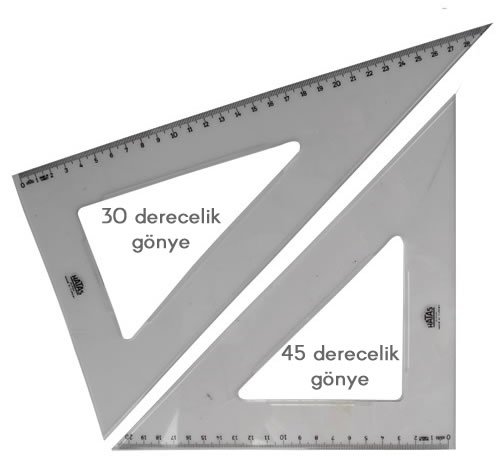
technical drawing set squares

Protractor

What is a protractor? Used to measure angles between 0°-180° and 0°-360°. The ones used in technical drawing are made of clear plastic. Wooden ones are used in math and geometry classes.

What’s another name for a protractor? Small ones are also called an “iletki.”

How Do You Use a Protractor?

The protractor’s center is placed on the vertex of the angle to be measured, and the measured angle is marked off along the graduations.

how to use a protractor

Using a protractor. Measuring angles smaller than 90 degrees

how to measure an angle with a protractor

Using a protractor. Measuring angles larger than 90 degrees.

French Curve

A tool used to draw irregular curved arcs (oval, ellipse, parabola, hyperbola, cycloid, etc.) that can’t be drawn with a compass and ruler.

french curve template

Templates

Tools and equipment used in technical drawing are designed for a variety of purposes. There are circle templates for drawing small, routine circles. They’re made from clear or translucent plastic. Circle templates usually have circle sizes ranging from 1 mm up to 36 mm in diameter. They’re available in different sizes and types.

Architectural drawing template

Lettering templates, on the other hand, are templates used with technical pens to write standardized lettering on the title blocks of machine manufacturing drawings, designed to minimize errors in standard lettering.


circle template

Compasses

Used to draw circles and arcs. It’s an essential drawing tool that everyone doing technical drawing should have on hand. The compass’s hinge needs to be firm and rigid, not loose, and shouldn’t loosen easily. A compass with a loose hinge will draw a doubled circle during drawing, so it’s important to be careful when choosing a compass and to use a good-quality one.

parts of a compass set

Technical Drawing Tools and Equipment

Pencils

What does HB mean on pencils? What does B or 2B mean on pencils?

Pencils used in technical drawing come in H and B series.

The H series are hard pencils, and the B series are soft pencils. The higher the series number, the harder or softer they are. HB and F pencils are medium hardness.

HB and F pencils are generally used for technical drawing. If a slightly softer line is wanted, a B pencil is used.

pencil hardness grades
Tools and equipment used in technical drawing / technical drawing pencil hardness symbols

For drawings on tracing paper, H and 2H pencils are recommended. Softer pencils are generally used for freehand drawing, shading work, and areas where erasing shouldn’t leave a mark.

technical drawing pen

There are also ink drawing pens, commonly known as technical drawing pens. They use India ink. India ink is used because it flows less freely than regular ink.

They’re used to draw continuous lines of consistent darkness and thickness on tracing paper, drawing film, and various other papers.

Technical Drawing Papers

Types of drawing paper:
1. Plain white drawing paper
2. Sketch paper
3. Tracing paper
4. Blueprint paper
5. Waxed paper
6. Vinyl-coated paper
7. Graph paper
8. Drawing film (acetate)

Teknik resim kağıt çeşitleri

Related Post Teknik resim kağıt çeşitleri

Teknik resim kağıt çeşitleri hakkında bilgi.Teknik çizim kağıt çeşitleri.Aydınger kağıt,ozalit kağıdı,eskiz kağıtları,milimetrik kağıt

Read Article →

Related Posts

Fit Tolerance Simulator Fit Tolerance Simulator Teknik resim kağıt çeşitleri Types of Technical Drawing Paper Specifying the Manufacturing Method by Surface Roughness Specifying the Manufacturing Method by Surface Roughness Geometric Drawings 4 - Tangent Arc Connections Geometric Drawings 4 – Tangent Arc Connections What Is Projection? Projection Methods What Is Projection? Projection Methods Ölçü Toleranslarının Teknik Resimde Gösterilmesi Showing Dimensional Tolerances in Technical Drawing International Projection Standards ISO-E and ISO-A International Projection Standards ISO-E and ISO-A Geometric Dimensioning and Tolerancing Geometric Dimensioning and Tolerancing
Introduction to Technical Drawing
Share. Facebook Twitter WhatsApp Tumblr Email Telegram Copy Link

Leave A Reply Cancel Reply

Car Cranks But Won’t Start: What Could Be the Cause?
Coilover (Coil Spring Shock Absorber) Advantages and Disadvantages
  • Contact
  • Terms of Service
  • Privacy & Cookie Policy

Type above and press Enter to search. Press Esc to cancel.