
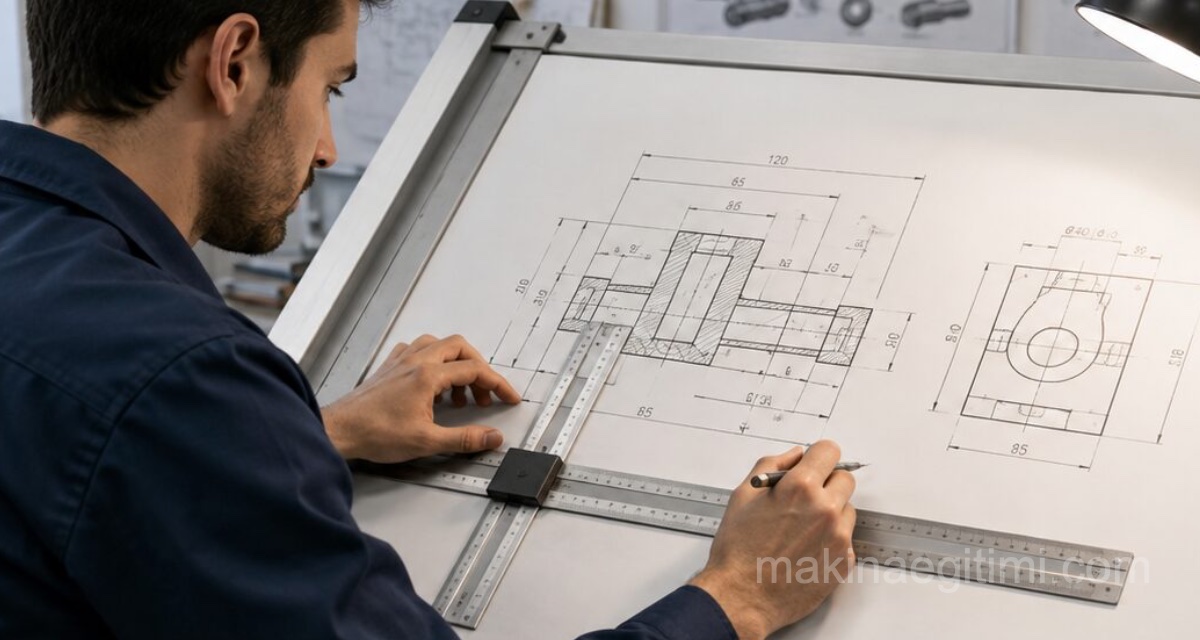
In this article, we’ve covered the use of the T-square, one of the basic drafting tools used in technical drawing classes. Check out the images and animation below to see how a T-square is used.
What Does a T-Square Do?
Beyond just being a ruler, a T-square is a functional aid used for drawing horizontal and vertical lines together with a single or double set square, and for drawing parallel lines at a 45° angle (hatching lines), again using a set square.
Besides enabling effective use of set squares, the T-square is also an important technical drawing tool for securing the drawing paper to the table.
How Is a T-Square Used?

Just as a T-square is used for drawing horizontal lines, it’s also used, with the help of a set square placed on top of it, for drawing vertical lines.

In technical drawings, we can draw parallel hatching lines using a set square along with a T-square.
The animation above shows the T-square being used together with set squares.
The T-square is one of the indispensable tools used in engineering and mechanical drafting. There are also adjustable types that allow any angle to be set as desired. However, in this article, we’ve covered the T-square in its commonly known form and its use. Until we meet again in new articles.
Related Posts
 What Is Tolerance? Tolerances Lesson 1
 Types of Sectioning in Technical Drawing? Sectioning Methods
 Auxiliary Views in Technical Drawing
 Geometric Drawings 2 – Dividing Circles
 Geometric Drawings 3 – Drawing Polygons
 Technical Drawing View Extraction Examples 1
 What Is Perspective. Types of Perspective and Exercises
 Specifying the Manufacturing Method by Surface Roughness