
Close Menu
  • MAKİNELER ve İMALAT
    • Tools & Equipment
    • Computer-Aided Drawing
    • CAD/CAM Education
    • CNC Machine Programming
    • Casting Technologies
    • Electrical & Electronics Technologies
    • Hydraulics & Pneumatics
    • Manufacturing Processes
    • Manufacturing Technologies
    • Occupational Safety
    • Mold & Die Design
    • Solid Modeling
    • Welding Technology
    • Machine Elements
    • Mechanical Trade Drawing
    • Materials Science
    • Automotive & Vehicle Technologies
    • Robotics Technologies
    • Health Technologies
    • Defense & Aerospace Technologies
    • Descriptive Geometry
    • Technical Drawing
    • Software & Hardware Technologies
    • Innovative Manufacturing Methods
  • TEKNOLOJİ ve YAŞAM
    • OTOMOBİLLER ve TAŞIT
      • Vehicle & Engine Knowledge
      • Safe Driving
      • Sürüş Destek Sistemleri
    • Genel Kültür
      • Movies & TV Shows
      • Görsel ve Grafik Sanat
      • Books & Literature
      • Music
      • Sports
      • History
      • History of Technology
    • GÜNDELİK YAŞAM TEKNOLOJİLERİ
    • Hobbies & Entertainment
    • Internet Technologies
    • Health
    • Mobile Technologies
Makine Eğitimi
  • Machines & Manufacturing
    Machine Elements
    Hydraulics & Pneumatics
    Technical Drawing
    Computer-Aided Design & Manufacturing
    Basic Manufacturing Processes
    Manufacturing Processes
    Industry Technologies
    Other Technical Courses
    Motion & Power Transmission
    Simple Machines
    Chains & Sprockets
    Shafts & Journals
    Gears
    Cams
    Couplings
    Belts & Pulleys
    Springs
    Bearings
    Keys
    Fastening Joining
    Retaining Rings
    Screws, Bolts & Nuts
    Cotter Pins
    Flanges
    Welding
    Rivets
    Pins & Bolts
    Washers
    Calculators
    Gear Ratio Calculator
    Spring Constant Calculator
    Belt Pulley Ratio Calculator
    Other Machine Elements
    Slides & Linear Guides
    Brakes
    Flywheels
    Clamps
    Shock Absorbers
    Gaskets & O-Rings
    Seals & Sealing Elements
    Hydraulics
    Introduction to Hydraulics & Principles
    Hydraulic Systems & Applications
    Accumulators
    Filters
    Motors
    Pumps
    Valves
    Pneumatics
    Introduction to Pneumatics & Principles
    Pneumatic Systems & Applications
    Pneumatic Circuit Components
    Valves
    Cylinders
    Silencers
    Motors
    Compressors
    Dryers
    Conditioning Units
    Common Topics & Maintenance
    Hydraulic & Pneumatic Maintenance
    Study Notes, Exams & Tests
    Technical Drawing
    Introduction to Technical Drawing
    Geometric Drawings
    Perspective & Projection
    Orthographic Views
    Dimensioning
    Sectioning
    Assembly & Detail Drawings
    Tolerances
    Surface Finish Symbols
    Mechanical Engineering Drawing
    Screws, Bolts & Nuts
    Pulley Drawings
    Gear Drawings
    Shafts & Journals
    Bearing Drawings
    Pins & Bolts
    Spring Drawings
    Welds in Technical Drawing
    Washers
    Cotter Pins
    Technical Drawing Exercises
    Mechanical Drawing Exercises
    Gear Exercises
    View Extraction Exercises
    Pulley Exercises
    Pin & Bolt Exercises
    Threaded Fastening Exercises
    Descriptive Geometry
    Computer-Aided Drawing
    AutoCAD Drawing Lessons
    Solid Modeling & Animation
    Solid Model Drawing Files
    Solid Model Assembly Examples
    Solid Model Drawing Lessons
    3D CAD Software Reviews
    Solid Modeling Exercises
    CNC Programming
    CAM
    Measurement & Inspection
    Dial Indicators
    Calipers
    Gauges
    Micrometers
    Materials Science
    Steels
    Cast Iron
    Aluminum
    Plastics
    Material Testing & Hardness Measurement
    Occupational Safety
    Workshop Safety
    Safety When Working With Electricity
    Machine Safety Rules
    Hand Operations
    Filing
    Marking
    Cutting Operations
    Reaming
    Tapping
    Threading With a Die
    Drill Bit Sharpening
    Working With Machines
    Basic Turning Operations
    Basic Milling Operations
    Shaper Machine
    Machining
    Turning
    Milling
    Grinding
    Innovative Manufacturing Methods
    EDM (Electrical Discharge Machining)
    Laser Machining
    Waterjet Machining
    3D Printing
    3D Scanners
    Welding
    Rolling
    Casting
    Mold & Die Design
    Mechanical & Hydraulic Presses
    Blanking & Piercing Dies
    Bending Dies
    Drawing Dies
    Plastic Injection Molds
    Extrusion Dies
    Compound Dies
    Progressive Dies
    Blow Molds
    Spinning Dies
    Spray Molds
    Manufacturing of Machine Parts
    Automotive & Vehicle Technologies
    Motor Vehicle Manufacturing
    Raw Material Production
    History of Technology
    Health & Medical Technologies
    Defense & Aerospace
    Robotics Technologies
    Software & Hardware Technologies
    Mechanics - Strength of Materials
    Physics Topics
  • Technology & Life
    Hobbies & Entertainment
    Sports
    Music
    Vehicle & Engine Knowledge
    Vehicle Maintenance & Repair
    Safe Driving
    Driver Assistance Systems
    History
    Movies & TV Shows
    Books & Literature
    Computers & Internet
    Computer Tips
    Software Reviews
    Hardware & Peripherals
    Practical & Safe Internet Use
    Visual & Graphic Art
    Mobile Technologies
    Travel
    Science
    Health
    First Aid Knowledge
    Everyday Technologies
Makine Eğitimi
Home»Technical Drawing»How to Draw an Ellipse? Ellipse Construction.
29 August 2026

How to Draw an Ellipse? Ellipse Construction.

Elips Nasıl Çizilir? Elips Çizimi.

What Is an Ellipse?

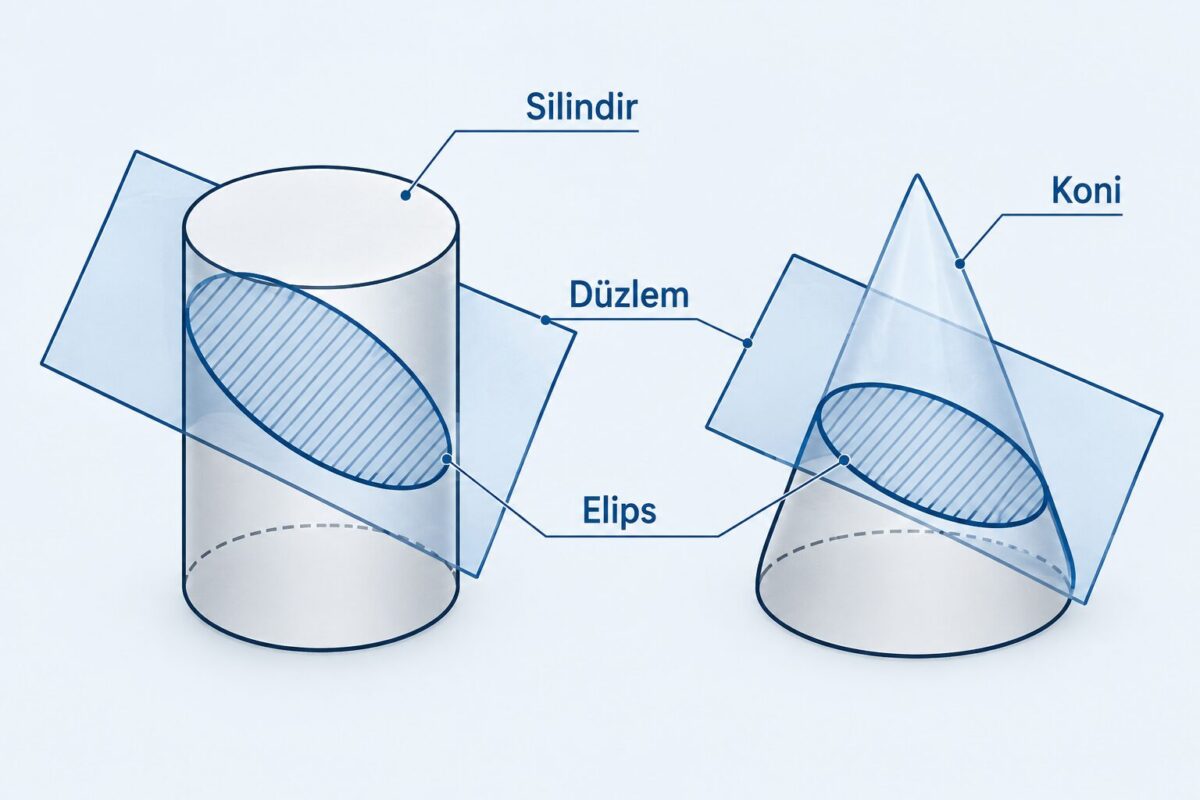
When a cylinder or cone is cut by a plane inclined to its base, the outline of the resulting cross-section is an ellipse. The outline of the cross-section formed when a cylinder or cone is cut by a plane inclined to its base is called an ellipse.
  • What Is an Ellipse?
  • How Is an Ellipse Drawn?
    • How to Draw an Ellipse with String? (Gardener’s Ellipse)
    • How to Draw an Ellipse Given Its Axes?
    • Drawing an Ellipse with the Rectangle Method
    • Drawing an Ellipse Inside a Parallelogram
    • Drawing an Ellipse Using Focal Points  (Major and Minor Diameters Known)
      • Finding the Curvature Circles at the Vertices of an Ellipse Given Its Axes
      • Finding the Axes of a Given Ellipse
formation of an ellipse

An ellipse is a closed curve and cannot be drawn with a compass. An ellipse drawn with a compass is only an approximate ellipse.

How Is an Ellipse Drawn?

Even though drawing an ellipse in technical drawing today can be done with a single click using software like AutoCAD, traditional ellipse-drawing methods can still be needed. In case you don’t have a computer/software on hand that can do this job, we’ve prepared this topic for those wondering how to draw an ellipse.

How to Draw an Ellipse with String? (Gardener’s Ellipse)

Drawing an ellipse with string is also one of the ellipse-drawing methods.
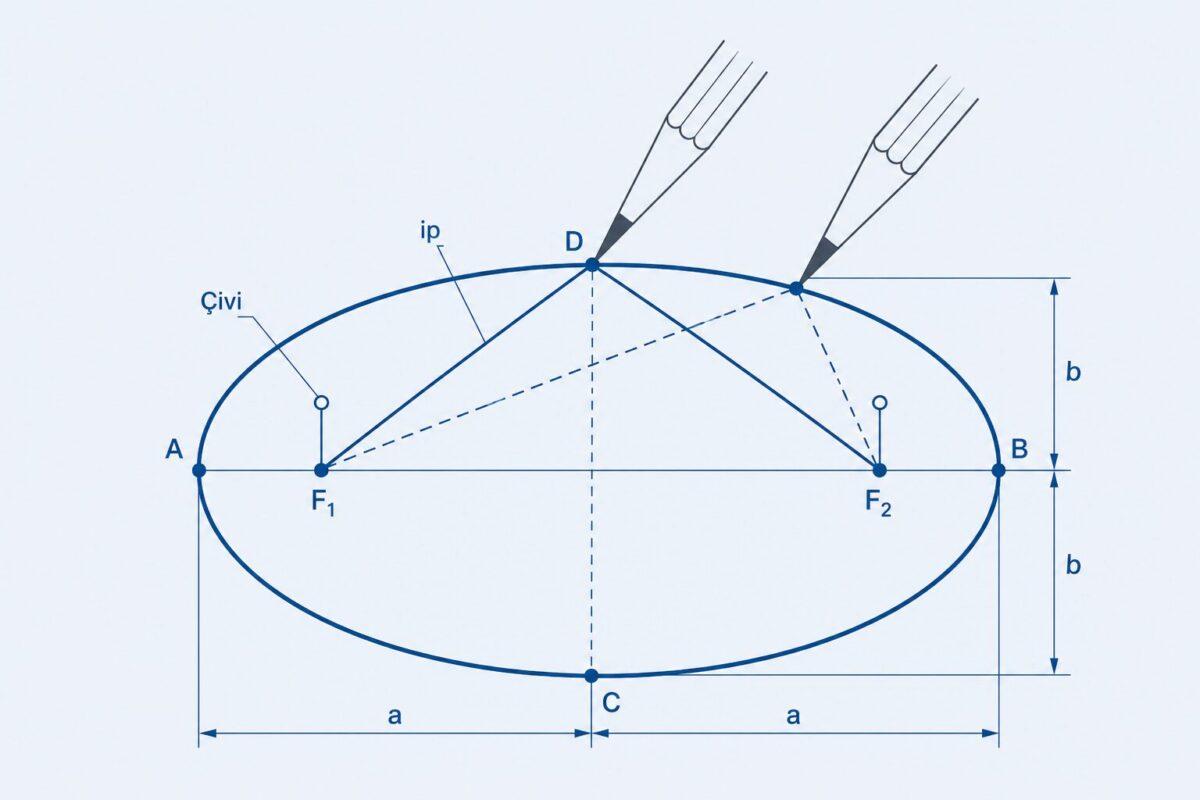
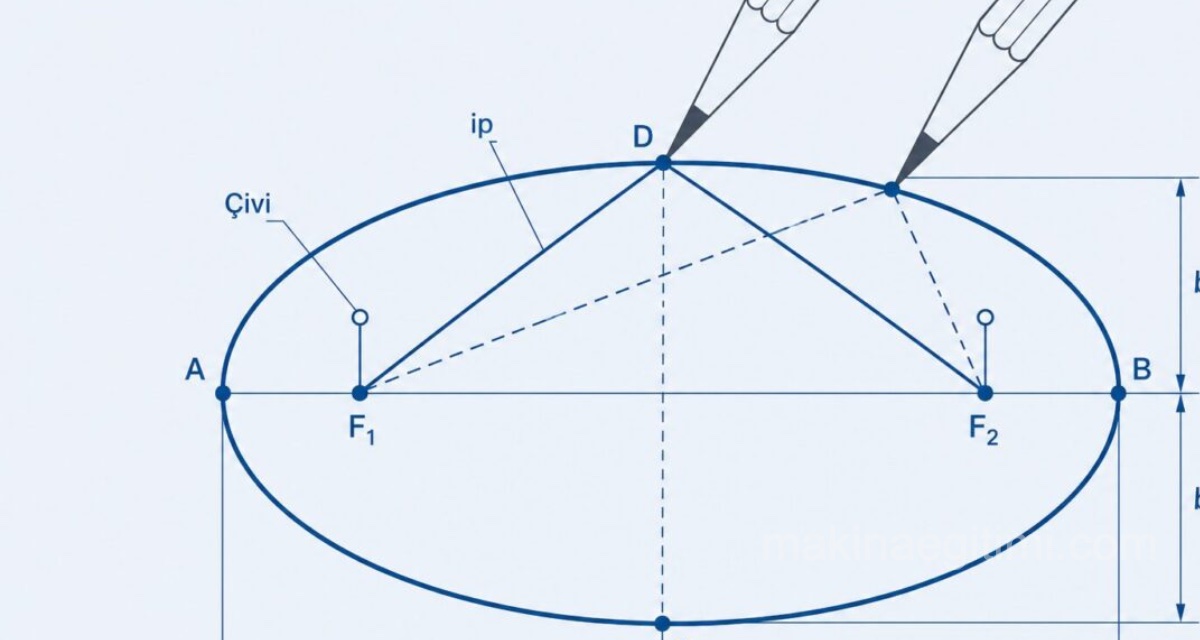
ellipse drawing-1

Given that 2a, 2b, and the focal points F1, F2 are known; mark the horizontal and vertical axes. Mark F1, F2 on the horizontal axis.

Tie a nail to the end of a string of length 2a. Drive the nails into the focal points F1, F2.
Keeping the string taut with a pencil, trace around the perimeter. This drawn curve forms the “gardener’s ellipse” used to lay out pools in gardens.

How to Draw an Ellipse Given Its Axes?

Circles are drawn centered at O with diameters equal to the ellipse’s axes. Any line passing through O is drawn, and its intersection points with these circles, P and P’, are found.

The intersection point M of the lines drawn from these points parallel to the ellipse’s axes is a point on the ellipse. By finding enough points this way and joining them appropriately, the ellipse is drawn.

how to draw an ellipse

Drawing an Ellipse with the Rectangle Method

drawing an ellipse with the rectangle method

A rectangle is drawn formed by lines passing through the ends of the ellipse’s axes. The short sides of the rectangle and the ellipse’s major axis are each divided into the desired number of equal parts and numbered as shown in the figure. These points are connected to the ends of the ellipse’s minor axis. The intersection point of the lines drawn from points with the same number is a point on the ellipse. The ellipse is drawn by finding enough points this way.

Drawing an Ellipse Inside a Parallelogram

A semicircle is drawn with one side of the parallelogram as its diameter. This circle’s radius DE and the ellipse’s half-axes MD and MC are each divided into the desired number of equal parts and numbered as shown in the figure. The intersection points 1′, 2’… of lines drawn from the points on DE, parallel to the parallelogram’s side, with the circle are found. From these points, the intersection points 1″, 2″… of lines drawn parallel to DE with the ellipse’s axis are determined.

The intersection points of the lines drawn parallel to CD from points 1″, 2″… with the lines drawn parallel to AB from the same-numbered points on CD are points on the ellipse

drawing an ellipse inside a parallelogram

The ellipse drawing is completed by finding enough points.

Drawing an Ellipse Using Focal Points  (Major and Minor Diameters Known)

– Draw the horizontal and vertical axes. Mark points A, B, and C, D.
– Open the compass to AB/2 and, centered at D, draw an arc to find the focal points F1, F2.
Mark a few points (such as 1 and 2) between F1 and M.
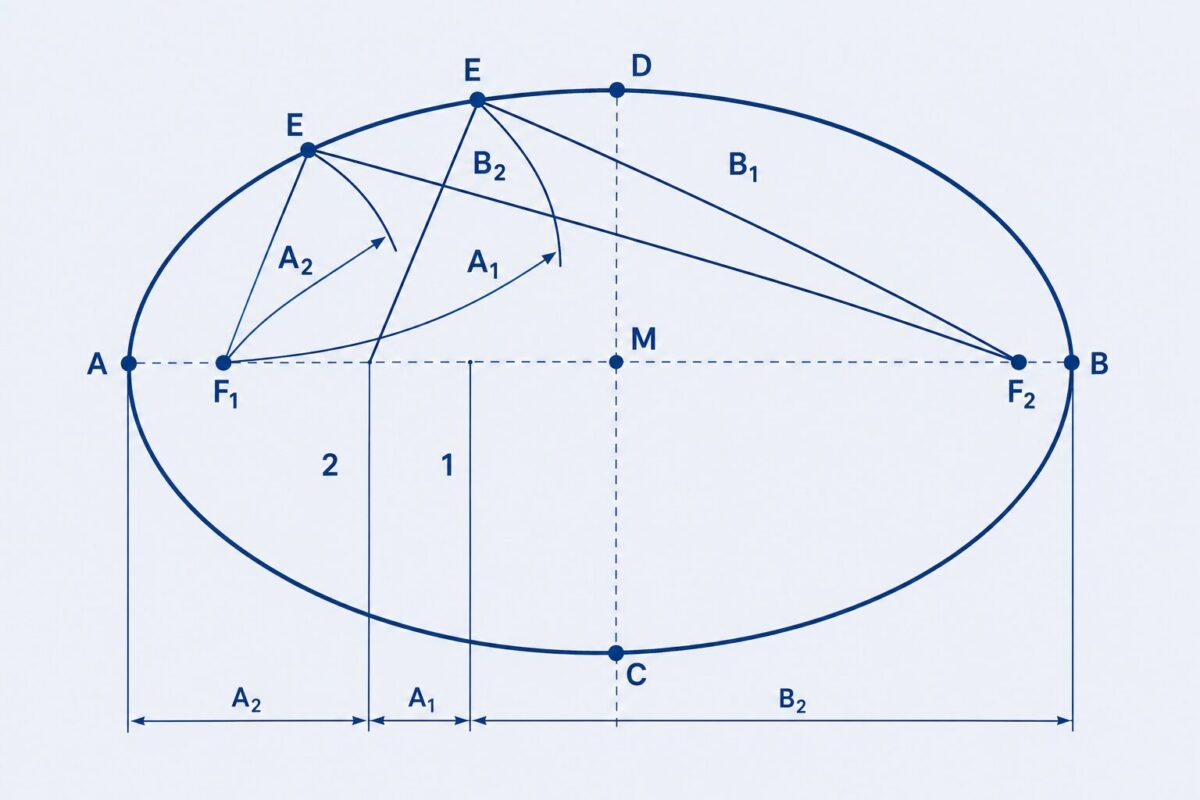
drawing an ellipse using focal points

Center the compass at A, open it to point 1, then center it at F1 and draw an arc.
Center the compass at B, open it to point 2, then center it at F2 and draw an arc, intersecting it with the previously drawn arc. This gives point E.
Continue the same process for point 1 as before. This completes 1/4 of the ellipse.

Finding the Curvature Circles at the Vertices of an Ellipse Given Its Axes

Lines parallel to the axes are drawn from the ellipse’s vertices to find point E. A perpendicular is dropped from this point to line BC, and the intersection points O1 and O2 with the ellipse’s axes are determined.

O1 and O2 are the centers of the curvature circles, and O1B and O2C are their radii. When drawing an ellipse by any method, it’s useful to make use of curvature circles at the ellipse’s vertices.

how to draw an ellipse

Finding the Axes of a Given Ellipse

Finding the axes of an ellipse whose center is known.

Any circle centered at M is drawn. The intersection points of this circle with the ellipse are the corners of a rectangle. The lines joining the midpoints of the opposite sides of this rectangle are the ellipse’s axes.

finding the axes of an ellipse

In this article, we covered how to draw an ellipse. We explained ellipse-drawing methods with illustrations. We gave information about ways to draw an ellipse. We hope it’s useful.

Related Posts

Technical Drawing Paper Types Technical Drawing Paper Sizes and Folding Tolerance Terms and Their Meanings in Mechanical Engineering Tolerance Terms and Their Meanings in Mechanical Engineering Geometric Drawings 1 - Dividing Lines and Erecting Perpendiculars Geometric Drawings 1 – Dividing Lines and Erecting Perpendiculars Teknik Resimde Yüzey Pürüzlülüğü Surface Roughness in Technical Drawing Introduction to Surface Finish Symbols Introduction to Surface Finish Symbols Hatching Lines in Technical Drawing Hatching Lines in Technical Drawing Showing Specially Treated Surfaces in a Drawing Showing Specially Treated Surfaces in a Drawing What Is Perspective. Types of Perspective and Exercises What Is Perspective. Types of Perspective and Exercises
Geometric Drawings
Share. Facebook Twitter WhatsApp Tumblr Email Telegram Copy Link

Leave A Reply Cancel Reply

Genghis Khan: From an Abandoned Child to History’s Greatest Emperor
The Biggest and Craziest Engines of All Time
  • Contact
  • Terms of Service
  • Privacy & Cookie Policy

Type above and press Enter to search. Press Esc to cancel.