Filing
In this article, we’ll cover how filing is done and filing techniques, a topic frequently used by Machine Department students in their Basic Manufacturing Processes lessons.
Even though it may seem like, or be thought of as, a simple hand operation, if filing is done without using certain techniques, it can lead to faulty workpieces, wasted time and effort, and even, worst of all, workplace accidents with injuries.
We covered the definition of a file, types of files, and file tooth angles in our previous article. Click here for our previous article → Definition of a File and Types of Files
How Is Filing Done?
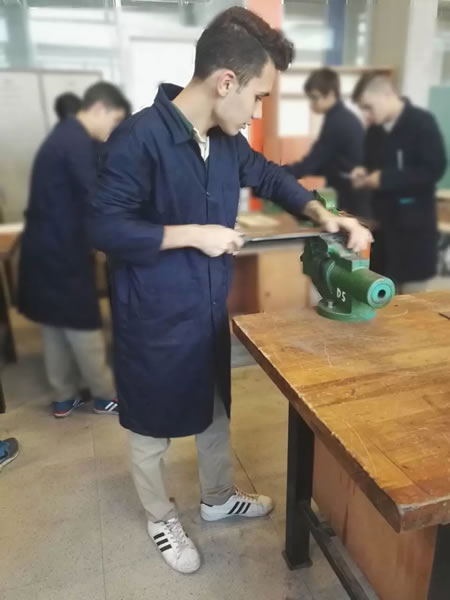
Filing Working Position
The body position during work should be as shown in the image alongside.
For a balanced stance while working, foot position should be as shown in the image alongside.
Grip Method for a Large Flat File


Grip Method for Medium and Small Files

Grip method with a medium file

Grip method with a small file
How to File to Square and to Size
There are specific filing techniques for filing a part square and to size. If a surface deviates from flatness as shown in the figure, flatness can be achieved by identifying and filing down the high spots. However, achieving surface flatness depends on skill, time, and being careful. It’s especially important that the filing is done parallel to the part and that this parallelism isn’t disturbed.

Checking surface flatness with a square
Most students, worried about finishing the job quickly, try to file with rapid strokes. However, in doing so, they unknowingly disturb the file’s parallelism to the plane. After a while, while the center point and periphery of the workpiece surface stay high, hollowing begins toward the edges. To avoid making this mistake, it’s important to be patient and not rush the filing job, file without disturbing your standing position, and check the surface with a fitter’s square at regular intervals.
Cross Filing Technique
Cross filing achieves a flatter, smoother result by working the surface from different angles.
Importance of File Cleaning
Chips that accumulate in the file’s teeth reduce cutting efficiency if not regularly cleaned with a wire brush.
Correct Stance and Force
Effective filing requires applying pressure on the forward stroke and reducing it on the return stroke.
Filing Techniques
The main technological rules that must be followed for correct filing are as follows.
Filing Techniques for Flat Surfaces

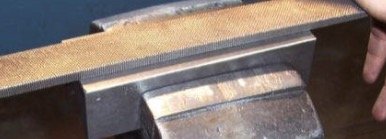
The basic rule for filing flat surfaces is drawing the file at a 45° angle across the surface. In particular, on wide square or rectangular surfaces, cross filing is done from corner to corner.
If we keep the stroke length long, filing to a square becomes more difficult. So beginners are advised to keep their stroke length as short as possible.
The long-stroke filing technique should be as given below.
Filing Curved and Round Surfaces
When working curved surfaces, curved motions are also given to the file. (above)
Filing Techniques for Internal and External Surfaces:
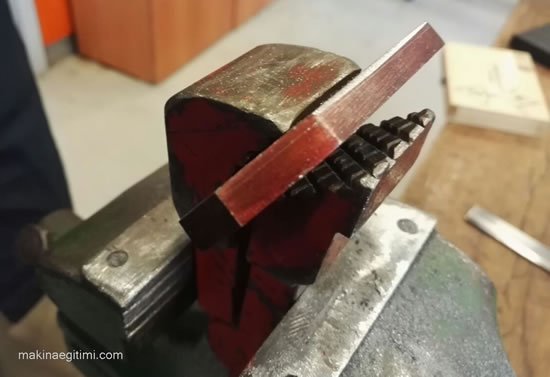
For filing internal and external surfaces, a file suitable for the profile is selected and drawn across the surface according to filing rules and the position of the part being filed. While filing, the same rules described for flat-surface filing should be followed

Filing Technique for Holes and Grooves
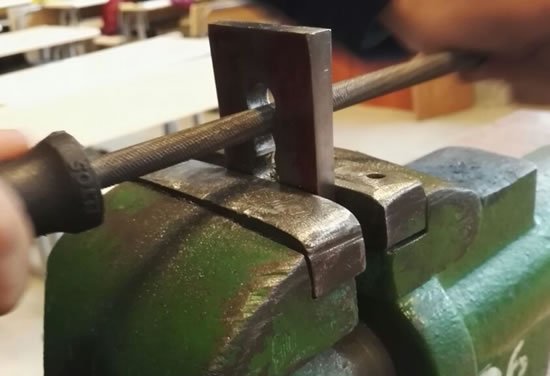
For filing holes and grooves, a file suitable for the profile is selected and drawn across the surface according to filing rules and the position of the part being filed.
Order of Operations in Filing

When filing prismatic surfaces:
a) Always start the filing job from a reference surface. If this surface isn’t ready, it must be prepared.
b) Using the reference surface as a basis, surfaces 1-2-3 that share a common boundary with each other should be machined in sequence.
The operation order for a prismatic part should be as follows:
Surface 1: Finish flat: The reference surface.
Surface 2: Finish flat, at 90° to surface 1.
Surface 3: Finish flat, at 90° to surfaces 1-2.
Surface 4: Finish flat, at 90° to surfaces 1 and 3; and, relative to surface 2, finish parallel and to size.
Surface 5: Finish flat, at 90° to surfaces 1 and 2; and, relative to surface 3, finish parallel and to size.
Surface 6: Finish flat, parallel and to size relative to surface 1, and at 90° to surfaces 2, 3, 4, and 5.
The Importance of File Maintenance in Filing Work:
File maintenance is important.
If we don’t follow the rules below, our work will become more difficult.
Files with clogged teeth are cleaned. Otherwise, the file will scratch or skate across the surface.

Cleaning file teeth with a wire brush
For quick cleaning, a brush is used in the direction of the teeth’s upper edges.
A file card is used for jammed metal particles.
Solvents are used for non-metallic contamination. Files should not be dropped or struck.A file with damaged and worn teeth won’t cut cleanly.
Since files are made of hardened material, attempting to use a file as a screwdriver, chisel, etc. can cause it to break. This can lead to an accident with injuries.
Precautions Against Possible Workplace Accidents During Filing
Possible workplace accidents and precautions to take:
- The file’s handle must be correctly and securely fitted. Broken, cracked, or repaired handles should never be used.
- The file shouldn’t be left on the workpiece.
- The file should be used correctly and with balanced motion.
- The resulting chips and dust shouldn’t be blown away.
- Attention shouldn’t be distracted while using a file
The filing techniques we’ve discussed here are techniques all experienced fitters agree on. Although filing isn’t the most important part of fitting, and isn’t fitters’ constant occupation, it’s accepted as the foundation of fitting. This may be because it’s primarily effective in developing work discipline and patience, is the stage where measuring and checking tools are used for the first time, and is the starting point for the concept of machining.
Related Questions
A balanced stance allows a steady, consistent force to be applied throughout the file’s motion. Incorrect posture can cause both uneven filing and the user tiring and losing control over time.
High spots on the surface are first identified visually or by touch. These high areas are targeted and filed down, gradually bringing the entire surface to the same level and achieving flatness.
Related Posts