
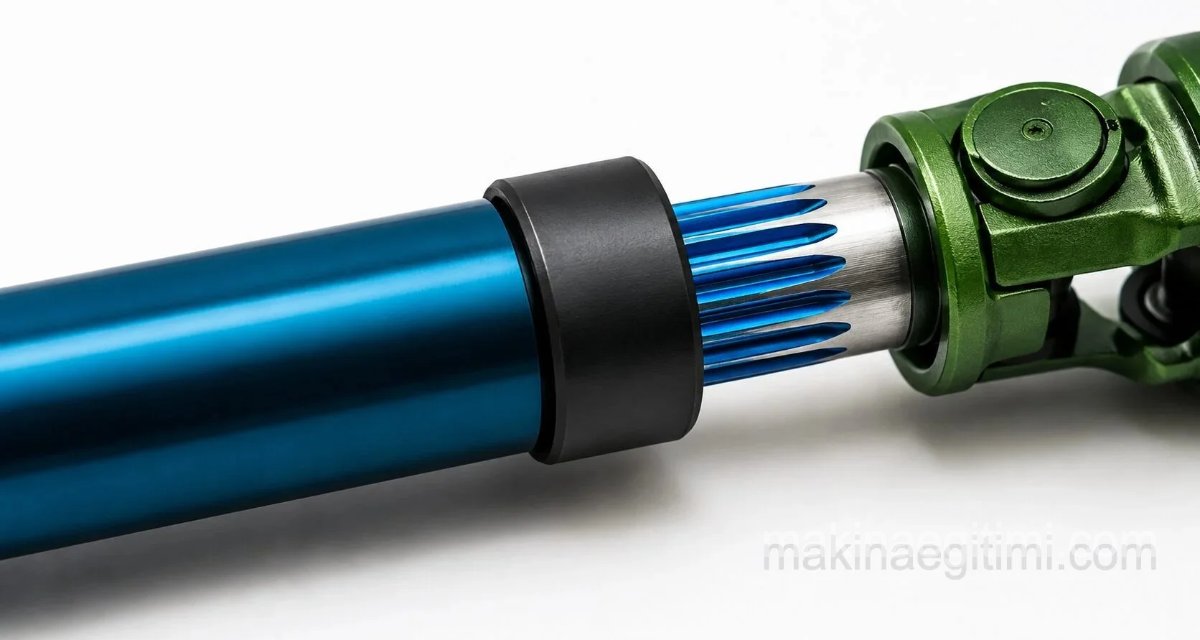
How Is a Splined Shaft Made?
Splined shafts are cut using either the hobbing method or with the help of a dividing head setup. A slitting saw or spline milling cutter is mounted on the dividing head setup. The number of splines on a splined shaft is determined based on the shaft diameter.

Either the hobbing method or a dividing head setup can be used to make splined shafts.
Splined shafts are grouped in the Turkish Standards as light, medium, and straight-sided types.
Light types are TS 147/15
Medium types are TS 147/16
4-spline shafts are specified as TS 147/18
6-spline shafts are specified as TS 147/19

A view of splined-shaft production. Here, a milling machine and dividing head were used for manufacturing.
Video of Making a Splined Shaft
In the video, spline grooves are cut into the shaft by mounting a module milling cutter on the milling machine’s vertical head and using a circular dividing device.

The ends of the grooves on splined shafts are produced chamfered.
To prevent stress concentrations, the ends of the grooves on the splined shaft are made chamfered (instead of an abrupt vertical end)
What Materials Are Used in Making Splined Shafts?
Because of their operating conditions, it’s important to pay attention to material selection when manufacturing splined shafts. The question of how a splined shaft is made also raises the question of what material it’s made from. Splined shafts are generally manufactured from metallic materials due to the local stresses seen between the shaft’s splines or teeth. The materials below are the most common.
Alloy steels are ferrous alloys based on alloying elements such as iron, carbon, and chromium, molybdenum, vanadium, and nickel. Alloy steels include hardenable high-alloy steels, high-strength low-alloy steels, and other special steel alloys.

Supporting the splined shaft between centers
Aluminum alloys offer good corrosion resistance and, with a density lower than steel’s, provide high toughness at medium strength levels.
Carbon steel is a commercial iron that contains any amount of carbon up to 1.7%, as a significant alloying element. Under the right conditions it is machinable, and it is distinguished from cast iron by its moderation and lower carbon content.
Stainless steels are corrosion-resistant iron alloys that contain additions of chromium and/or nickel.
Depending on the application, splined shaft material is manufactured from steels such as 1040-1050-4140-4340-8620 and stainless materials such as 303-304-316-431. Splined shafts are generally heat-treated to a hardness of 32-37 HRC.

Making a splined shaft using the hobbing method
A view of splined-shaft production. Spline grooves are being cut using a hob cutter and a milling dividing device. (Above)
A video explaining how to make a splined shaft using a dividing device and how to harden the splined shaft
Related Posts
 Plastic Injection Molding
 What Is Electrical Discharge Machining (EDM). Machining with EDM
 What Is Submerged Arc Welding, How Is It Done
 Mercedes-Benz S-Class W222 Manufacturing Stages
 How Are Piston Rings Made? How Are Piston Rings Manufactured?
 What Is an Automatic Lathe, How Does It Work?
 What Is Reaming? How Is It Done?
 How Is a Crankshaft Made