

The topic of this article in our vehicle maintenance and repair section will be the timing belt. We will look for answers to commonly asked questions such as what a timing belt is, what it does, and how it works. We will also cover topics such as when a timing belt should be replaced and how long it lasts. First, let’s explain what a timing belt is.
What Is a Timing Belt?
In engines, the belt that transmits motion from the crankshaft to the camshaft and provides timing synchronization between the crankshaft and camshaft is called the timing belt. It is generally manufactured from high-quality rubber together with nylon-reinforced cords to extend the belt’s service life. Depending on the engine design, in many cases the water pump also gets its motion from the timing belt.

Where is the timing belt located on the vehicle?
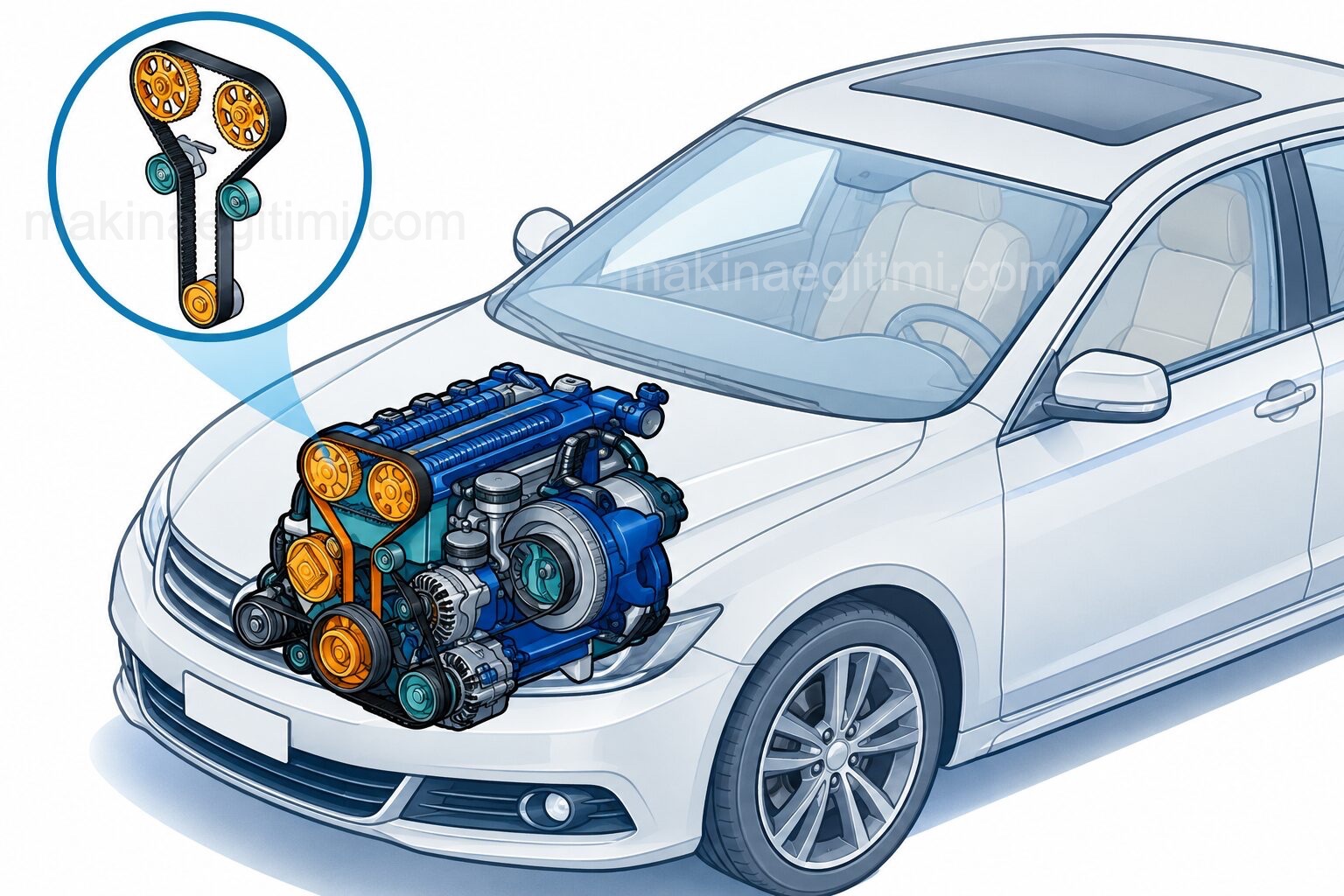
So where is the timing belt located on the vehicle? It is in the engine section of the vehicle. It should also be noted that in some vehicles, transmission is provided by a chain instead of a belt.
It is usually located behind a cover that protects the gear system it works with. (Video above)

If you’re wondering whether you can replace the timing belt yourself, the answer is yes. The timing belt is actually located somewhere that isn’t too difficult to reach, and with a bit of knowledge you can check, and even replace, the timing belt on your vehicle yourself.
Crankshaft-Camshaft Synchronization
The timing belt synchronizes the rotation of the crankshaft and camshaft, preventing the valves and pistons from colliding.
Rubber-Kevlar Construction
Modern timing belts contain Kevlar or fiberglass cords embedded in the rubber construction for durability.
Replacement Interval
Timing belts, though this varies by manufacturer, should generally be replaced every 90,000-120,000 km.
What does the timing belt do?
In engines, the circular motion produced at the crankshaft needs to be transmitted to the camshaft. A properly functioning engine requires precise timing between the rotation of the camshaft and the crankshaft. However, because the distance between the two is long and they operate on parallel axes, this transmission is carried out by means of a belt. Since the distance between the crankshaft and camshaft axes is long, motion must be transmitted with a belt.
So, is the answer to the question what does the timing belt do? simply that it transmits motion between two shafts? No. The job of the timing belt isn’t merely a simple matter of transmitting motion. It synchronizes the engine’s camshaft and crankshaft and ensures each cylinder fires at the correct time. This is why the timing belt is so important.
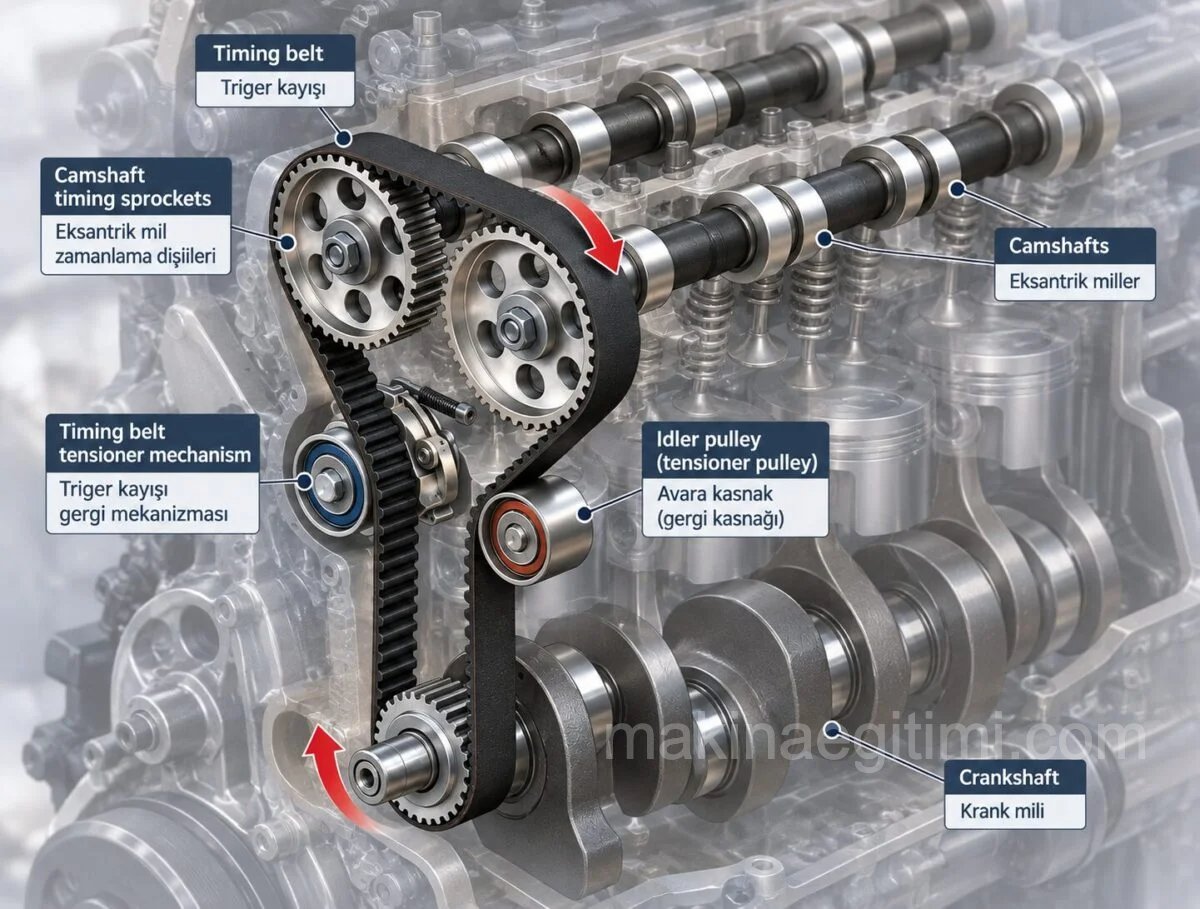
If you think the timing belt is just a simple piece of rubber, you have no idea how important the timing belt really is. The synchronized operation of many engine parts is thanks to this belt. This is also why it’s called the timing belt in English.
Depending on your vehicle’s engine type, there may not be two camshafts as shown in the picture above. Some engines have only 1.

The timing belt’s job isn’t limited to transmitting motion between just two shafts. Depending on the engine design, in most cases it also transmits motion to the water pump, and even to the injection pump. (picture at the side)
The distinguishing features of the timing belt are its high durability and quiet operation during motion transmission. To prevent slack from forming while the timing belt operates, it is kept taut by a belt tensioning system. (picture at the side)
How does the timing belt work? The timing belt’s operating principle
The timing belt connects to the engine’s crankshaft and camshaft by means of a series of pulleys. The crankshaft converts the vertical motion it receives from the pistons in the engine’s combustion chamber into circular motion. The camshaft, in turn, operates the cylinder head valves and rocker arm assembly, which send fuel into the combustion chamber and expel the burned gases out through the exhaust manifold.
For a detailed article about the camshaft, SEE: What is a camshaft. What does it do. The camshaft’s role and operation
3D animation of the timing belt in operation (above)

The timing belt’s operating principle is based on transmitting motion between shafts rotating at high speed, while also providing synchronization between the engine’s camshaft and crankshaft. Because it carries out such a vital role, it must be kept at a specific tension. Tensioner pulleys and tensioner springs are used to establish and maintain this tension. (picture above)
In this article, we tried to answer questions such as what a timing belt is, what it does, and how it works. We provided an illustrated and animated explanation of the timing belt’s operating principle. Until we meet again in a new article.
Related Questions
In some engine designs, the water pump gets its motion directly from the timing belt. When there’s a problem with the belt, the water pump driven by it may not turn at the expected speed, or may not turn at all, which affects the cooling system.
The belt operates continuously under tension, and rubber alone cannot withstand this tension for long. Nylon cords give the belt extra tensile strength, extending its service life and preventing sudden failure.
Related Posts
 Types of Gears
  How Does a Vehicle’s Charging System Work? Components, Jobs, and Failures
  Engine Noises and What They Mean
  What Is a Drum Brake System, How Does It Work
  What Is ESP in Vehicles? What Does It Do? How Does It Work?
  What Is a Catalytic Converter, What Is It For?
  What Is a Clutch? How Does It Work? Failures and What Drivers Should Know
  If the Engine Won’t Start, the Reason. Reasons the Engine Won’t Start