Close Menu
  • MAKİNELER ve İMALAT
    • Tools & Equipment
    • Computer-Aided Drawing
    • CAD/CAM Education
    • CNC Machine Programming
    • Casting Technologies
    • Electrical & Electronics Technologies
    • Hydraulics & Pneumatics
    • Manufacturing Processes
    • Manufacturing Technologies
    • Occupational Safety
    • Mold & Die Design
    • Solid Modeling
    • Welding Technology
    • Machine Elements
    • Mechanical Trade Drawing
    • Materials Science
    • Automotive & Vehicle Technologies
    • Robotics Technologies
    • Health Technologies
    • Defense & Aerospace Technologies
    • Descriptive Geometry
    • Technical Drawing
    • Software & Hardware Technologies
    • Innovative Manufacturing Methods
  • TEKNOLOJİ ve YAŞAM
    • OTOMOBİLLER ve TAŞIT
      • Vehicle & Engine Knowledge
      • Safe Driving
      • Sürüş Destek Sistemleri
    • Genel Kültür
      • Movies & TV Shows
      • Görsel ve Grafik Sanat
      • Books & Literature
      • Music
      • Sports
      • History
      • History of Technology
    • GÜNDELİK YAŞAM TEKNOLOJİLERİ
    • Hobbies & Entertainment
    • Internet Technologies
    • Health
    • Mobile Technologies
Makine Eğitimi
  • Machines & Manufacturing
    Machine Elements
    Hydraulics & Pneumatics
    Technical Drawing
    Computer-Aided Design & Manufacturing
    Basic Manufacturing Processes
    Manufacturing Processes
    Industry Technologies
    Other Technical Courses
    Motion & Power Transmission
    Simple Machines
    Chains & Sprockets
    Shafts & Journals
    Gears
    Cams
    Couplings
    Belts & Pulleys
    Springs
    Bearings
    Keys
    Fastening Joining
    Retaining Rings
    Screws, Bolts & Nuts
    Cotter Pins
    Flanges
    Welding
    Rivets
    Pins & Bolts
    Washers
    Calculators
    Gear Ratio Calculator
    Spring Constant Calculator
    Belt Pulley Ratio Calculator
    Other Machine Elements
    Slides & Linear Guides
    Brakes
    Flywheels
    Clamps
    Shock Absorbers
    Gaskets & O-Rings
    Seals & Sealing Elements
    Hydraulics
    Introduction to Hydraulics & Principles
    Hydraulic Systems & Applications
    Accumulators
    Filters
    Motors
    Pumps
    Valves
    Pneumatics
    Introduction to Pneumatics & Principles
    Pneumatic Systems & Applications
    Pneumatic Circuit Components
    Valves
    Cylinders
    Silencers
    Motors
    Compressors
    Dryers
    Conditioning Units
    Common Topics & Maintenance
    Hydraulic & Pneumatic Maintenance
    Study Notes, Exams & Tests
    Technical Drawing
    Introduction to Technical Drawing
    Geometric Drawings
    Perspective & Projection
    Orthographic Views
    Dimensioning
    Sectioning
    Assembly & Detail Drawings
    Tolerances
    Surface Finish Symbols
    Mechanical Engineering Drawing
    Screws, Bolts & Nuts
    Pulley Drawings
    Gear Drawings
    Shafts & Journals
    Bearing Drawings
    Pins & Bolts
    Spring Drawings
    Welds in Technical Drawing
    Washers
    Cotter Pins
    Technical Drawing Exercises
    Mechanical Drawing Exercises
    Gear Exercises
    View Extraction Exercises
    Pulley Exercises
    Pin & Bolt Exercises
    Threaded Fastening Exercises
    Descriptive Geometry
    Computer-Aided Drawing
    AutoCAD Drawing Lessons
    Computer-Aided Drawing Exams
    Solid Modeling & Animation
    Solid Model Drawing Files
    Solid Model Assembly Examples
    Solid Model Drawing Lessons
    3D CAD Software Reviews
    Solid Modeling Exercises
    CNC Programming
    CAM
    Measurement & Inspection
    Dial Indicators
    Calipers
    Gauges
    Micrometers
    Materials Science
    Steels
    Cast Iron
    Aluminum
    Plastics
    Material Testing & Hardness Measurement
    Occupational Safety
    Workshop Safety
    Safety When Working With Electricity
    Machine Safety Rules
    Hand Operations
    Filing
    Marking
    Cutting Operations
    Reaming
    Tapping
    Threading With a Die
    Drill Bit Sharpening
    Working With Machines
    Basic Turning Operations
    Basic Milling Operations
    Shaper Machine
    Machining
    Turning
    Milling
    Grinding
    Innovative Manufacturing Methods
    EDM (Electrical Discharge Machining)
    Laser Machining
    Waterjet Machining
    3D Printing
    3D Scanners
    Welding
    Rolling
    Casting
    Mold & Die Design
    Mechanical & Hydraulic Presses
    Blanking & Piercing Dies
    Bending Dies
    Drawing Dies
    Plastic Injection Molds
    Extrusion Dies
    Compound Dies
    Progressive Dies
    Blow Molds
    Spinning Dies
    Spray Molds
    Manufacturing of Machine Parts
    Automotive & Vehicle Technologies
    Motor Vehicle Manufacturing
    Raw Material Production
    History of Technology
    Health & Medical Technologies
    Defense & Aerospace
    Robotics Technologies
    Software & Hardware Technologies
    Mechanics - Strength of Materials
    Physics Topics
  • Technology & Life
    Hobbies & Entertainment
    Sports
    Music
    Vehicle & Engine Knowledge
    Vehicle Maintenance & Repair
    Safe Driving
    Driver Assistance Systems
    History
    Movies & TV Shows
    Books & Literature
    Computers & Internet
    Computer Tips
    Software Reviews
    Hardware & Peripherals
    Practical & Safe Internet Use
    Visual & Graphic Art
    Mobile Technologies
    Travel
    Science
    Health
    First Aid Knowledge
    Everyday Technologies
Makine Eğitimi
Home»Manufacturing Technologies»Plastic Injection Molding
29 August 2026

Plastic Injection Molding

Plastic Injection Molding

In this article on Machine Education mold making and mold design, we’ll give information about the plastic injection molding method. We’ll cover how a plastic injection machine works. We’ll examine the parts of a plastic injection machine.

  • Plastic Injection Molding
    • Plastic Injection Molding Method
    • Plastic Injection Molding Machines
    • How does a plastic injection machine work?
    • Video of a plastic injection machine’s operating system
    • How does the plastic injection method work?
    • Videos Related to Plastic Injection Molding
  • Related Questions

Plastic Injection Molding

Injection molding isn’t a manufacturing method used continuously on its own; this method is mainly used only in cases where mass production is involved. Additionally, this method uses special machines and special molds attached to these machines. The machines used for this purpose have aspects resembling the machines used in metal die casting. In injection machines, spraying the liquid material into the mold is generally provided by a piston. However, in many cases, presses operating with a screw (auger) system are used, and these machines are gradually replacing piston-type presses.

Plastic Injection Molding Method

Special injection machines have been developed to prepare large volumes of liquid plastic and to inject it directly into the mold at any desired moment. This method closely resembles the long-known die casting of metals. Injection machines basically consist of a compression cylinder containing a piston, along with heating equipment used to melt the injected molding material and keep it at the desired temperature.

plastic injection molding

1- Outer mold half 4- Inner mold half 6- Injection piston 7- Hopper 8- Heater 9- Nozzle

The molding material is loaded into the funnel-shaped hopper (7) mounted on the machine’s injection cylinder, shown schematically in the figure. A nozzle (9), surrounded by heating elements (8), is fitted to the front of the cylinder. In front of the nozzle are the mold halves (1, 4). When the piston (6) is pulled back, the mold opens on its own; when the piston moves forward, pressure builds and the mold closes immediately.

As the piston moves forward, a certain amount of the molten material is pressed into the mold. Since the mold is cooled, the pressed material solidifies immediately. As the piston retracts, the solidified part is automatically ejected from the mold. While this operating method gives good results, especially for thermoplastic materials, it’s a bit complex.

Plastic Injection Molding Machines

parts of a plastic injection machine

The figure above shows the exterior view of a plastic injection machine and some of its parts.

How does a plastic injection machine work?

The figure below shows the parts of a plastic injection machine. The plastic injection machine’s operating system is explained in the section below.

parts of a plastic injection machine 2

Since these machines resemble both a machine and a tool, they’re hard to tell apart. For this reason, it’s best to examine these machines together with their molds. The figure above shows the schematic of such an assembly. In the figure, the injection press and cylinder are explained schematically. The moving plate is actuated via a double-jointed lever and cylinder.

Both cylinders are hydraulic; the required hydraulic oil is pumped upward from the reservoir (12) by the oil pump (9,10), and is directed through the injection cylinder (2), shut-off valves (8), the throttle valve (11), and the control valve (6). The control valve is a four-way valve, and this valve can actuate the injection cylinder from either side. Four-way valves are often remotely operated, either electrically or hydraulically. The clamping cylinder (1) is also generally operated the same way. In the system whose schematic is given, a camshaft is fitted to stop the press’s main motor once operation is complete, and to relieve the load on the entire hydraulic system.

Video of a plastic injection machine’s operating system

How does the plastic injection method work?
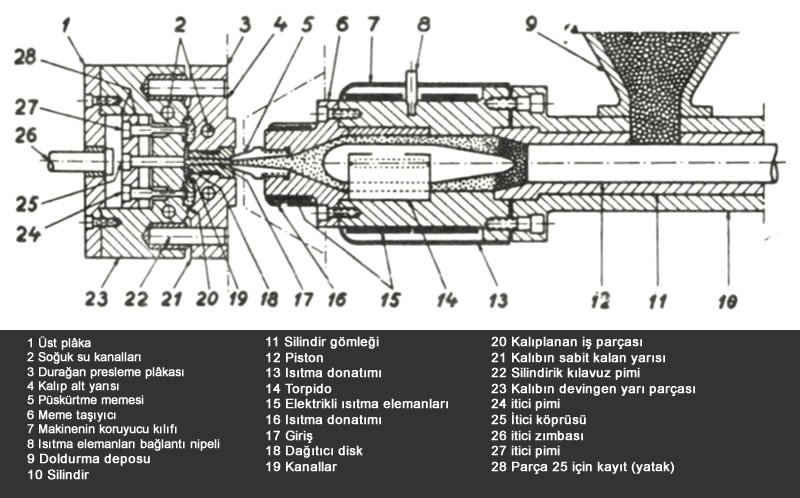
plastic injection machine and its parts

In the cross-section image above, you can see the approximate construction of the individual parts. This image shows the final state of the machine’s injection stage. Essentially, the mold, made up of a stationary lower part (21) and a moving upper part (23), is held closed by the press’s stationary work table and the moving pressure plate. The molten plastic material is injected from the injection nozzle (17) into the mold cavity through the runner channels (19). Before the pressing operation begins, the plastic material is loaded from the hopper (9) into the injection cylinder (11), and the pressing piston (12) is moved forward, while current is simultaneously supplied to the electric heating elements (15).

Heating is generally increased gradually, in proportion to the rising pressure. The molding mass is evenly mixed and distributed with the help of a torpedo (14) located in the middle of the machine. The torpedo is mounted stationary inside the cylinder (10). The liquefied material reaches the nozzle (5), gaining an even flow rate as it passes through the torpedo. After the injection process is done, the mold is cooled with the help of cooling channels (2).

After this, the moving plate (1) is returned to its starting position and the mold opens; the bridge (25) carrying the ejector pins rests against the stationary ejector. The ejector pins (27) on the bridge extend all the way into the mold cavity. With the help of these pins and the thick central pin (25), the injected workpiece is ejected outward.

Videos Related to Plastic Injection Molding

injection molding animation video

injection molding animation video

The Technology of Injection Molding Training with 3-D Animations

The Technology of Injection Molding

Plastic Injection Molding

Plastic Injection Molding

plastic injection processing technique

plastic injection processing technique

Plastic Injection Molding

Plastic Injection Molding

What is Injection Molding and How Does it Work?

What is Injection Molding and How Does it Work?

MAKING A PLASTIC BUCKET

Making a Plastic Bucket from Scratch

Plastic Processing Overview

Plastic Processing Overview

Injection Molding Overview

Injection Molding Overview


In this article, we tried to give information about the plastic injection molding method. We covered how a plastic injection machine works. We examined the parts of a plastic injection machine. See you in upcoming articles.

High Production Speed


Plastic injection molding is a very efficient method for mass production, producing complex parts within seconds.

Molten Plastic Injection


The process takes place by heating plastic pellets until they melt, then injecting them at high pressure into a closed mold cavity.

High Mold Cost


Since injection molds are precise and expensive, this method generally becomes economical only in high-volume production.

Related Questions

This method requires expensive special machines and special molds; this investment only pays for itself when a large number of parts are produced. This high upfront cost isn’t economical for small quantities of parts.

The screw both transports the molten plastic and mixes it, resulting in a more homogeneous melt. This more consistent feed produces a higher-quality and more predictable molding result compared to piston systems.

Related Posts
What Is Reaming? How Is It Done? What Is Reaming? How Is It Done? Applications of Lasers Applications of Lasers Operations Performed on a Lathe Operations Performed on a Lathe modern factory manufacturing processes Surprising Manufacturing Processes in Modern Factories Aluminum Production. How Is Aluminum Produced Aluminum Production. How Is Aluminum Produced Dişli Çark Üretim Yöntemleri Gear Manufacturing Methods Industrial 3D Scanners Industrial 3D Scanners How Is Aluminum Extrusion Done? What Is Aluminum Extrusion, How Is It Done?
Manufacturing of Machine Parts Plastic Injection Molds
Share. Facebook Twitter WhatsApp Tumblr Email Telegram Copy Link

Leave A Reply Cancel Reply


How Is Engine Oil and Oil Filter Change Done?
Traffic Signs and Their Meanings. Warning Signs
  • Contact
  • Terms of Service
  • Privacy & Cookie Policy

Type above and press Enter to search. Press Esc to cancel.