
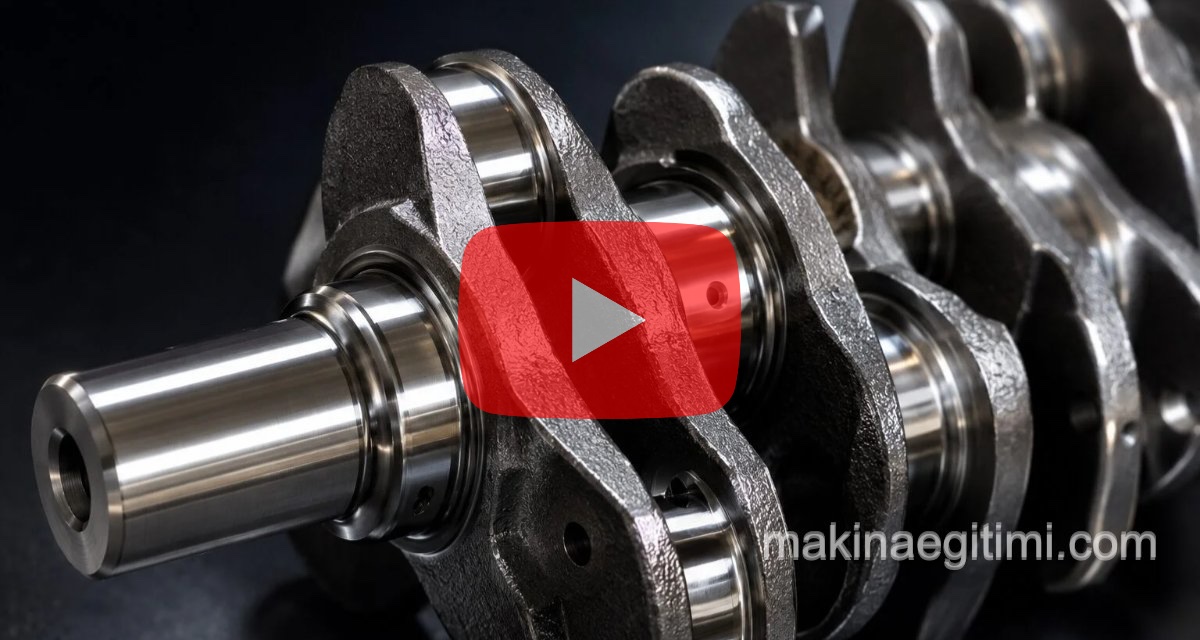
In the Machine Education How Is It Made? category, we’ve dedicated this article to the crankshaft. For those wondering how a crankshaft is made, the videos below cover the manufacturing methods and production processes of crankshafts.
What Is a Crankshaft. What Does It Do?
The crankshaft’s job is to convert the linear motion coming from the pistons into rotary motion. Thanks to their eccentric structure, they carry out this job successfully.
The crankshaft is one of the most important parts of a motor vehicle. It needs to be manufactured to extremely high precision. Its manufacturing process isn’t limited to casting and machining. Since it will operate constantly under vibration and rotate inside a precision bearing, it needs high wear resistance. For this reason, the crankshaft undergoes a number of heat treatments to achieve the ideal material properties.
The crankshaft is an eccentric shaft. Its job is to convert the linear motion produced by the pistons into rotary motion.
How a Crankshaft Is Made
The crankshaft is mostly produced by forging. Crankshafts are obtained either by hot-press forging in a die or by casting. Cast crankshaft forms are better suited to withstand stresses than forged crankshafts and are more durable. The areas where the connecting rod will operate are precisely machined by machining.
Crankshaft Material
It’s generally manufactured from low-alloy steel. Cast crankshafts are also produced from nodular (ductile) cast iron. The material’s properties need to resist wear, melting, and torsion. The plain (sliding) bearings that support the crankshaft (crankshaft bearings), on the other hand, are made of brass to prevent micro-welding.
Once machining of the crankshaft is complete, it goes through a number of heat treatments for durability and to increase the wear resistance of its journals. First, a process called quenching and tempering (heat treatment) is performed. In this process, the crankshaft is first annealed. Then it’s quenched. It’s then tempered at 600 degrees and quenched again.
To harden the crankshaft’s surface, its outer surfaces are heated using electric current (induction hardening) and then quenched.
Another video on the topic of how a crankshaft is made
Crankshaft manufacturing can also make use of methods such as machining, grinding, honing, heat treatments, induction hardening, nitriding, salt-bath treatment, and nitrogen coating.
Related Posts
 What Is a Turret Lathe. How Is It Used
  What Is a Pantograph? How Does It Work?
  The Best 3D Scanners of 2022 – Buying Guide
  What Is Rolling? How Is It Done? Rolled Products in Our Lives
  What Is an Automatic Lathe, How Does It Work?
  What Is Honing? How Is It Done? Where Is It Used?
  Metal Hardening Methods
  What Is Submerged Arc Welding, How Is It Done