
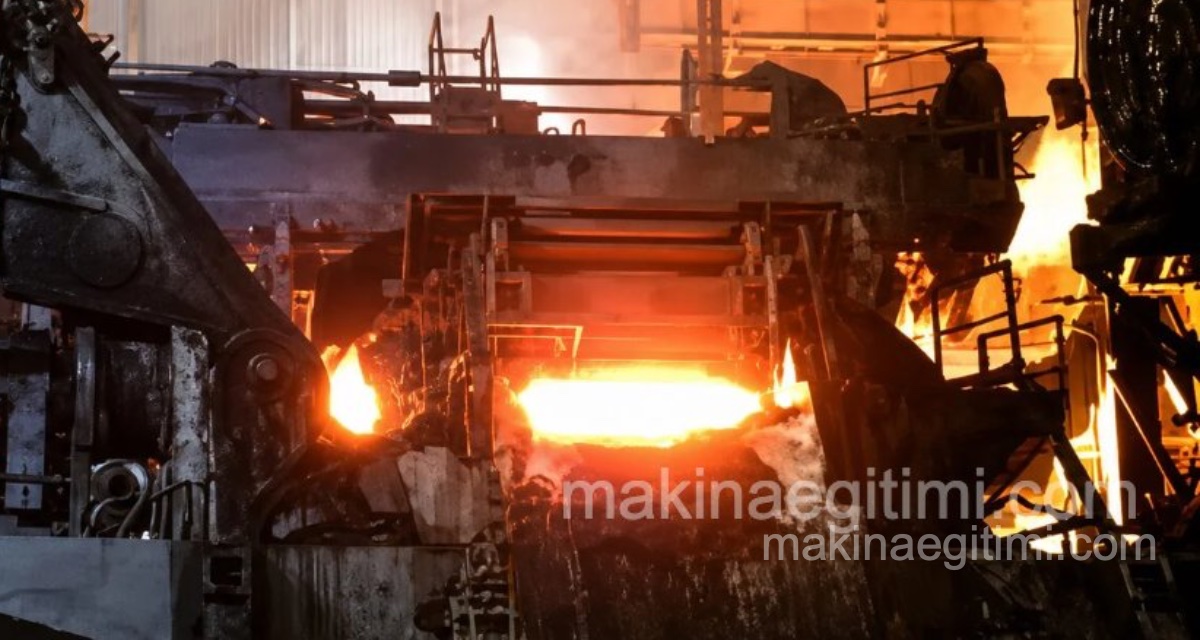
In our Manufacturing Operations Materials Science section, this article will cover what steel is and how steel is made. The answer to the question of what iron needs to be mixed with to obtain steel will be in our article. We’ll share detailed information about how steel is made, along with a video about steelmaking.

What Is Steel
Steel is an iron-carbon alloy containing up to 1.7% carbon, up to 1% manganese, up to 0.5% silicon, and less than 0.05% sulfur (S) and phosphorus (P).
Iron-Carbon Alloy
Steel is an alloy of iron with generally less than 2% carbon; the carbon ratio directly affects hardness.
Blast Furnace Process
In the first stage of steel production, iron ore is converted into pig iron by being reduced with coke in a blast furnace.
Oxygen-Blowing Method
In the basic oxygen furnace, pure oxygen is blown into the molten pig iron, rapidly removing excess carbon to produce steel.
How Is Steel Made?
There are basically two current routes followed in steel production today.
Route 1: Producing pig iron from iron ore in blast furnaces at integrated plants, followed by steel production from this pig iron in Basic Oxygen Furnaces (BOF)
Route 2: Producing steel by re-melting existing iron and steel scrap in electric arc furnaces.

About 1/3 of the world’s steel production comes from steel scrap, while the rest comes from iron ore.
Iron and steel production plants in Turkey include: Zonguldak Iron and Steel, Karabük Iron and Steel, and İskenderun Iron and Steel factories.
How Steel Is Made, Brief Explanation
For steel to be made, iron and carbon need to be combined. Steel is made either by adding the required carbon to iron produced in blast furnaces through certain processes, or by re-melting steel scrap in electric arc furnaces. Carbon is an element that hardens iron, and as the carbon ratio in the resulting mixture increases, the steel’s hardness and brittleness increase proportionally as well.
In today’s industry, carbon content ranging from 0.02% to 2% is used in steel production. Elements such as tungsten, vanadium, chromium, and nickel can also be added to give the produced steel various properties such as corrosion resistance, heat resistance, and elasticity.
Video Explanation of How Steel Is Made
Alternative link for the video
How Steel Is Made
Steel, which isn’t an element found on its own in nature, is an alloy formed by combining the element Iron (Fe) with Carbon (C) in ratios ranging from 0.02% to 2%. The quality of the steel used in today’s industry is largely determined by the ratio of Carbon in the alloy.
Although the Carbon atom has a major effect on steel classification, elements such as Chromium, Magnesium, Tungsten, and Vanadium are also used in converting Iron into an alloy. Carbon and the other elements form a tight bond with Iron atoms, ensuring the resulting Steel is a very strong material in terms of physical properties.
Steel production can also be done using different ratios of elements depending on the intended use of the resulting alloy. The ratio of elements used to convert Iron into an alloy determines the resulting Steel’s properties such as yield point, ductility, and durability.
For this reason, some changes can be made to the ratio of elements used during the alloying stage so that the Steel alloy to be used in different fields has the desired physical properties. For example, Steel alloys very rich in Carbon are much harder than Iron, but have much lower ductility.
Methods Used in Steelmaking
Various methods are used in steelmaking. These are:
- Bessemer-Thomas steel production method
- Siemens-Martin steel production method
- Steel production in electric arc furnaces
- Steel production in basic oxygen converters
You can examine these steel production methods in detail by clicking the links above.
Some of these steel production methods have lost their importance today, and steel production is mostly carried out with newer production techniques. As of 2002, of the approximately 900 million tons of steel produced worldwide, 60% is produced in Basic Oxygen Converters, 33.9% in Electric Arc Furnaces, 3.8% in Siemens-Martin furnaces, and 2.2% with other production methods. In Turkey, 31% of the steel produced is made in basic oxygen converters, and the remaining 69% in electric arc furnaces.
Related Questions
Pig iron contains a much higher ratio of carbon than steel, and this excess carbon makes the material brittle. To obtain steel, this excess carbon must be reduced in a controlled manner by blowing in oxygen.
This method reuses existing scrap material instead of processing iron ore from scratch. This both reduces the need for raw material and can make the production process less energy-intensive compared to the blast furnace stage.
Related Posts
 What Is Submerged Arc Welding, How Is It Done
 Gear Manufacturing Methods
 How Are Piston Rings Made? How Are Piston Rings Manufactured?
 What Is Rolling? How Is It Done? Rolled Products in Our Lives
 How Are Bearings Made? Video
 Properties of Laser Beams and Their Working Principle
 Steel Production Methods
 What Is a Pantograph? How Does It Work?