The unrolled length of a part before it’s bent is called the bend length (developed length), and the total unrolled length of the part is called the blank length (flat pattern length). To calculate the bend length, you first find the distance from the neutral axis to the bend center (R). This is the neutral axis’s bend radius.
Finding the Bend Length
The radius (R) used to find the actual bend length is calculated as shown below.
If the bend radius equals the sheet material thickness, Ri = T, the coefficient
y = 0.33 is used, and the radius used for the bend length is found as
R = R1 + 0.33T, mm.
If the bend radius equals 2 to 4 times the sheet material thickness,
R1 = (2 – 4) T, the coefficient y = 0.4 is used, and the radius used for the bend length is found as
R = R1 + 0.4 T (mm).
If the bend radius is greater than 4 times the sheet material thickness, R1 > 4T, the coefficient y = 0.5 is used, and the radius used for the bend length is found as
R = R1 + 0.5 . T mm.

The following steps are used exactly as given to find the bend length.
- Write the formula for the circumference of the neutral axis;
Lç = 2π R
R= (R1 + yT)
From this, Lç = 2π (R1 + yT) - Determine the bend angle α,
- Find the length of the part bent through angle α.
Bend length L = α /360 . 2π (R1 + yT)
L= π . α /180 . (R1 + yT)
Lç = Circumference of the neutral axis, mm
L = Bend length, mm
R = Bend radius of the neutral axis, mm
R1 = Bend radius, mm
y = Coefficient
α = Bend angle
T = Sheet material thickness, mm
Finding the Blank Length
For the part above, the blank length of the part to be bent is found using the following formula.
Blank length LT = L +L1+ ……………..+Ln
LT = Blank length of the part to be bent, mm
L1 and L2 = The flat (unbent) lengths, mm
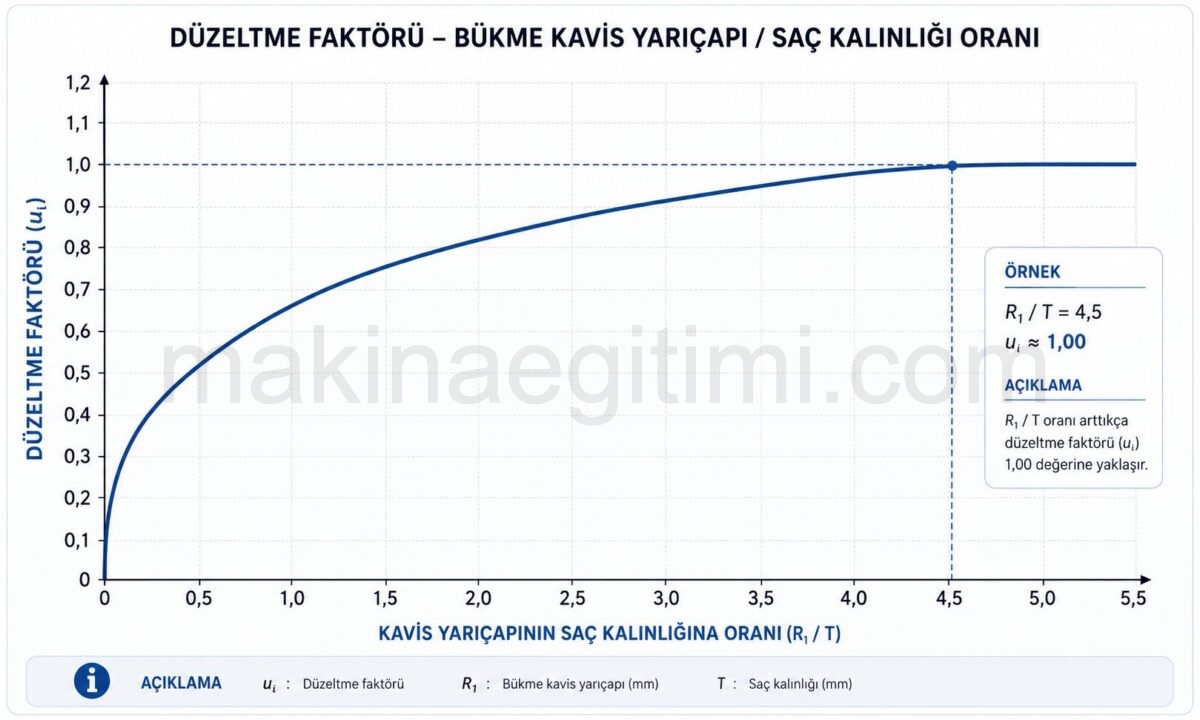
The (y) coefficient used to find the bend length is taken as the correction factor from the table above, and the bend length can also be found with the formula below.
Bend length L = π . α /180 ( R1 + T/2 .y)
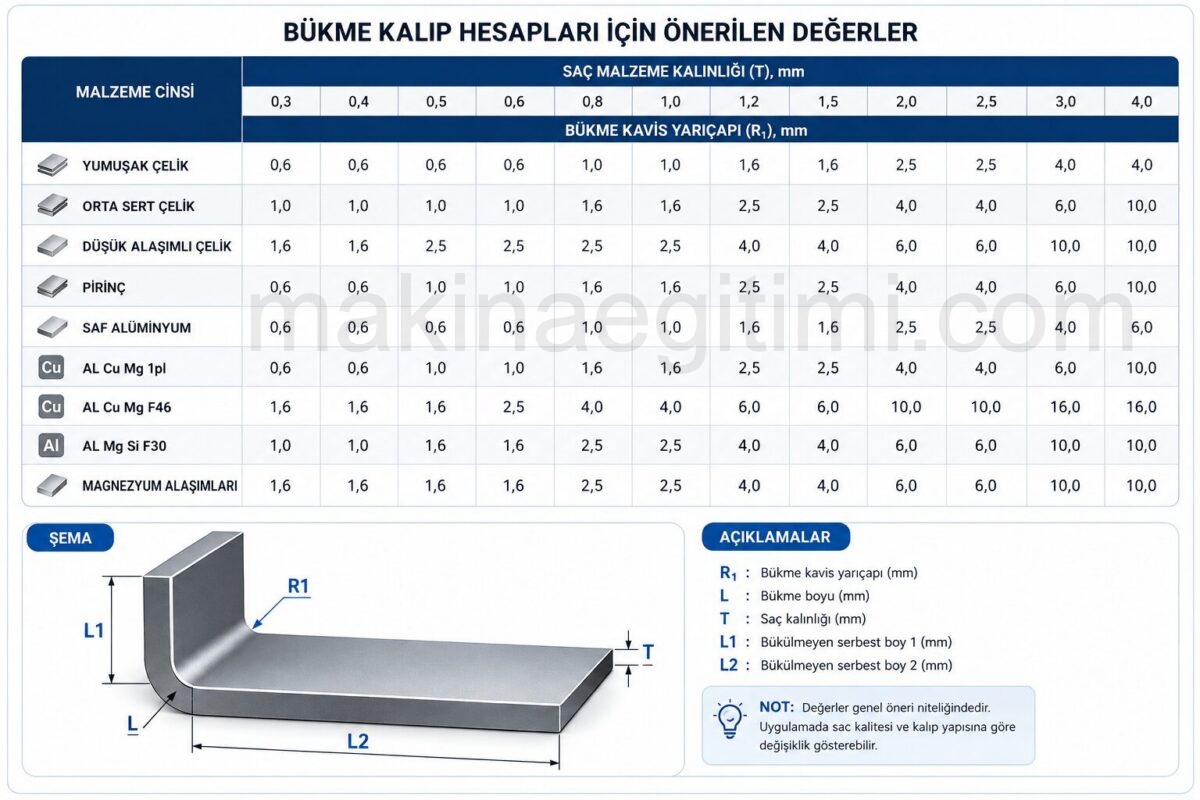
The table above gives the bend radius R1 for 90° bends according to the material type.
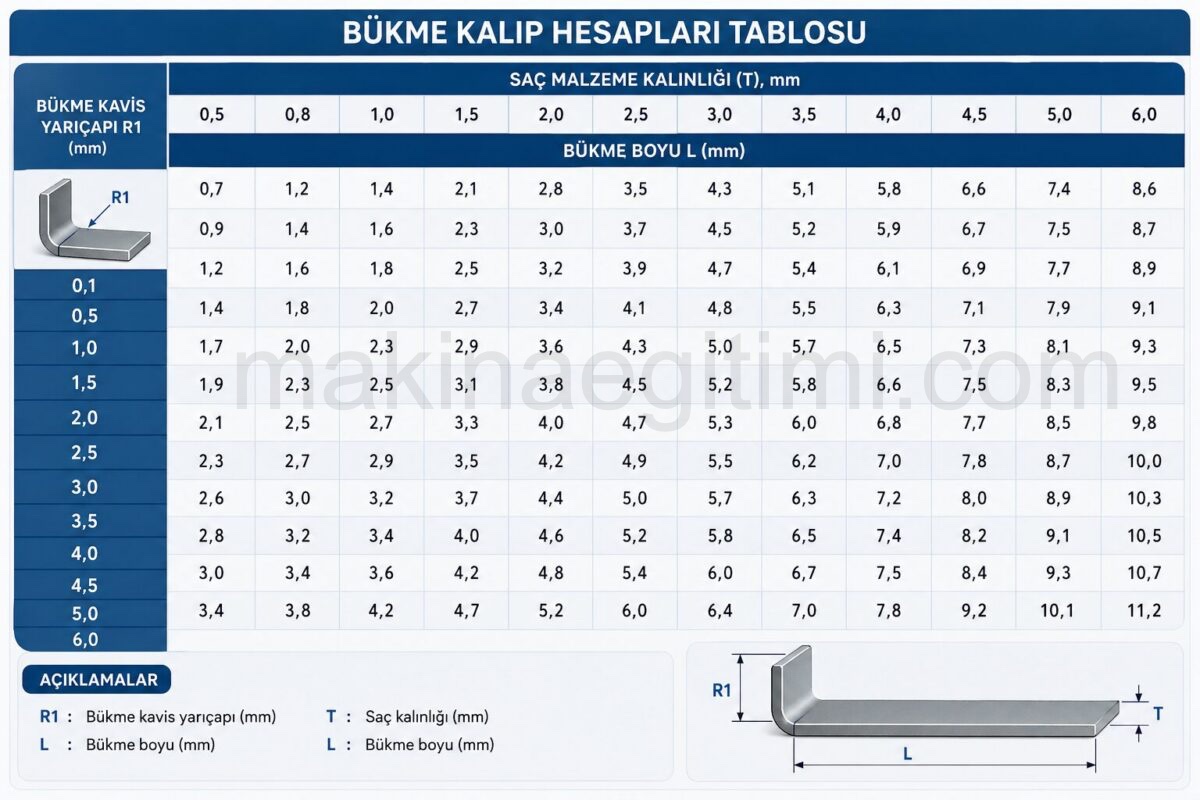
The table above gives bend lengths based on sheet material thickness and bend radius.
Bend Length Calculation – Worked Example

The part with the dimensions given above will be bent from 3 mm thick brass sheet, 40 mm wide. Since this part will be produced in a series, find the blank length of the part to be bent.
Solution
The blank length of the bent part;
from the table above, the correction factor is y = 0.65

Bend length L2 = π . α /180 ( R1 + T/2 .y)
L2 = 3.14 . 90 /180 ( 3+ 3/2 . 0.65)
L2 = 6.24 mm
Blank length of the part LT = 2 . (LT = L1 + L2 + L3/2)
LT = 2. (20 + 6.24 + 15 )
LT = 82.48 mm
Bend Length and Blank Length Calculation – Worked Example 2

The part with the dimensions given will be bent into a 90° V-bend from 2 mm thick aluminum sheet, 50 mm wide. Since this part will be produced in a series;
find the blank length of the part.
Solution

Bend length L2 = π . α /180° ( R1 + T/2 .y)
We said that if the bend radius equals 2 to 4 times the sheet material thickness,
R1 = (2 – 4) T, the coefficient y = 0.4 is used, and the radius used for the bend length is found as
R = R1 + 0.4 T (mm). (The part shown in green in the explanation above)
R = 4+0.4 . 2
R=4.8 mm
Bend length L2:
L2= (45° . π /180°) x 4.8
L2= 3.77 mm
L4= (90° . π /180°) x 4.8
L4= 7.54 mm
L3 = 17 / cos 45° + 2 x 4, so
L3 = 32 mm
Blank length LT = L1 + L2 + ……….. +Ln
Blank length LT = 7 + (2 x 3.77) + ( 2 x 32) + 7.54 + 12
LT = 98.08 mm
Bend Length and Blank Length Calculation – Worked Example 3

The part shown in the image above will be formed from stainless steel with a thickness of 2 mm. Find the blank length of this part, which will be produced in a series.
Solution

Bend length L2 = π . α /180° ( R1 + T/2 .y)

taking the correction factor from the table above as y = 0.8.
L2 = π . 180° / 180° ( 6 + 3/2 . 0.8) = 22.62 mm
L4 = π . 90° / 180° ( 6 + 3/2 . 0.8) = 11.31 mm
Blank length:
Lt = L1+ (2 . L2) + (2. L3) + (2 . L4) + L5+ L9
Lt = 20+ (2 . 22.62)+(2 . 11.31)+ (2 . 38)+150+3
Lt = 316.86 mm
Related Posts