
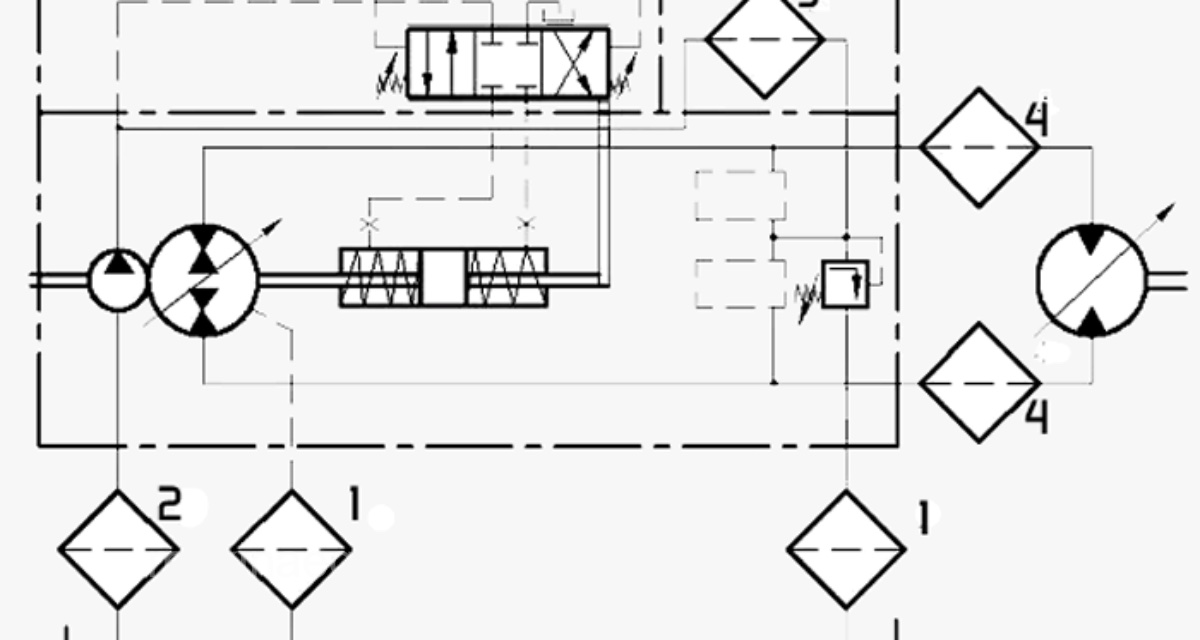
Filters are elements used to separate solid particles from fluids. Filters used to separate solid particles from fluids, or dust from gases, are manufactured from granules or fibers. Using a filter in a system is of great importance for preserving the service life of its structural components.
Filters used in hydraulic systems can be placed within the system in different ways. Two cases are described below:
- Full-flow filtration: filtration occurs on the return line, the suction line, and the pressure line.
- Partial-flow filtration: only a portion of the flow rate is filtered.
Full-Flow Filtration

Return line filter in a hydraulic circuit diagram

Suction line filter in a hydraulic circuit diagram

Pressure line filter in a hydraulic circuit diagram
Full-Flow Filter Location
Full-flow filters are placed on the main line through which the system’s entire fluid flow passes.
Partial-Flow Advantage
Partial-flow filtration can clean the oil more thoroughly over time by continuously cycling a portion of the system through it.
Filtration Rating
Hydraulic filters typically have a particle-retention capacity of between 3 and 25 microns, depending on the application.
Partial-Flow Filtration

When placing filters in the most suitable way, above all, the sensitivity of the structural elements that need to be protected against dirt, the contamination level of the hydraulic fluid, and the price factor all play an important role.

Filtration methods used in hydraulic circuits and the recommended filter sensitivity values
Cleaning Filters:
These filters consist of a fine mesh layer made from, for example, metal, cellulose, paper, or synthetic fiber. They’re mostly used during initial system commissioning and cleaning, and are filters that should be discarded afterward.
Fine Filters:
These are filters made of textile, cellulose, synthetic fiber, glass fiber, metal, or sintered metal, either pressed together or made up of several layers. For the same filter surface area, these filters have a higher dirt-holding capacity than others.
Related Questions
Full-flow filtration instantly cleans all of the fluid in the system, while partial-flow filtration continuously cycles only a portion of it, providing a deeper clean over time. This more effectively reduces the system’s overall contamination level in the long run.
Tight-tolerance parts, such as precision valves, can be affected even by very small particles, while more coarsely operating systems don’t need such fine filtration. Filter fineness is chosen based on the sensitivity of the part being protected.
Related Posts
 Hydraulic System Applications in Machine Tools
 4-Way 2-Position Directional Control Valves
 AND Valve Explanation and Applications
 What Is a Hydraulic Accumulator Used For
 Time Delay Valve Explanation and Applications
 The Importance and Applications of Hydraulics and Pneumatics
 Types of Hydraulic Motors
 Contamination in Hydraulic Systems and Its Causes