
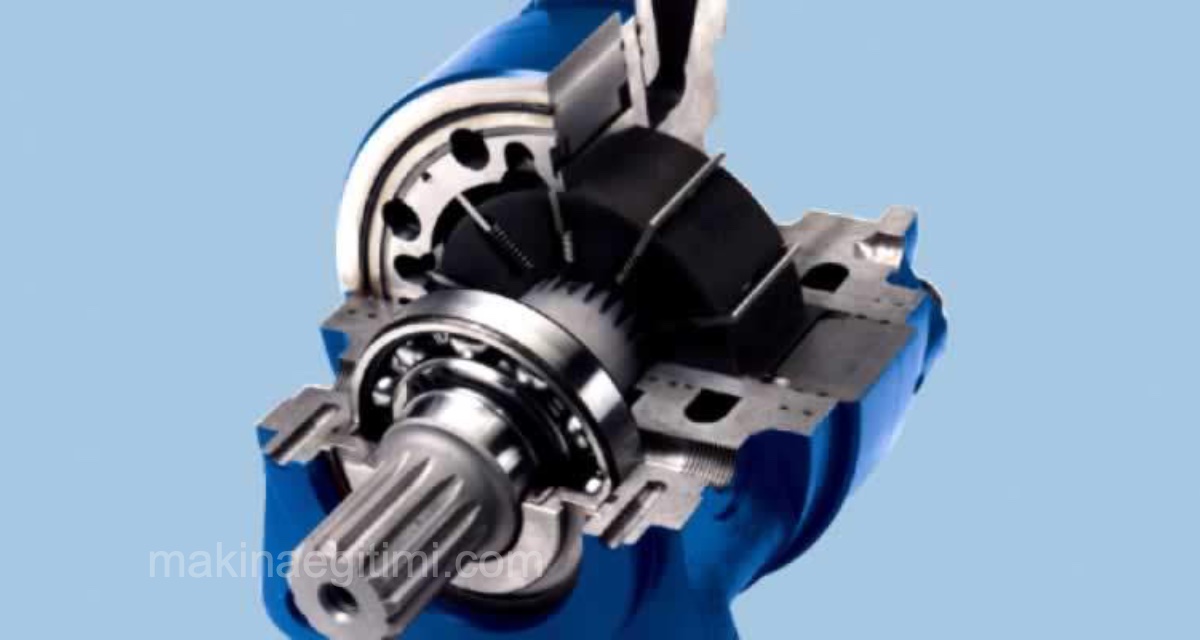
We can look at the types of hydraulic motors under 3 main headings:
Gear-Type Hydraulic Motors (Gear Motors)
Hydraulic motors that work with gears operate on the principle of fluid entering between the gear teeth, generating a certain torque, and rotating a shaft coupled to the gears.

Working system of a gear-type hydraulic motor (above)


External Gear Hydro Motors
This is a circuit component used to produce rotary motion, converting hydraulic energy into mechanical energy. Their construction and operating principle are similar to pumps.

Internal Gear Hydro Motors
Fluid entering the motor from the high-pressure zone applies pressure to the surface of the gears. If the pressure value exceeds the load value, the hydro motor starts to rotate. Both gears are designed to rotate freely.

Internal gear hydro motors have low speeds and a short service life. These properties limit their fields of use. They’re used in simple mechanisms, in places where high efficiency isn’t needed and torque requirements are low. They’re used more in automobiles and agricultural vehicles than in industrial systems.
Orbit-Type Hydro Motors
Despite their compact construction, these motors can produce high torques. As with gerotor motors, the outer gear doesn’t move. The inner gear, however, rotates.

Roller-Type Hydro Motors
This is the roller-based variant of orbit motors. Rollers are used to increase motor efficiency and make maintenance easier. Fluid sent into the motor applies pressure to the inner gear, generating a torque that tries to rotate the motor.
Simplicity of Gear-Type Motors
Gear-type hydraulic motors offer a low-cost, durable solution thanks to their simple construction.
Efficiency of Piston Motors
Piston hydraulic motors can deliver higher efficiency and torque than other types by operating at high pressures.
Quietness of Vane Motors
Vane-type hydraulic motors are known for relatively quiet operation and moderate performance.
Piston Hydraulic Motors
Piston motors are divided into two types: radial and axial piston motors.
Axial Piston Hydraulic Motors
Below, the operation of an axial piston motor is shown. Axial piston motors have a high flow rate even at low speeds. They can start operating under high torques. They’re an ideal choice for high operating speeds.
Axial piston motors are made in two different types: bent-axis and swashplate. (below)

Radial Piston Hydraulic Motors
Below is an exterior view of a radial piston hydraulic motor. In radial piston motors, the pistons don’t operate on axes parallel to each other.

Radial piston motors can start operating with high torques. There can be torque ripple or fluctuations in operating speed at low speeds.


Two views of a radial piston motor, in cross-section.
Click the images to enlarge.

A radial piston motor with a fixed cylinder block and rotating shaft (above)
Vane-Type Hydraulic Motors
In vane hydro motors, the pressure the fluid applies to the vanes creates a force that drives the rotor to turn. The rotor’s motion is transmitted outward through the shaft. Vane motors have lower torque and a shorter service life compared to piston motors. They operate up to speeds of 1000 rpm. With good electronic control, speeds as low as 0.1 rpm can also be achieved.


The rotation of the motor shaft results from a pressure differential. It applies a force against the vanes across from it. This force is tangent to the rotor and causes the rotor, and along with it the motor shaft, to rotate.
If fluid is directed into the motor from the motor housing, the shaft, viewed from its end, rotates
clockwise. When the oil supply is instead directed to the cover port, rotation, viewed from the shaft end, is counterclockwise.
This is how the direction of fluid flow is changed. This is usually done by a suitable directional control valve.

Parts of a vane hydraulic motor (above)
Related Questions
High-pressure fluid enters the gaps between the gears and applies a pushing force on the teeth. This force rotates the gears and the shaft coupled to them, converting hydraulic energy into mechanical rotary motion.
These motors run at low speeds and have a shorter service life due to their construction. These limitations make them better suited to simpler needs, like automobiles and agricultural vehicles, rather than industrial systems that demand high performance.
Related Posts
 Pneumatic Application Examples, Sample Circuits
 Basic Components of Pneumatic Systems
 Hydraulic Oil Selection and Properties Required in Hydraulic Oils
 Cushioning in Pneumatic Cylinders
 Hydraulic Pump Maintenance
 Time Delay Valve Explanation and Applications
 Types of Hydraulic Pumps
 Hydraulic Oils and Their Properties