

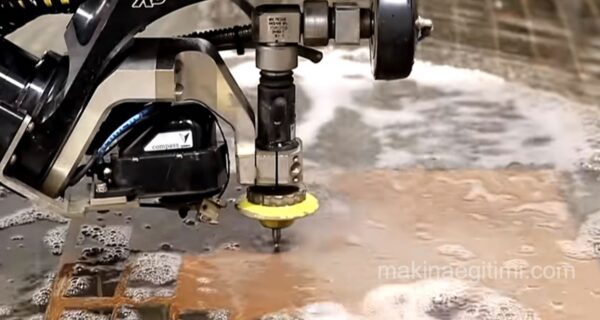
Just as there are waterjets that cut with pure water, there are also waterjets that work with abrasive additives, and these can cut harder materials.
What Materials Can a Waterjet Cut?
An abrasive waterjet can cut almost any material, such as wood, rubber, glass, metal alloys, ceramics, carbides, composite materials, and more. It can also cut composite materials with complex structures, such as honeycomb and carbon fiber-reinforced plastic sandwich materials. Harder materials such as alumina or zirconia typically require harder abrasive materials to achieve efficient waterjet cutting.
What Materials Can a Pure Waterjet Cut
Plastics (both solid and foam), rubber, floor mats and other non-woven materials, plywood, and corrugated cardboard are examples of materials that can be cut this way with a pure waterjet.
Even softer metals such as tin and lead can be cut this way, with the advantage that the material remains as burr on the workpiece as it bends under the waterjet’s pressure; this is especially advantageous in the case of lead, which shouldn’t be allowed to enter the wastewater system.
Thin, lightweight materials are usually cut at high speeds, but even 100 mm thick rubber can be cut, albeit at lower speeds. This cutting technique using only a water stream is known as pure waterjet cutting.
Fiber materials are another group of materials that can be cut advantageously with a pure waterjet.
What Materials Can an Abrasive Waterjet Cut
- An abrasive waterjet can cut a wide range of materials, including very high-strength materials. If a material is going to undergo heat treatment (e.g., quenched and/or tempered), it’s recommended that cutting be done after the heat treatment. (This applies to hardened material.)
- Laminated and/or brittle material can be difficult to cut and requires a more experienced operator.
- Materials that are traditionally difficult to machine can be cut more easily with an abrasive waterjet. For example, cutting titanium alloys with a waterjet is easier than cutting steel.
- For abrasive waterjet cutting, the composition of an alloy doesn’t play a significant role. The cutting speed for composite materials (alloys) is generally the same as that used for the base material. The hardness of the base material is the most influential factor for each material group.
- In general, most materials, including very thick ones, can be cut with an abrasive waterjet.
Use of High Pressure
Waterjet cutting is typically carried out at ultra-high water pressure between 3000-6000 bar.
Abrasive Additive
Abrasive particles such as garnet are typically mixed into the water to cut hard materials like metal.
Cutting Without Heat Effects
Unlike laser cutting, a waterjet produces no heat, preventing heat-related deformation of the material.
What Materials Can a Waterjet Not Cut?
Tempered glass cannot be cut with a waterjet, because there’s a stress balance in the glass that any disturbance will cause to crack. Diamond is difficult to cut due to its extreme hardness. It’s theoretically possible to cut, but requires an extremely hard abrasive material for the cutting process, which would give the currently available focusing tubes an impractically short lifespan.
Video Examples of Waterjet Cutting
What Is the Maximum Cutting Depth of a Waterjet
Cutting two-dimensional geometries in flat sheet and plate material up to 300 mm thick is the most common application of abrasive waterjet cutting. However, for various reasons, many companies state that the method is suitable up to 100 mm.
Related Questions
While pure water can cut soft materials, it doesn’t have the power on its own to abrade hard materials such as metal or ceramic. The hard particles mixed into the water add an extra abrasive effect during cutting, making it possible to cut these hard materials too.
Using an abrasive can cause metal particles to mix into the wastewater, creating an environmental problem. Cutting with pure water eliminates this risk, which is why it’s preferred for sensitive metals like lead.
Related Posts
 Properties of Laser Beams and Their Working Principle
 Motion Capture Technology
 Laser or Waterjet, Which Is Better?
 Industrial 3D Scanners
 Advantages and Disadvantages of Laser Welding
 What Is 3D Printing – How Do 3D Printers Work?
 Laser Cleaning: Removing Rust, Dirt, and Grease
 What Is Electrical Discharge Machining (EDM). Machining with EDM