

3D printing, invented in 1986 by Chuck Hull, is the process of taking a digital 3D model and turning that digital file into a physical object.
While there are many technologies that can be used to 3D print an object, most of the 3D printers you’ll find in a home or office environment are based on Fused Filament Fabrication (FFF) or Stereolithography (SLA) processes, since these technologies are currently cheaper and easier.
How Do 3D Printers Work?
Not all 3D printers use the same underlying technology, but they all still manage to perform the same basic tasks. However, before getting into each of these individual technologies, we need to understand the basic principles of getting a 3D model from your computer screen to a 3D printer.

Once a 3D model is designed, to print that model on a 3D printer, the file needs to be converted into something called G-code. The original file usually has an extension like 3MF, STL, OBJ, PLY, etc.
G-code: a numerical control computer language used for computer-aided manufacturing that tells a machine how to move.
Programs like Slic3r are needed to convert 3D model files into G-code. Once the G-code has been generated, it can be sent to the 3D printer, providing a plan for what the next several thousand moves will consist of. All of these steps contribute to the complete production of a physical object.
Fused Filament Fabrication (FFF)
This was invented a few years after Chuck Hull first invented 3D printing, by a man named S. Scott Crump.
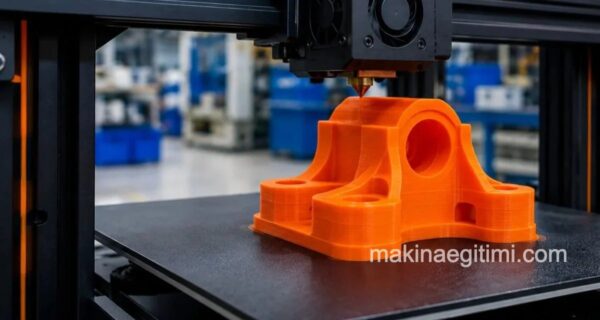
The way this technology works is fundamentally quite simple, and that’s why 95% of all desktop 3D printers found in homes and garages today use FFF. A thermoplastic, such as PLA or ABS, is fed into an extruder and a hotend. The hotend then melts the plastic, turning it into a sticky liquid.
The printer then receives its instructions from the computer via G-code, and deposits the molten plastic layer by layer until an entire object has been produced. The plastic melts fairly quickly and provides a solid surface for each additional layer to be deposited on.
Depending on the maximum temperature and other variables, many other materials can be used besides ABS and PLA, including composites of both materials, nylon, and more.
Stereolithography (SLA)
The model’s layer is traced onto the surface of a liquid polymer, which the laser or light beam causes to solidify.
A light source, such as a laser or a projector, cures the resin layer by layer as the object is built. Objects are printed inside a vat of resin.
After each layer is formed, the model is lowered along the Z-axis by the thickness of one layer.
This lowering motion works using similar mechatronic systems, such as hydraulic, pneumatic, or screw-and-nut systems.

SLA machines can achieve much better accuracy and a less layered appearance than FDM/FFF technology.
Selective Laser Sintering (SLS)
Selective Laser Sintering (SLS) can be described as using a laser beam to sinter powders of non-metallic materials such as plastic, ceramic, glass, etc., layer by layer.
Metal powder is spread over the build platform, and laser beams are aimed at the powder material, forming layers by melting and bonding the powder within the model’s geometry.
After each layer is formed, the model is lowered along the Z-axis by the thickness of one layer. Metal powder is spread again, and the process continues until the model is built.

Prevalence of FDM
FFF/FDM technology is the most widely used 3D printing method, thanks to its low cost and ease of use.
SLA Precision
Stereolithography (SLA) offers much higher surface precision than FDM by curing resin with a laser.
SLS Needs No Support
Since Selective Laser Sintering (SLS) uses the powder itself as the support material, complex geometries don’t need a separate support structure.
DMLS Technology
DMLS (Direct Metal Laser Sintering), applied with the same method as SLS, is ideal for metal alloys, because molecules have varying melting points, meaning it can sometimes be hard to achieve a fully melted state.
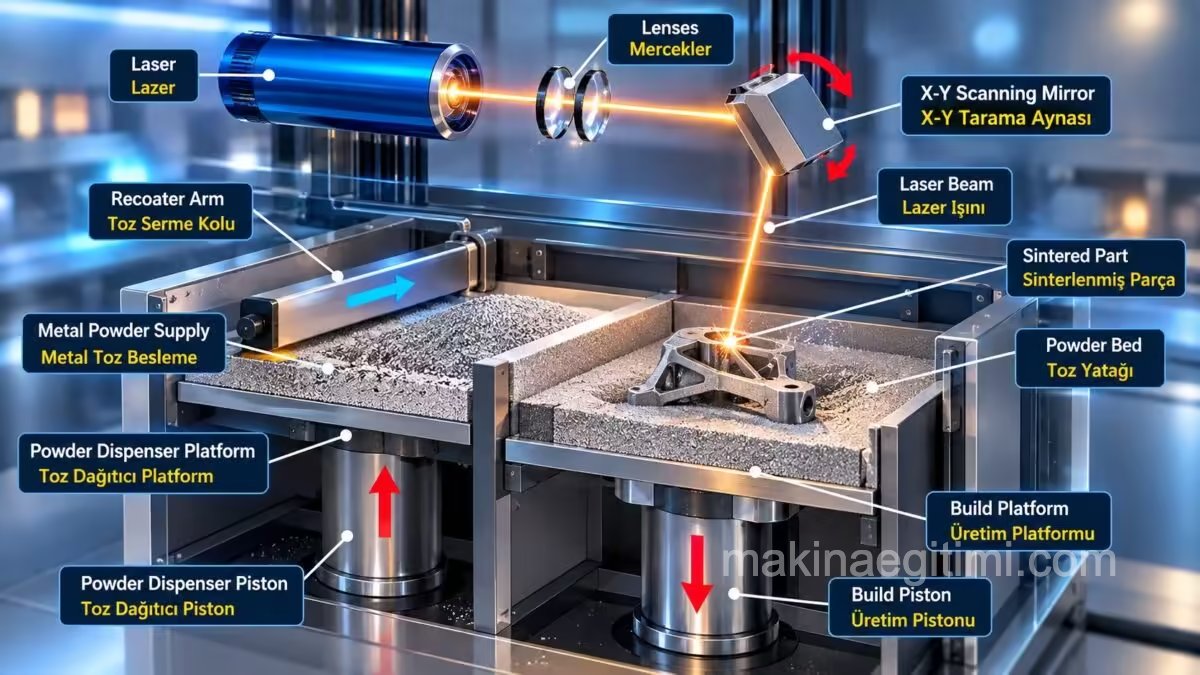
Devices using this method build layers by spraying molten metal through a small opening. Their costs are high, but precise metal parts can be produced.
These technologies are currently expensive, and given the high-power laser beams required, they’re beyond the budget of most individuals and even small businesses. Additionally, safety measures must be taken, meaning additional costs on the user’s side.
PolyJet Technology
PolyJetting, a technology invented in 2012 by the Israeli company Objet, incorporates elements of both inkjet 2D printing and the Stereolithography process.
The model is built by spraying photopolymer resin onto the build platform layer by layer and curing it with UV light. PolyJet technology is a state-of-the-art additive manufacturing method that uses multiple materials together.
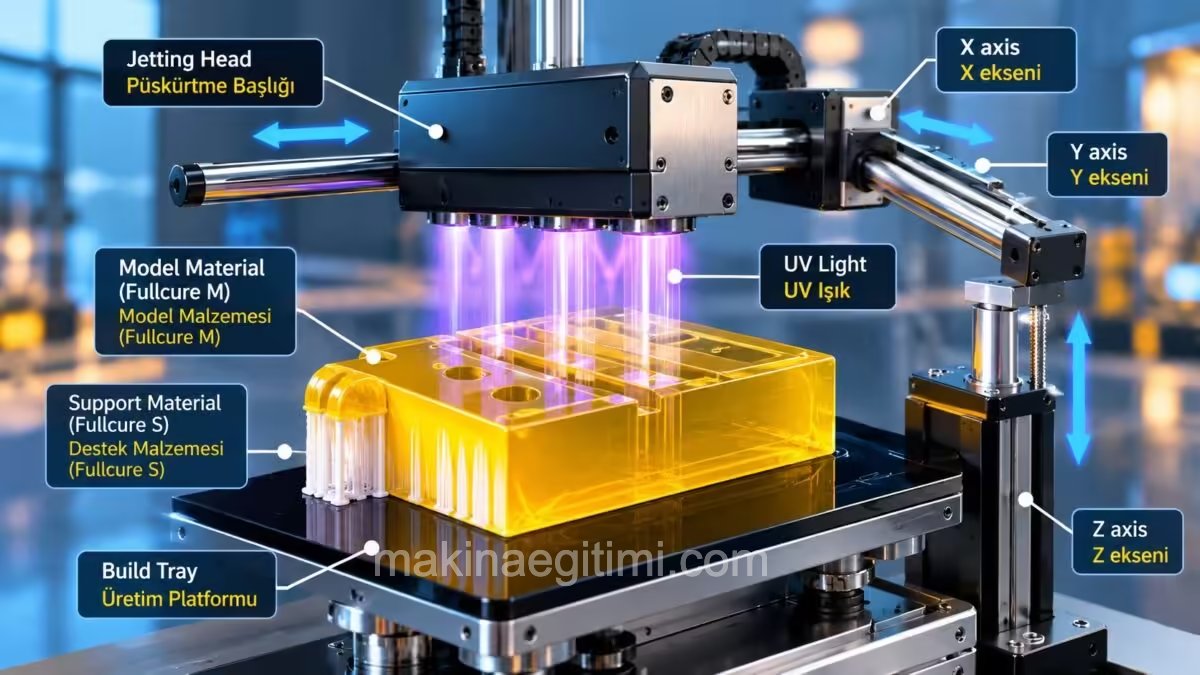
Inkjet nozzles spray a light-sensitive liquid resin onto a build platform, similar to how ink is sprayed onto paper in printers.
Immediately after the material is sprayed, it’s exposed to a UV light source and cures rapidly before the next layer of light-sensitive liquid is sprayed on top. This process repeats until an entire object has been produced.
Materials used in PolyJet technology: Digital ABS, FullCure 720, VeroClear, Tango, Endur
Printing via Deposition (FDM)
The most widely known and used method worldwide is FDM technology (fused deposition modeling), also known as fused-deposition build-up technology. This technique uses thermoplastic materials that can be shaped with heat.
Materials usable with FDM:
ABS, PLA, PET, Nylon 3D Filament,
Metal-look 3D Filament,
Ceramic 3D Filament, Wood 3D Filament
Glow-in-the-Dark 3D Filament, Carbon Fiber PLA, Polycarbonate ABS, UV-Sensitive ABS

Plaster-Based 3D Printing (PP)
This is a process that requires two different materials: a powder material (plaster, starch, etc.) that sits on a print bed, and a binder ink sprayed from a nozzle
Similar to how an inkjet printer works, this binds the powder bed. Once a powder layer is bonded, a rake-like tool spreads additional powder over that layer, and the process continues until an entire object has been produced. This technology was first invented in the early ’90s at MIT.
Related Questions
The original 3D model file (like an STL) only describes the shape’s geometry — it doesn’t tell the printer what move to make in what order. G-code translates this shape into concrete movement instructions the printer can understand, describing how to print it layer by layer.
These two technologies use simpler mechanisms and cheaper materials than other 3D printing methods. This lowers the printer’s cost, making them more accessible to individual users.
Related Posts
 What Can a Waterjet Cut? What Can It Not Cut?
 Advantages and Disadvantages of Waterjet Cutting
 Waterjet Cutting Basics
 What Determines the Color of Laser Beams?
 What Is Sinker EDM, How Does It Work. Where Is It Used
 3D Printer Applications Today and in the Future
 Advantages and Disadvantages of 3D Printers
 Laser Cleaning: Removing Rust, Dirt, and Grease