Close Menu
  • MAKİNELER ve İMALAT
    • Tools & Equipment
    • Computer-Aided Drawing
    • CAD/CAM Education
    • CNC Machine Programming
    • Casting Technologies
    • Electrical & Electronics Technologies
    • Hydraulics & Pneumatics
    • Manufacturing Processes
    • Manufacturing Technologies
    • Occupational Safety
    • Mold & Die Design
    • Solid Modeling
    • Welding Technology
    • Machine Elements
    • Mechanical Trade Drawing
    • Materials Science
    • Automotive & Vehicle Technologies
    • Robotics Technologies
    • Health Technologies
    • Defense & Aerospace Technologies
    • Descriptive Geometry
    • Technical Drawing
    • Software & Hardware Technologies
    • Innovative Manufacturing Methods
  • TEKNOLOJİ ve YAŞAM
    • OTOMOBİLLER ve TAŞIT
      • Vehicle & Engine Knowledge
      • Safe Driving
      • Sürüş Destek Sistemleri
    • Genel Kültür
      • Movies & TV Shows
      • Görsel ve Grafik Sanat
      • Books & Literature
      • Music
      • Sports
      • History
      • History of Technology
    • GÜNDELİK YAŞAM TEKNOLOJİLERİ
    • Hobbies & Entertainment
    • Internet Technologies
    • Health
    • Mobile Technologies
Makine Eğitimi
  • Machines & Manufacturing
    Machine Elements
    Hydraulics & Pneumatics
    Technical Drawing
    Computer-Aided Design & Manufacturing
    Basic Manufacturing Processes
    Manufacturing Processes
    Industry Technologies
    Other Technical Courses
    Motion & Power Transmission
    Simple Machines
    Chains & Sprockets
    Shafts & Journals
    Gears
    Cams
    Couplings
    Belts & Pulleys
    Springs
    Bearings
    Keys
    Fastening Joining
    Retaining Rings
    Screws, Bolts & Nuts
    Cotter Pins
    Flanges
    Welding
    Rivets
    Pins & Bolts
    Washers
    Calculators
    Gear Ratio Calculator
    Spring Constant Calculator
    Belt Pulley Ratio Calculator
    Other Machine Elements
    Slides & Linear Guides
    Brakes
    Flywheels
    Clamps
    Shock Absorbers
    Gaskets & O-Rings
    Seals & Sealing Elements
    Hydraulics
    Introduction to Hydraulics & Principles
    Hydraulic Systems & Applications
    Accumulators
    Filters
    Motors
    Pumps
    Valves
    Pneumatics
    Introduction to Pneumatics & Principles
    Pneumatic Systems & Applications
    Pneumatic Circuit Components
    Valves
    Cylinders
    Silencers
    Motors
    Compressors
    Dryers
    Conditioning Units
    Common Topics & Maintenance
    Hydraulic & Pneumatic Maintenance
    Study Notes, Exams & Tests
    Technical Drawing
    Introduction to Technical Drawing
    Geometric Drawings
    Perspective & Projection
    Orthographic Views
    Dimensioning
    Sectioning
    Assembly & Detail Drawings
    Tolerances
    Surface Finish Symbols
    Mechanical Engineering Drawing
    Screws, Bolts & Nuts
    Pulley Drawings
    Gear Drawings
    Shafts & Journals
    Bearing Drawings
    Pins & Bolts
    Spring Drawings
    Welds in Technical Drawing
    Washers
    Cotter Pins
    Technical Drawing Exercises
    Mechanical Drawing Exercises
    Gear Exercises
    View Extraction Exercises
    Pulley Exercises
    Pin & Bolt Exercises
    Threaded Fastening Exercises
    Descriptive Geometry
    Computer-Aided Drawing
    AutoCAD Drawing Lessons
    Computer-Aided Drawing Exams
    Solid Modeling & Animation
    Solid Model Drawing Files
    Solid Model Assembly Examples
    Solid Model Drawing Lessons
    3D CAD Software Reviews
    Solid Modeling Exercises
    CNC Programming
    CAM
    Measurement & Inspection
    Dial Indicators
    Calipers
    Gauges
    Micrometers
    Materials Science
    Steels
    Cast Iron
    Aluminum
    Plastics
    Material Testing & Hardness Measurement
    Occupational Safety
    Workshop Safety
    Safety When Working With Electricity
    Machine Safety Rules
    Hand Operations
    Filing
    Marking
    Cutting Operations
    Reaming
    Tapping
    Threading With a Die
    Drill Bit Sharpening
    Working With Machines
    Basic Turning Operations
    Basic Milling Operations
    Shaper Machine
    Machining
    Turning
    Milling
    Grinding
    Innovative Manufacturing Methods
    EDM (Electrical Discharge Machining)
    Laser Machining
    Waterjet Machining
    3D Printing
    3D Scanners
    Welding
    Rolling
    Casting
    Mold & Die Design
    Mechanical & Hydraulic Presses
    Blanking & Piercing Dies
    Bending Dies
    Drawing Dies
    Plastic Injection Molds
    Extrusion Dies
    Compound Dies
    Progressive Dies
    Blow Molds
    Spinning Dies
    Spray Molds
    Manufacturing of Machine Parts
    Automotive & Vehicle Technologies
    Motor Vehicle Manufacturing
    Raw Material Production
    History of Technology
    Health & Medical Technologies
    Defense & Aerospace
    Robotics Technologies
    Software & Hardware Technologies
    Mechanics - Strength of Materials
    Physics Topics
  • Technology & Life
    Hobbies & Entertainment
    Sports
    Music
    Vehicle & Engine Knowledge
    Vehicle Maintenance & Repair
    Safe Driving
    Driver Assistance Systems
    History
    Movies & TV Shows
    Books & Literature
    Computers & Internet
    Computer Tips
    Software Reviews
    Hardware & Peripherals
    Practical & Safe Internet Use
    Visual & Graphic Art
    Mobile Technologies
    Travel
    Science
    Health
    First Aid Knowledge
    Everyday Technologies
Makine Eğitimi
Home»Innovative Manufacturing Methods»Laser or Waterjet, Which Is Better?
30 August 2026

Laser or Waterjet, Which Is Better?

laser cutting

Laser cutting and waterjet cutting both have their advantages and disadvantages. Before asking “which is better?”, let’s go over the characteristics of both methods:

  • Characteristics of Laser Cutting
    • Differences Between CO2 Cutting and Fiber Laser Cutting
  • Characteristics of Waterjet Cutting
  • Conclusion: Which Is Better?
  • Related Questions

Characteristics of Laser Cutting

It uses laser radiation heating to cut the workpiece. This technology is unmatched in terms of speed and accuracy. Cutting precision is high, and it produces very little waste while being able to process workpieces with complex shapes.

It’s suitable for cutting thinner materials, such as plastic, ceramic, or metal, less than 25 mm thick. Cutting can be done quickly in any direction.

laser cutting

There are currently two types of laser cutting machines: one is CO2 cutting (carbon dioxide cutting), and the other is fiber laser cutting.

Differences Between CO2 Cutting and Fiber Laser Cutting

Cutting Power: Fiber laser cutting machines adopt a diode Aurora system that can effectively transmit very high power without any attenuation. In CO2 laser cutting machines, it’s difficult to increase power, and the mirror it uses can burn out when power is high. For this reason, a fiber laser cutting machine’s available power is much higher than that of a CO2 laser cutting machine.

Cutting Thickness: Currently, in many cases, the thickness a fiber laser can cut is nearly the same as CO2, but it’s more efficient than CO2, with 70% less power consumption and less wear.

Simplicity: Many fiber laser manufacturers call fiber laser cutting machine setup “plug and play”. For users who need this technology, fiber laser offers high efficiency and quick cost recovery.

Laser cutting has become a low-cost form of production due to its fast cutting speed, short cycle time, and high accuracy.

Laser Cutting Speed


On thin metal sheets, laser cutting can generally work 3-5 times faster than waterjet.

Heat-Affected Zone


Since laser cutting melts material to cut, it leaves a thin heat-affected zone (HAZ); waterjet is entirely exempt from this.

Cutting Thick Material


Waterjet can cut materials up to 150 mm thick, while laser is generally more efficient on thinner materials.

Characteristics of Waterjet Cutting

Waterjet cutting is more economical than laser cutting.

Because it’s a cold cutting process and can be applied to many types of materials, it has a wider range of application than laser cutting. It’s a suitable, sustainable, and environmentally friendly cutting method for heat-sensitive materials.

It doesn’t cause thermal damage to the workpiece and can be used in industries with high requirements, such as aerospace, marine, automobile manufacturing, textiles and shoemaking, ceramics, machining, and other industries.

waterjet cutting

It can’t be used to cut absorbent materials like wood, or materials that could rust when exposed to moisture.

Another advantage of waterjet cutting is that, since it can cut from any direction, it can use 3D nesting software.

Pure water alone can be used when cutting softer materials. For harder materials, garnet sand is generally used, mixed with water suitable for cutting sheet metal.

The nozzle size varies depending on the workpiece’s thickness.
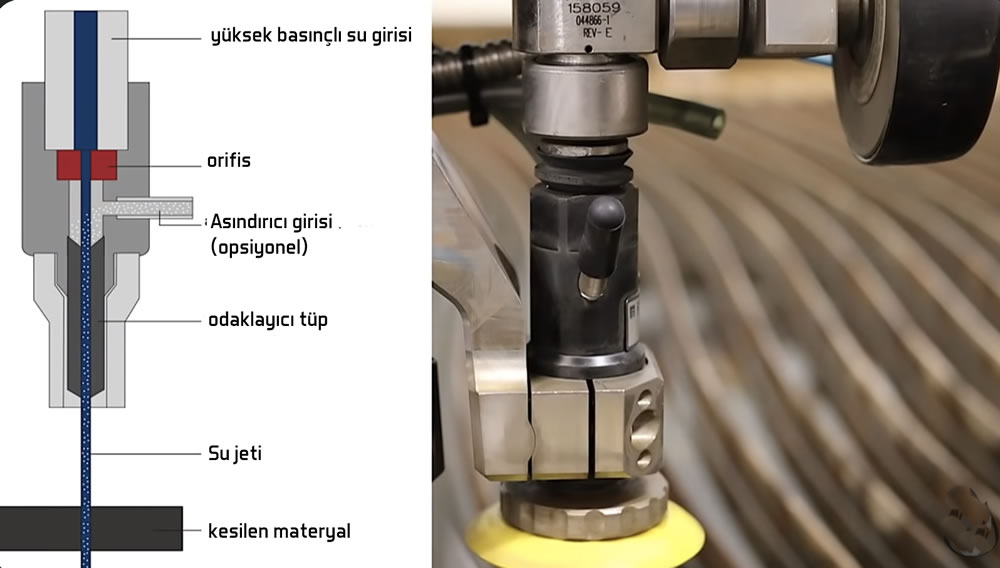
the construction and operation of a waterjet

The smaller the nozzle, the thinner the material that can be cut, and vice versa. However, cutting very thick and hard materials takes more time, which increases cost.

Although waterjet cutting is more economical, its maintenance cost is high, since parts like high-pressure pumps and cutting heads wear out.

Conclusion: Which Is Better?

Laser cutting and waterjet cutting share one common advantage: compared to other methods (plasma and oxy-fuel cutting), their kerf widths are very small, so they can be used for workpieces too small to be cut by other machines.

To summarize, laser and waterjet cutting methods are completely different, but neither is better than the other — they complement each other. Businesses can use laser cutting or waterjet depending on their needs. When your factory has both of these cutting machines, your competitive advantage will undoubtedly increase significantly.

Because you can have more flexible options regarding the type of cutting materials, the thickness of the workpieces, or the factory’s subsequent order management system.

Related Questions

Since the laser cuts using heat, the thicker the material, the harder it has to work, and cutting quality can suffer. On thin materials under 25 mm, it has the advantage in both speed and precision.

Increasing power in a CO2 laser is difficult due to the risk of the system’s mirrors being damaged at high power. Fiber lasers, using a different light delivery system, can reach higher power without hitting this limitation.

Related Posts
Electrical Discharge Machining (EDM) Machines Electrical Discharge Machining (EDM) Machines The Best 3D Scanning Apps The Best 3D Scanning Apps How 3D printers work What Is 3D Printing – How Do 3D Printers Work? En İyi 3D Tarayıcılar Satın alma rehberi The Best 3D Scanners of 2022 – Buying Guide laptop showing a SolidWorks screen and a solid model The Best Free CAD Software for 3D Print Design laser cutting The Relationship Between Laser Cutting Quality and Material Composition 3d Baskıya Hazır Kedi-Fare Oyuncak Otomat 3D-Print-Ready Cat & Mouse Automaton Toy Lazer Kaynağının Avantaj ve Dezavantajları Advantages and Disadvantages of Laser Welding
Laser Machining Waterjet Machining
Share. Facebook Twitter WhatsApp Tumblr Email Telegram Copy Link

Leave A Reply Cancel Reply


In the Shadow of Revolution: 5 Books About the French Revolution
What Is a Vehicle Ignition System, How Does It Work? What Are Its Failures?
  • Contact
  • Terms of Service
  • Privacy & Cookie Policy

Type above and press Enter to search. Press Esc to cancel.