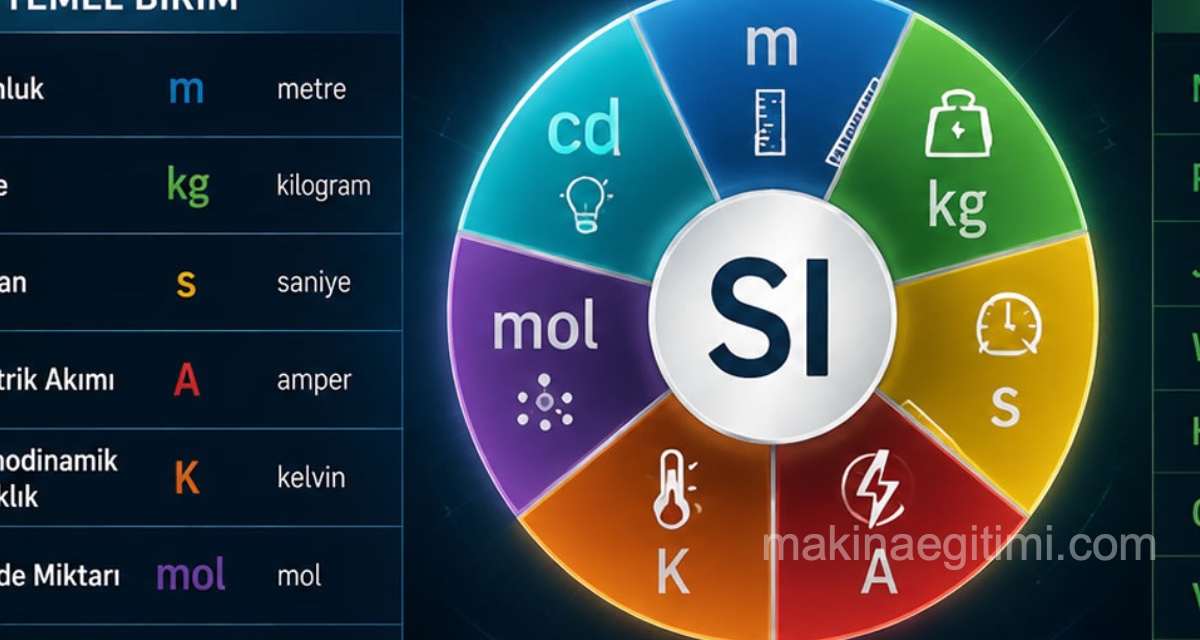
The common language of physics and engineering calculations is systems of units. The standard system used in science and engineering worldwide is the International System of Units (SI – Système International d’Unités). In this article, we examine the base and derived units of the SI system, its prefixes, and why it is so important.
What Is the SI System of Units?
The SI (International System of Units) is a standard, decimal-based (powers of 10) system of units used in science, engineering, and industry worldwide. It allows different countries and scientists to express the same quantities using the same units; this makes calculations, production, and trade consistent at an international level. For example, when the dimension of a machine part is given in millimeters in Turkey, a manufacturer in Germany using the same system can produce that part correctly.
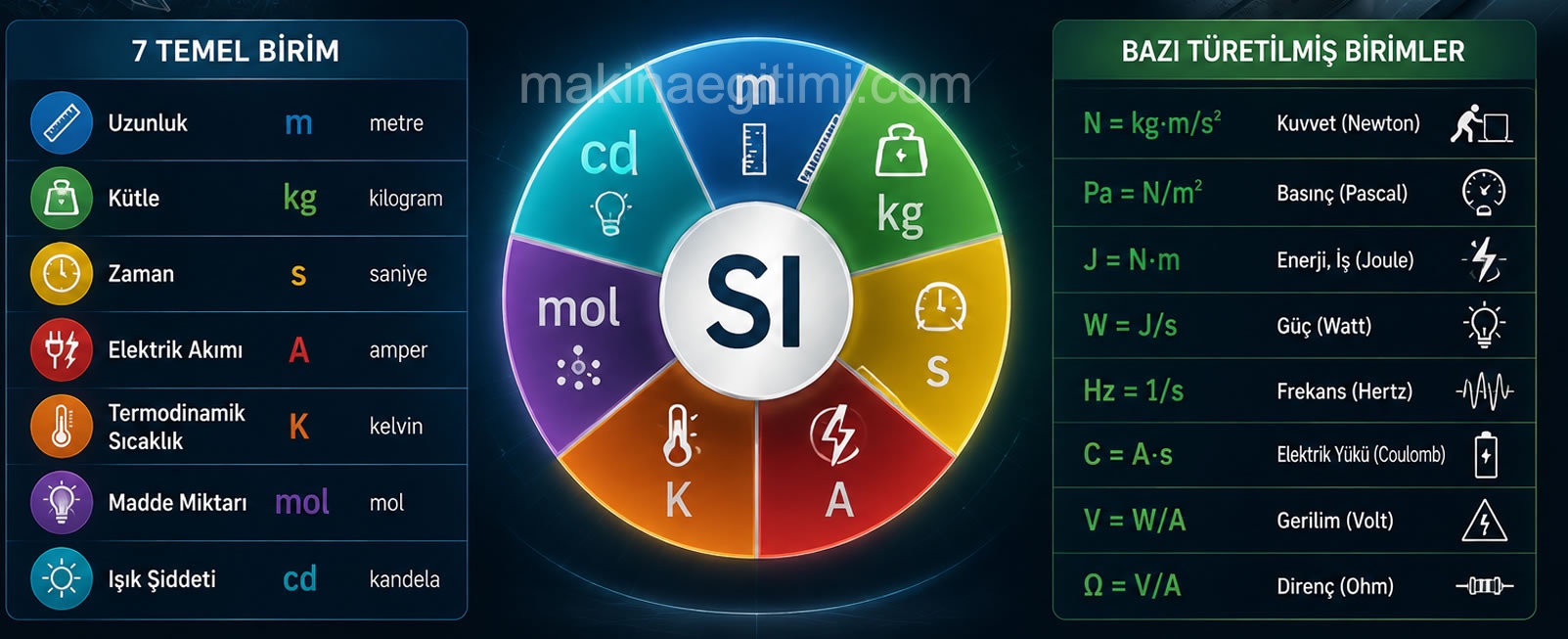
The 7 Base SI Units
At the foundation of the SI system are 7 base units, from which all other units are derived:
| Quantity | Unit Name | Symbol |
|---|---|---|
| Length | meter | m |
| Mass | kilogram | kg |
| Time | second | s |
| Electric current | ampere | A |
| Temperature | kelvin | K |
| Amount of substance | mole | mol |
| Luminous intensity | candela | cd |
Derived Units
Many units frequently used in engineering are obtained by mathematically combining the base units. The derived units most commonly encountered in the field of machinery and manufacturing are:
| Quantity | Unit | Symbol | In Terms of Base Units |
|---|---|---|---|
| Force | newton | N | kg·m/s² |
| Pressure | pascal | Pa | N/m² |
| Energy / Work | joule | J | N·m |
| Power | watt | W | J/s |
| Frequency | hertz | Hz | 1/s |
| Torque (moment) | newton meter | N·m | kg·m²/s² |
| Speed | meter/second | m/s | m/s |
| Acceleration | meter/second² | m/s² | m/s² |
SI Prefixes (Multipliers)
Standard prefixes are used in the SI system to easily express very large or very small values. The ones most commonly encountered in engineering are:
| Prefix | Symbol | Multiplier | Example |
|---|---|---|---|
| giga | G | 10⁹ | GPa (gigapascal – modulus of elasticity) |
| mega | M | 10⁶ | MPa (megapascal – strength) |
| kilo | k | 10³ | kN (kilonewton – force) |
| centi | c | 10⁻² | cm (centimeter) |
| milli | m | 10⁻³ | mm (millimeter – dimension) |
| micro | µ | 10⁻⁶ | µm (micrometer – surface roughness) |
Common Examples in Mechanical Engineering
- Pressure: In hydraulic systems, pressure is generally expressed in “bar”; 1 bar ≈ 100,000 Pa = 0.1 MPa.
- Strength: The tensile strength of steel is generally given in MPa (for example, ~360-510 MPa for S235 steel).
- Surface roughness: The Ra value is expressed in micrometers (µm).
- Rotational speed: A machine’s spindle speed is given in revolutions per minute (rpm); although this is not a derived SI unit, it is a widely used engineering unit.
Why Is It Important to Use SI Units Correctly?
A unit error in engineering calculations can produce consequences just as dangerous as a scale error. One of the most well-known incidents in history caused by unit confusion is NASA’s Mars Climate Orbiter spacecraft in 1999, which lost its orbit and was destroyed because one team worked with imperial (pound-force) units while another team worked with SI (newton) units. This example shows that unit consistency is not just an academic detail, but a critical issue that directly affects real engineering outcomes.
Conclusion
The SI system of units is the common language of physics and engineering calculations. Using base and derived units correctly, along with their prefixes, both prevents calculation errors and allows engineers from different countries and sectors to speak the same language. Anyone learning or working in the field of machine technology gaining a solid grasp of these fundamental units builds a strong foundation for the more complex calculations they will encounter later.
Related Posts