In this article we will cover how to connect batteries in series, the purpose of connecting batteries (sources) in series, and whether connecting batteries in series and parallel actually increases current and voltage.
First, let us explain what a source and a battery are.
Source: a component, such as a battery or accumulator, that produces the electrical energy needed for a circuit to operate.
Battery/Cell: a source that converts stored chemical energy into electrical energy on demand.
Connecting Batteries in Series
Many electronic devices use not just one, but two, three, four, or more batteries. Batteries can be combined and arranged in several different ways, for different reasons, to obtain more voltage or more capacity.
How to Connect Batteries in Series
To connect batteries in series, the batteries must have the same voltage and current rating. This way, their voltage increases in proportion to the number of cells connected, while the current stays constant. As shown below, batteries must be connected positive terminal to negative terminal.

The diagram above shows four 1.5 V batteries. When batteries are connected in series like this, the total voltage of the battery pack equals the sum of the individual voltages: 1.5+1.5+1.5+1.5 = 6 V

Equivalent Voltage and Capacity for Series-Connected Batteries
The equivalent voltage (Volts) of batteries connected in series equals the total voltage of the batteries.
Capacity (Ah) does not change.
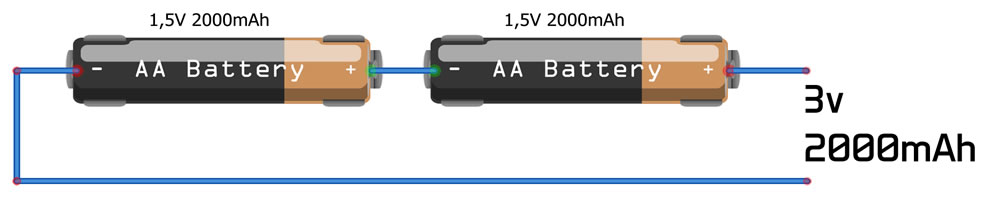
The runtime of identical batteries connected in series equals the runtime of a single battery. That is, if one battery lasts 3 hours in a circuit, two batteries connected in series will also last 3 hours in the same circuit. But it supplies a greater potential difference, and therefore more current, to the circuit.
Series Battery Holders
Inside many electronic devices and battery-powered toys, we can find battery holders like the one in the picture.
When we want to build our own battery-powered system, holders like this make our job easier. The series-connection battery holder is the most common type.
Still, if you want to check whether the battery holder you ordered is wired in series or parallel, look for a wire connecting the positive and negative terminals to each other. If such a connection exists, it is a series-wired battery holder.

Total Voltage in Series
When batteries are connected in series, the total voltage equals the sum of the individual battery voltages.
Current Capacity in Parallel
In a parallel connection, voltage stays constant while the total current capacity (mAh) increases by the sum of the individual battery capacities.
Using Batteries with Matching Specs
Mixing batteries of different capacity or voltage in a series or parallel connection can cause overheating and performance loss.
Connecting Batteries in Parallel
When connecting batteries in parallel, matching terminals are connected to each other. This means one battery’s positive terminal is connected to the other battery’s positive terminal, and likewise for the negative terminals. The voltage of batteries connected this way turns out to be the average voltage of the connected batteries. The resulting capacity is the sum of the capacities of the connected batteries.
Equivalent Voltage and Capacity for Parallel-Connected Batteries
When batteries are connected in parallel, the equivalent voltage (Volts) does not change.
Capacity (Ah) equals the total capacity of the batteries.

As shown in the example above, if two batteries with a capacity of 2000 mAh and a rated voltage of 1.5 V are connected in parallel, the equivalent voltage remains 1.5 V. However, the battery capacity doubles (4000 mAh).
Why Are Batteries (Sources) Connected in Parallel?
The purpose of connecting batteries in parallel: to increase the current-supplying capacity of the battery to the circuit. Connecting batteries in parallel provides higher capacity and a longer runtime.
Battery Runtime in a Parallel Connection
In a parallel connection, matching terminals of the batteries are connected to each other (positive to positive, negative to negative). In this connection, the total voltage stays the same as a single battery’s voltage, but the capacities (in mAh) add up. This lets the circuit run for a longer time.
Example: If 2 batteries, each 1.5 V and 2000 mAh, are connected in parallel:
- Total voltage: 1.5 V (unchanged, because voltage stays constant in a parallel connection).
- Total capacity: 2000 mAh + 2000 mAh = 4000 mAh.
Runtime calculation: If the circuit draws a constant current, for example 1000 mA (1 A):
- Runtime for a single battery (2000 mAh):
2000 mAh ÷ 1000 mA = 2 hours - Runtime for two batteries in parallel (4000 mAh):
4000 mAh ÷ 1000 mA = 4 hours.
In other words, for a circuit drawing the same current, a parallel connection doubles battery life. If the load current increases (for example, to 2000 mA), the runtime stays the same as a single battery (4000 mAh ÷ 2000 mA = 2 hours). This is the key advantage of a parallel connection:
Increasing Voltage and Capacity with a Mixed Series/Parallel Connection
Of course, it is possible to create a series-parallel connection that combines the properties of series and parallel wiring. For example, if batteries are connected according to the diagram below, the resulting nominal voltage of this battery pack will be 3V and its capacity will be 4000 mAh.

The calculation for the example above is given below. Let us recall the basic rule:
In a series connection of batteries, the equivalent voltage (V) equals the total voltage of the batteries. Capacity (mAh) stays constant.
In a parallel connection of batteries, the equivalent voltage (V) stays constant. Capacity equals the total capacity of the batteries.
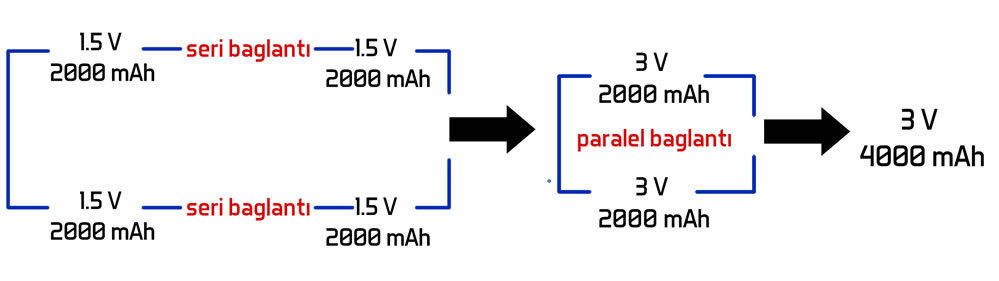
In the system above, for example, if a single battery’s runtime before depleting is 2 hours, the new system’s runtime will be 4 hours since the capacity has doubled.
The equivalent voltage of the 4 batteries has doubled through the series connection, becoming 3V. It remained unchanged through the parallel connection.
Related Questions
In a series connection, the batteries share the same electrical path (circuit), so the same current flows through all of them. Each battery’s own voltage adds to this shared current, increasing the total voltage, but the current itself does not change.
Connecting them this way lets each battery’s voltage add on top of the previous one. If connected the wrong way, the batteries cancel out each other’s voltage, which can make the total voltage much lower than expected or even damage the batteries.
Related Posts