Close Menu
  • MAKİNELER ve İMALAT
    • Tools & Equipment
    • Computer-Aided Drawing
    • CAD/CAM Education
    • CNC Machine Programming
    • Casting Technologies
    • Electrical & Electronics Technologies
    • Hydraulics & Pneumatics
    • Manufacturing Processes
    • Manufacturing Technologies
    • Occupational Safety
    • Mold & Die Design
    • Solid Modeling
    • Welding Technology
    • Machine Elements
    • Mechanical Trade Drawing
    • Materials Science
    • Automotive & Vehicle Technologies
    • Robotics Technologies
    • Health Technologies
    • Defense & Aerospace Technologies
    • Descriptive Geometry
    • Technical Drawing
    • Software & Hardware Technologies
    • Innovative Manufacturing Methods
  • TEKNOLOJİ ve YAŞAM
    • OTOMOBİLLER ve TAŞIT
      • Vehicle & Engine Knowledge
      • Safe Driving
      • Sürüş Destek Sistemleri
    • Genel Kültür
      • Movies & TV Shows
      • Görsel ve Grafik Sanat
      • Books & Literature
      • Music
      • Sports
      • History
      • History of Technology
    • GÜNDELİK YAŞAM TEKNOLOJİLERİ
    • Hobbies & Entertainment
    • Internet Technologies
    • Health
    • Mobile Technologies
Makine Eğitimi
  • Machines & Manufacturing
    Machine Elements
    Hydraulics & Pneumatics
    Technical Drawing
    Computer-Aided Design & Manufacturing
    Basic Manufacturing Processes
    Manufacturing Processes
    Industry Technologies
    Other Technical Courses
    Motion & Power Transmission
    Simple Machines
    Chains & Sprockets
    Shafts & Journals
    Gears
    Cams
    Couplings
    Belts & Pulleys
    Springs
    Bearings
    Keys
    Fastening Joining
    Retaining Rings
    Screws, Bolts & Nuts
    Cotter Pins
    Flanges
    Welding
    Rivets
    Pins & Bolts
    Washers
    Calculators
    Gear Ratio Calculator
    Spring Constant Calculator
    Belt Pulley Ratio Calculator
    Other Machine Elements
    Slides & Linear Guides
    Brakes
    Flywheels
    Clamps
    Shock Absorbers
    Gaskets & O-Rings
    Seals & Sealing Elements
    Hydraulics
    Introduction to Hydraulics & Principles
    Hydraulic Systems & Applications
    Accumulators
    Filters
    Motors
    Pumps
    Valves
    Pneumatics
    Introduction to Pneumatics & Principles
    Pneumatic Systems & Applications
    Pneumatic Circuit Components
    Valves
    Cylinders
    Silencers
    Motors
    Compressors
    Dryers
    Conditioning Units
    Common Topics & Maintenance
    Hydraulic & Pneumatic Maintenance
    Study Notes, Exams & Tests
    Technical Drawing
    Introduction to Technical Drawing
    Geometric Drawings
    Perspective & Projection
    Orthographic Views
    Dimensioning
    Sectioning
    Assembly & Detail Drawings
    Tolerances
    Surface Finish Symbols
    Mechanical Engineering Drawing
    Screws, Bolts & Nuts
    Pulley Drawings
    Gear Drawings
    Shafts & Journals
    Bearing Drawings
    Pins & Bolts
    Spring Drawings
    Welds in Technical Drawing
    Washers
    Cotter Pins
    Technical Drawing Exercises
    Mechanical Drawing Exercises
    Gear Exercises
    View Extraction Exercises
    Pulley Exercises
    Pin & Bolt Exercises
    Threaded Fastening Exercises
    Descriptive Geometry
    Computer-Aided Drawing
    AutoCAD Drawing Lessons
    Solid Modeling & Animation
    Solid Model Drawing Files
    Solid Model Assembly Examples
    Solid Model Drawing Lessons
    3D CAD Software Reviews
    Solid Modeling Exercises
    CNC Programming
    CAM
    Measurement & Inspection
    Dial Indicators
    Calipers
    Gauges
    Micrometers
    Materials Science
    Steels
    Cast Iron
    Aluminum
    Plastics
    Material Testing & Hardness Measurement
    Occupational Safety
    Workshop Safety
    Safety When Working With Electricity
    Machine Safety Rules
    Hand Operations
    Filing
    Marking
    Cutting Operations
    Reaming
    Tapping
    Threading With a Die
    Drill Bit Sharpening
    Working With Machines
    Basic Turning Operations
    Basic Milling Operations
    Shaper Machine
    Machining
    Turning
    Milling
    Grinding
    Innovative Manufacturing Methods
    EDM (Electrical Discharge Machining)
    Laser Machining
    Waterjet Machining
    3D Printing
    3D Scanners
    Welding
    Rolling
    Casting
    Mold & Die Design
    Mechanical & Hydraulic Presses
    Blanking & Piercing Dies
    Bending Dies
    Drawing Dies
    Plastic Injection Molds
    Extrusion Dies
    Compound Dies
    Progressive Dies
    Blow Molds
    Spinning Dies
    Spray Molds
    Manufacturing of Machine Parts
    Automotive & Vehicle Technologies
    Motor Vehicle Manufacturing
    Raw Material Production
    History of Technology
    Health & Medical Technologies
    Defense & Aerospace
    Robotics Technologies
    Software & Hardware Technologies
    Mechanics - Strength of Materials
    Physics Topics
  • Technology & Life
    Hobbies & Entertainment
    Sports
    Music
    Vehicle & Engine Knowledge
    Vehicle Maintenance & Repair
    Safe Driving
    Driver Assistance Systems
    History
    Movies & TV Shows
    Books & Literature
    Computers & Internet
    Computer Tips
    Software Reviews
    Hardware & Peripherals
    Practical & Safe Internet Use
    Visual & Graphic Art
    Mobile Technologies
    Travel
    Science
    Health
    First Aid Knowledge
    Everyday Technologies
Makine Eğitimi
Home»Physics Topics»Basic Topics in the Mechanics Course
29 August 2026

Basic Topics in the Mechanics Course

In this article, we will define the meaning and importance of mechanics, the fields of application of mechanics, the branches of mechanics, and concepts such as statics, dynamics, kinematics, aerodynamics, and hydrostatics. Our topics are as follows:

  • Mechanics
    • The Importance of Mechanics
    •  Fields of Application of Mechanics
    • Branches of mechanics
      • Mechanics of Liquids (Hydrostatics)
      • Mechanics of Gases (Aerodynamics)
      • Mechanics of Solids

Mechanics

Mechanics: A branch of science that studies, both graphically and analytically, the force systems acting on bodies and the motions these systems produce in the body.

The Importance of Mechanics

The task of the theoretical natural sciences is to tie the state of the bodies around us and the changes they undergo to clear, definite rules, organize them, and report their results in measured, numerical terms. The essential condition required to accomplish this is provided by our observations, which have continued for centuries.

A human being is a creature that can think about the causes of events, develop them, and use them for its own benefit. Since its existence, it has studied the events unfolding around it and nature itself. The technical level we have reached today is the sum of observations that began with the very first humans.
Lifting and throwing a stone, or stacking stones to form a structure, people walking or running, water flowing, the wind blowing, and similar things are each physical events — among the first things people saw or were able to do.

As a result of studying and evaluating such events, various systems were developed. Many ancient civilizations successfully used “levers,” developed for lifting heavy loads. Making use of the energy carried by moving bodies, and studying how bodies interact with one another, drew people in and made it necessary for them to learn about these things.
The knowledge gained through this study tied these events and their causes to definite rules.

 Fields of Application of Mechanics

Today, just as in the past, knowledge of mechanics holds a large place in human life. Opening a door, tightening a screw, the flow of water, the flight of an aircraft, a car’s ability to move, every kind of human movement, the operation of machines, and many more things one could list all follow the principles of mechanics.

From a lever, to a clock used for measuring time, to the most advanced spacecraft, knowledge of mechanics is needed everywhere. In particular, a significant part of the lives of those receiving a technical education will involve working with mechanical systems. This is why the subject of mechanics carries such importance.

robot mechanics

Among the scientists who dealt with mechanical problems and whose principles form the basis of today’s industrial developments, the ones most relevant to our subject are: Aristotle, Archimedes, Newton, Pascal, Galileo, Hooke, and Euler.

Branches of mechanics

branches of mechanics
The branches of mechanics are divided into 3 main areas: the mechanics of solids, liquids, and gases.

Mechanics of Liquids (Hydrostatics)

Hydrostatics studies the equilibrium conditions of liquids at rest. Liquids exert a pressure on the base of the container they are in. Liquids are also substances with a flowing property, taking the shape of the container they are held in.

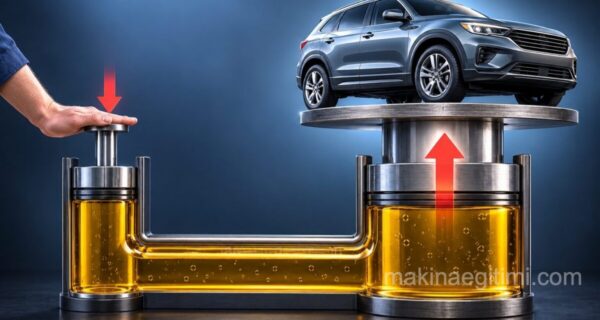
According to Pascal’s principle, liquids transmit any pressure applied to them equally to the surfaces they touch. As a result, a small force acting over a small area produces a large force over a large area. In machining, the system built to make use of the energy carried by pressurized liquids to produce various motions is called a hydraulic system. 

hydraulic lever Pascal's principle

Liquids are fluid substances and transmit pressure as it is applied to them. For this reason, a liquid transmits force in direct proportion to the surface area it acts on. As shown in the figure, the pressure provided by the small piston is transmitted by the liquid to the large piston and turns into a large force. Because of this property, liquids are used to generate pressure and force in presses, lifting machines, pumps, hydraulic power units, etc.

Pascal's law
With the application of Pascal’s principle, it became possible to lift large loads with small forces.

Mechanics of Gases (Aerodynamics)

Aerodynamics: Studies the motion of all fluids in the form of air or gas. For example, the shapes given to aircraft wings to increase flight efficiency are calculated using this branch — such as making the wings and certain sections oval in form. Gases are flowing, volatile substances that can change in volume and pressure under the effect of heat.

aerodynamics
When we say mechanics of gases, aerodynamics comes to mind.

Mechanics of Solids

A solid body: any body that, under the effect of forces, preserves its geometric shape and dimensions exactly in every case — that is, undergoes no change in shape — is called a “solid body.”
However, no body shows this property perfectly. Every body changes shape somewhat under the effect of force. But depending on the magnitude of the force and the dimensions of the body, if the amount of shape change is so small it can be neglected, such bodies can be considered solid bodies.

For example, the atoms of steel are bonded to one another very strongly. As a result, steel does not easily change shape. Because of this property, we find steel used in the material of many machine components.
The mechanics of solids is divided into three main branches according to the effects of factors such as equilibrium, force, velocity, and acceleration

Related Posts

Table of SI base units used in physics and engineering What Is the SI System of Units? Base and Derived Units Base and derived quantities, title image Base and Derived Quantities Connecting Batteries in Series and Parallel Connecting Batteries in Series and Parallel Branches of Solid Mechanics – Statics, Kinematics, Dynamics What Is Pascal’s Principle? Where It Is Used What Is Pascal’s Principle? Where It Is Used simple machines Simple Machines How to Calculate the Resultant Force How to Calculate the Resultant Force Finding Component Forces Finding Component Forces
Mechanics of Materials
Share. Facebook Twitter WhatsApp Tumblr Email Telegram Copy Link

Leave A Reply Cancel Reply

The October Revolution: How a Tsardom Fell Overnight
The Miracle of Istanbul: Football History’s Most Incredible Comeback
  • Contact
  • Terms of Service
  • Privacy & Cookie Policy

Type above and press Enter to search. Press Esc to cancel.