

What is Pascal’s law — one of the laws of hydraulics — also known as Pascal’s principle? What vehicles, tools, and machines run on Pascal’s principle? What are some everyday examples of Pascal’s principle in use? These are the topics we’ll cover in this article.
What Is Pascal’s Principle?

When pressure is applied to a fluid inside a closed system, the same pressure prevails throughout the entire system.
In other words, this fluid is under the same pressure everywhere. This phenomenon was discovered in the 17th century by Blaise Pascal, and is called Pascal’s principle or Pascal’s law.
Pressure is created when a force acts on an area.
Pressure = Force / cross-sectional area
P = F / A
According to Pascal’s principle, this pressure acts equally on every point of the fluid in the container that it touches.
This seemingly simple principle has actually been the inspiration behind many machines and systems used in everyday life and in industry.

By building a system that takes advantage of Pascal’s principle, it’s possible to amplify a small force and use it in various applications — elevators, lift platforms, presses, hydraulic jacks, and so on.
So how does this work?
Pascal’s law says the pressure is the same at the input and the output.
Since we find pressure with the formula P = F/A;
P = F1 /A1 = F2 / A2
is the correct way to write it. So, since the pressure is always the same, if we make the cross-sectional areas at the first and second parts different, the transmitted force will be different too.

Let’s explain this with an example:
What if we told you that, using this principle, we can lift very heavy loads with small forces — vehicles weighing more than 1 ton, for example? What would you say? Yes, it’s possible.

In the system shown below, the relationship between the applied force and the force lifting the car depends on the relationship between their cross-sectional areas.

Since the pressure is the same everywhere;
P1 = P2
If we substitute F / A for P,
F1 / A1 = F2 / A2
F1 /A1 = F2 / 10.A1
F1 /A1 . A1 = F2 / 10
F1 = F2 /10
F2 = F1 .10
So we can see that by making the cross-sectional area 10 times larger, we’ve made the transmitted force 10 times larger.
What does Pascal’s Principle mean in practice?
Because pressure is distributed evenly throughout a hydraulic system, force applied at just one point can be used at another point in the system. In this sense, the fluid can act like a mechanical push rod.
Where Pascal’s Principle Is Used
Since Pascal’s principle is one of the basic principles of fluids, we could say it’s the foundation of hydraulics. Because the principle relates to cross-sectional area and pressure, it’s most prominent in piston-cylinder applications. Pascal’s principle is used in a very wide range of fields. Here we’ll cover a few of its applications:
1- Hydraulic jack

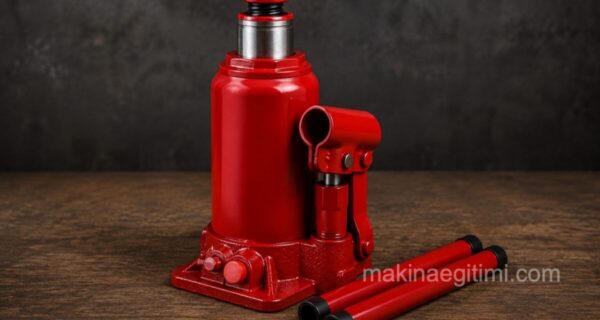
Hydraulic jacks are designed using Pascal’s principle from hydraulics and pneumatics (a topic covered in physics classes). The image above shows how a hydraulic jack, which works according to Pascal’s principle, operates.
Related Post How Does a Hydraulic Jack Work?
The working principle of a hydraulic jack. Cross-section view of a jack. Animated cross-section of a hydraulic jack in operation. How does a hydraulic jack work.
2- Heavy equipment
Also based on Pascal’s principle — that pressure generated at any point in a system can be reliably transmitted to another point in the system — hydraulic heavy equipment (bulldozers, graders, etc.) has been developed. High-pressure hydraulic oil pushing pistons and piston rods gives heavy equipment its multiple ranges of motion.
3- Hydraulic brake system
Another example of a machine that runs on Pascal’s principle is a car’s brake system. In a hydraulic brake system, when the brake pedal is pressed, the oil that moves from the cylinder attached to the pedal toward the brake pads causes the pads to close and press against the wheel. When we release the brake pedal, the compressed oil returns to the cylinder as the volume increases, and the pressure on the pads disappears.

Equal Distribution of Pressure
Pascal’s principle states that pressure applied to an enclosed fluid is transmitted equally to every point of the fluid.
Force-Multiplying Effect
Hydraulic presses can lift heavy loads by multiplying a small force applied to a small piston through a larger piston.
Use in Brake Systems
Vehicles’ hydraulic brake systems use Pascal’s principle to transmit pedal force equally to all wheels.
According to Pascal’s principle, the pressure applied to the brake fluid at the central cylinder is distributed without loss. So the brake fluid transfers the pressure from a small area (the central cylinder) to a larger area (the wheel cylinders), increasing the force.

Hydraulic brakes are an example of Pascal’s principle at work in everyday life. Above we see a simplified illustration of how a disc brake mechanism works

Aircraft brake systems are also built based on Pascal’s law. (above)
4- Oil wells
Oil wells are also among the applications of Pascal’s principle.

In oil wells, oil is extracted by being pushed upward with the help of pressure. The pump we see at oil wells, known as a pumpjack, draws air molecules upward on every upstroke, creating a low-pressure zone and a vacuum effect. A second well is drilled next to the main well. Water pumped into this well creates high pressure through cracks in the rock. This high pressure directs oil that can’t be drawn up by the vacuum toward the main well as well.
5- Lift platform
While we’re on the subject of tools and machines that run on Pascal’s principle, we can’t skip hydraulic lift platforms. The car lift platforms we see at auto repair shops are a great example of Pascal’s principle at work.

We said earlier that, according to Pascal’s principle, when pressure is applied to a fluid inside a closed system, the same pressure prevails throughout the entire system. So P1 = P2.
If F1 = P1 x A1 and F2 = P2 x A2,
let’s say the pressure P is 4 bar
F1 = 4 x A1 and F2 = 4 x A2
F1 = 4 x A1 and F2 = 4 x (10 x A1)
according to the equations above, if F1 = 4 units, F2 = 40 units.
In other words, when we make the area 10 times larger, we’ll also make the resulting force 10 times larger.
Related Questions
Pressure applied to an enclosed fluid is transmitted equally to every point. When the pressure created by a force applied to a small piston is transferred to a piston with a much larger surface area, that larger surface turns it into a much greater total force.
A jack transfers a small force applied by hand into pressure on a fluid through a small piston. When this pressure reaches the large piston, it turns into a force large enough to lift a vehicle — all made possible by Pascal’s simple principle.
Related Posts
How Does a Hydraulic Jack Work?  What Is the SI System of Units? Base and Derived Units
 Finding the Resultant Force in a System of Forces
 What Is Moment? How Is It Calculated? Moment Lesson
 Connecting Batteries in Series and Parallel
 Simple Machines
 How to Calculate the Resultant Force Branches of Solid Mechanics – Statics, Kinematics, Dynamics