
This article covers one of the topics that comes up in science, basic physics, mechanics, and strength-of-materials classes: what is a resultant force, and how is it calculated. We’ll cover force systems, how to calculate the resultant force, and give sample resultant-force problems. We’ll try to explain finding the resultant force as simply as possible, with plenty of examples, and reinforce the explanation with resultant force calculation questions.
What Are Resultant Force and Component Forces
Resultant force may look like a purely physics-class topic, but it’s actually present in every area of our lives. For example, some of our proverbs are related to resultant force. Like “one hand has no strength, but two hands make a sound” or “strength comes from unity.”

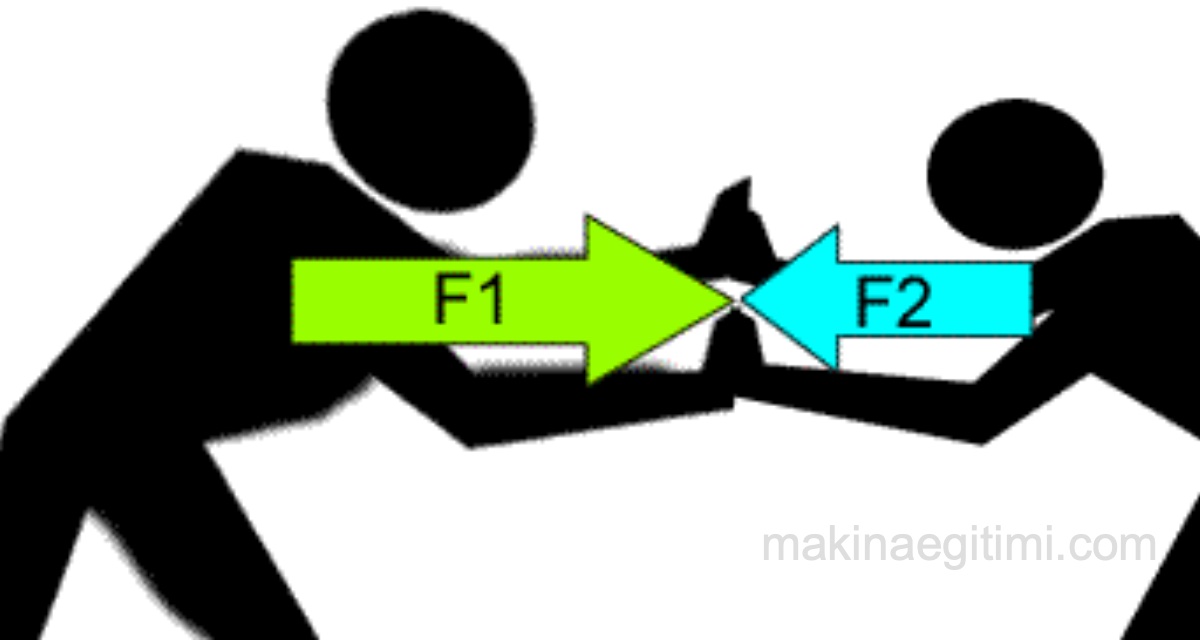
We all know the tug-of-war game played for fun in some villages, at schools, in scout activities, at holiday resorts, and so on. In this game, a rope pulled in different directions with different amounts of force ends up moving in one direction. There’s a system of forces at play here, but when we look at the direction the rope moves in, it looks as if there’s just a single force — the one toward the winning side. That’s because the resultant force points in the direction of the winning side.
If two or more forces act on an object, this group of forces is called a force system. As a result of these forces acting together, the object starts moving in one direction. The magnitude of this motion is called the resultant force, and each individual force is called a component force.
How to Calculate the Resultant Force
Finding the resultant force depends on the direction and orientation of the forces in the force system. The resultant force is calculated differently depending on whether the component forces are in the same direction, in different directions, or at an angle smaller than 90 degrees to each other.
Finding the Resultant Force When the Forces Are in the Same Direction


If the forces are in the same direction, the resultant force equals the sum of the component forces. The resultant force is denoted by R. The direction of the resultant force is the same as the direction of the component forces.
Finding the Resultant Force When the Forces Are in Different Directions

As in the example above, if two forces are in different (opposite) directions, the difference between the forces forms the resultant force.
Resultant Force Calculation
Finding the Resultant of Opposite-Direction Forces
Sample Problem
Let’s find the direction and magnitude of the resultant force in the force system shown in the figure.

Solution
If we call the sum of the rightward forces R2, and the sum of the leftward forces R1, we find the resultant force as follows:


Sample Problem 2:

How large is the single force (resultant force) that can, by itself, produce the same effect as the force system shown above, all acting along the same line?

Calculating the Resultant Force for Forces Meeting at an Acute Angle
If the forces are not along the same line and meet at an acute angle, the resultant force is calculated with the method below.


Sample Problem:
Calculate the resultant force of the two forces shown below, which have 60° between them.


Calculating the Resultant Force for Forces Meeting at a Right Angle
This is calculated using the same method as the resultant of forces meeting at an acute angle. The only difference is that since the angle between them is 90°, and cos 90° equals zero, and zero is the absorbing element in multiplication, it absorbs the values next to it in the formula. This shortens the formula.


Resultant Force Question 1:
The pulley shown in the figure is held by a rod. Based on the given forces, find analytically the force that strains the rod.

Solution


Resultant Force Question – 2 (for machining students):

In the turning operation shown above, given that the forces acting on the turning tool are Fv=80 N and Fk=60 N, calculate the resultant force analytically.

Finding the Resultant Force with the Parallelogram Method
Finding the resultant force analytically with the parallelogram method is shown step by step below.

In this article, we’ve covered how to calculate the resultant force. We looked at the methods for calculating the resultant force. Don’t forget to check out the related links below.
Related Posts
 What Is the SI System of Units? Base and Derived Units
  Connecting Batteries in Series and Parallel
  Base and Derived Quantities
  Science Fair Project Examples About Pascal Principle
  What Is Moment? How Is It Calculated? Moment Lesson
  Finding the Resultant Force in a System of Forces
  Newton’s Laws