
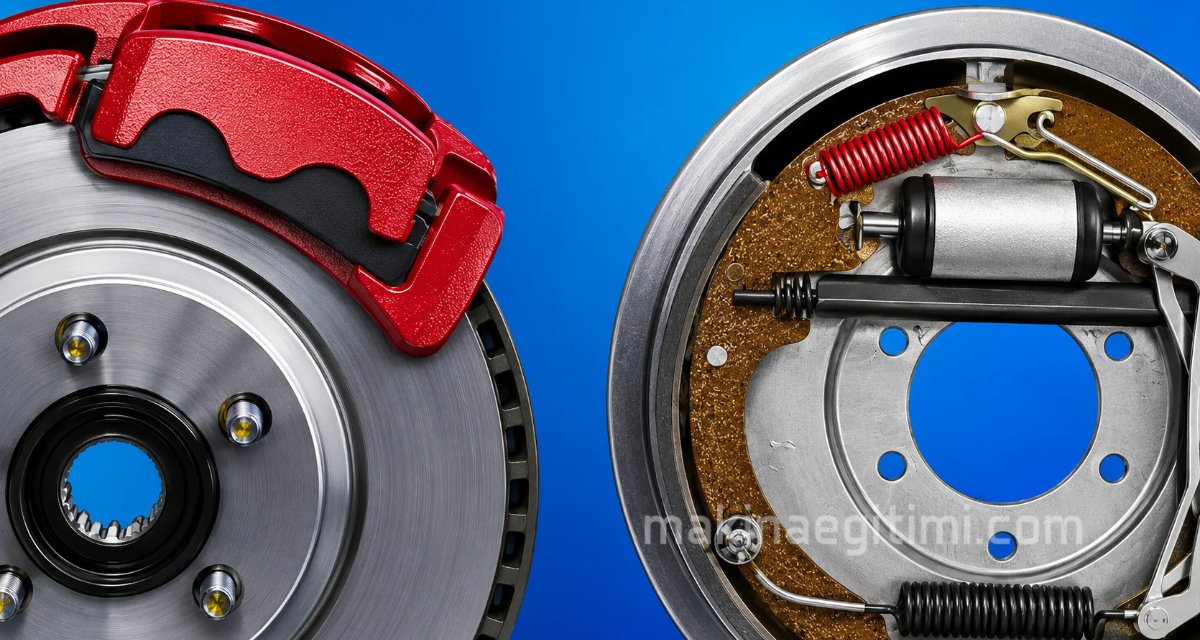
In this article, we’ll compare disc brakes and drum brakes among hydraulic brake types, and cover their strengths and weaknesses. We’ll try to answer the question “Which brake system is better?“
Although both operate on the same basic hydraulics, the two brake types perform differently. Disc brakes are more efficient, provide better stopping power, dissipate heat more easily, and work better in wet conditions. Disc brakes are also less complex.

Why Disc Brakes Are Preferred
Most vehicles today have disc brakes on all four wheels. To reduce costs, some base models use disc brakes at the front and drums at the rear, which makes them more cost-effective. Why is a disc placed at the front and a drum at the rear in these models? It comes down to weight factors. A typical, unloaded vehicle is about ten percent heavier in front due to the engine. Then, when you hit the brakes, the vehicle’s weight shifts forward. More braking power is needed there, which leads to disc brakes being preferred on the front wheels.
For those with drum-braked vehicles who want disc brakes, conversion kits are available to switch to disc brakes.
Better Heat Dissipation
Thanks to their open structure, disc brakes dissipate heat much more effectively than drum brakes.
Performance in Wet Conditions
Disc brakes dry themselves faster in rainy weather, offering more consistent performance than drum brakes.
Easy Maintenance
Checking and replacing disc brake pads is generally faster and easier than with a drum system.
Advantages of Disc Brakes
Disc brakes apply braking force faster, providing shorter stopping distances.
Heat management. Because they’re exposed to air, disc brakes cool better. Drum brake components aren’t exposed much to air, so they take longer to cool after braking. This can cause the brake to weaken and lose stopping power when the friction material overheats.
Another advantage of disc brakes is their wet performance. Disc brakes perform better in wet conditions because they’re exposed to air and can easily throw off water. The rotors are also dried by the pads dragging across them. When water gets inside a drum brake, it tends to get trapped inside the drum, so the friction material takes longer to dry.
Weight. Discs are lighter than drum brakes designed to apply the same force.
Service and Maintenance/Repair
Cleanliness. Disc brakes are self-cleaning. The brake pads “wipe” the rotor when they engage. Drum brakes are enclosed and prone to dust buildup on the shoes, so they need to be cleaned periodically.
Repairs. Drum brakes have more hardware and can be more complex to maintain. However, replacing drum brake shoes and wheel cylinders is typically cheaper than disc brake pads and calipers.
Disc Brake vs. Drum Brake Comparison
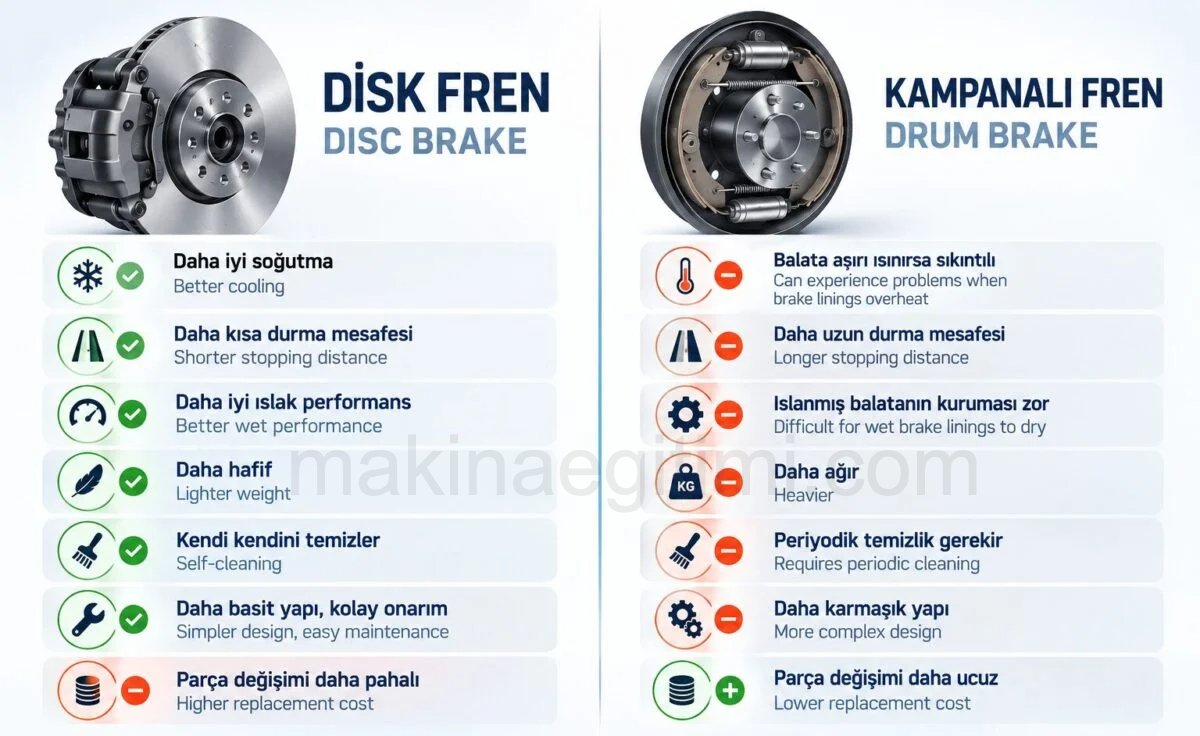
As you can see in the disc brake vs. drum brake comparison shown above, disc brakes’ strengths far outweigh their weaknesses. We think this gives a sufficient answer to the question which brake system is better?
Related Questions
Because a disc brake’s rotor is exposed, it comes into direct contact with air and the generated heat spreads out quickly. In drum brakes, on the other hand, heat is trapped more within the enclosed drum structure, so it dissipates slowly.
Since the vehicle’s weight shifts forward under braking, the front wheels have to carry more braking force. This is why the stronger and more efficient disc brakes are placed at the front, while the less loaded rear can get by with cheaper drum brakes.
Related Posts
 Engine Noises and What They Mean
 Why Does an Engine Misfire? Engine Misfire Problem
 Front-Wheel-Drive Vehicles: Advantages and Disadvantages
 What the Markings on a Car Tire Mean
 Parts of the Engine, Illustrated Explanation
 Vehicle Fuel System Components and Their Functions
 If the Engine Won’t Start, the Reason. Reasons the Engine Won’t Start
 The Importance of Using Original Parts on a Motorcycle