

In this article, we’ll look at the components of a vehicle’s engine fuel system. We’ll try to explain the parts of the engine fuel system and their functions. First, let’s cover what the fuel system is and what it does:
Fuel System
An engine needs three things to produce power: fuel, air, and a source of ignition. The engine draws in air and then adds this air to the fuel that burns in the engine cylinder to turn the engine. The fuel system is responsible for making sure the engine has the correct air-fuel mixture for combustion.
A modern engine’s fuel injection system is very different from the one used 30 years ago. In the past, the engine used a moving piston to create a vacuum, drawing fuel from the carburetor and mixing it with atmospheric air. Today, computers can sense when fuel is needed and inject it directly into the engine cylinder. While pistons are still used to draw air into the cylinder, today’s engines run much more efficiently.
Fuel Pump Pressure
Modern electric fuel pumps typically produce a supply pressure of 3-6 bar in gasoline engines.
Fuel Filter Life
Fuel filters are typically replaced every 20,000-40,000 km to prevent injectors from becoming contaminated.
Vapor Recovery System
Gasoline vapors in the fuel tank are captured by an activated-carbon canister before they can be released into the environment.
Components of the Fuel System and How They Work
Fuel System in Gasoline Vehicles

The components of the fuel system in gasoline vehicles are:
- Fuel tank
- Fuel pump
- Carburetor / throttle valve and choke valve
- Air filter
- Intake manifold
The job of the choke valve: To help the engine start easily in cold weather.
The job of the throttle valve is to supply the system with air/fuel in proportion to how far the accelerator pedal is pressed.
Fuel Pump

The fuel pump carries fuel from the tank to the engine. It can be mounted in the fuel tank, just outside the fuel tank, or even on the engine itself.
Fuel Tank

In the past, gas vapors in the fuel tank were released into the atmosphere. Today, the fuel tank has a valve that allows these vapors to be routed back to the engine and burned as part of the combustion process. This system is called the evaporative emission control (EVAP) system.
NOTE: Compressed air is used to clean air filters. However, oil-bath type air filters (usually used in diesel vehicles) are cleaned with kerosene. Failing to clean the air filter causes excessive fuel consumption. A rich mixture forms and the exhaust smoke comes out black.
Fuel System in Diesel Vehicles
The fuel system in diesel vehicles is somewhat different. Spark plugs are not used for ignition in diesel vehicles. While the fuel system in gasoline vehicles focuses on preparing the fuel-air mixture, in diesel vehicles it focuses on injecting fuel into the cylinder under very high pressure.
Components of the Fuel System in Diesel Vehicles
- Fuel tank
- Fuel filter
- Supply pump
- High-pressure pump
- Common rail (fuel rail) or distributor pump
- Injectors
How Does the Fuel System Work in Diesel Vehicles?
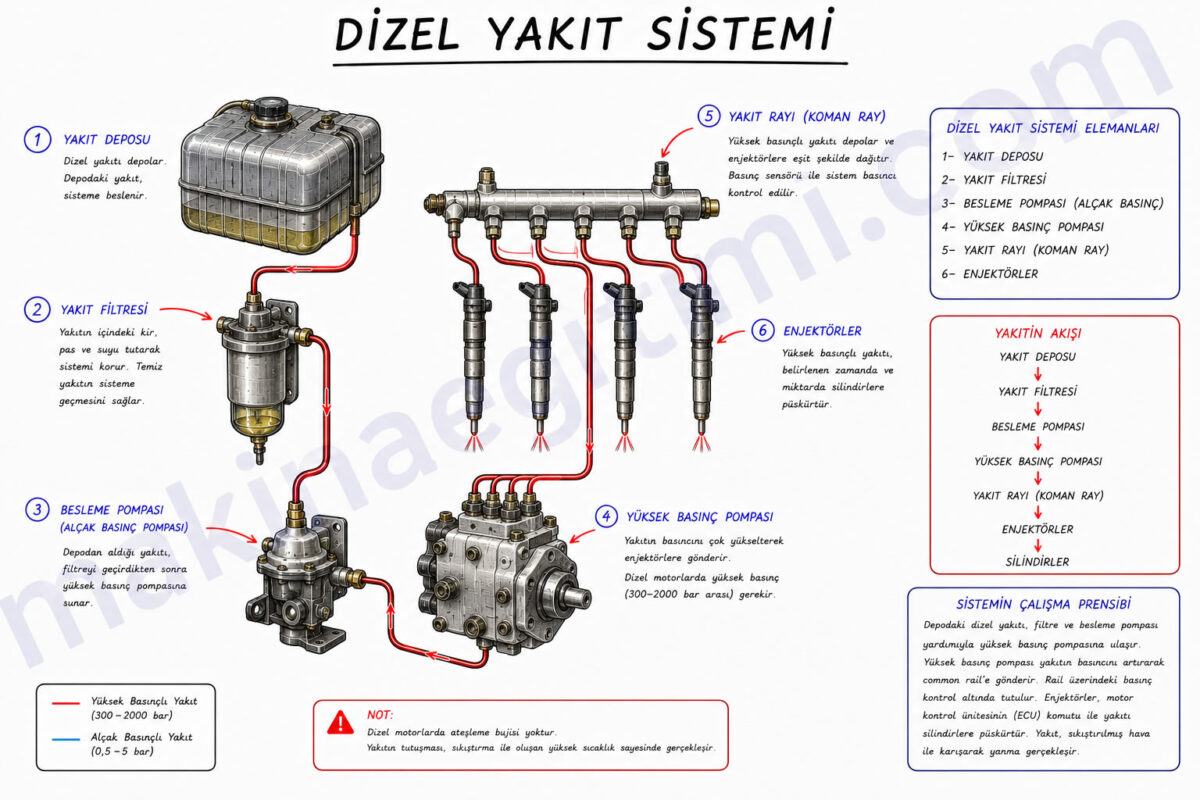
Differences Between Gasoline and Diesel Vehicle Fuel Systems
Gasoline engine: Fuel + air mixture is prepared → the spark plug ignites it.
Diesel engine: Air is compressed first → the air heats up significantly → diesel fuel is injected at high pressure → the fuel ignites on its own.
Gasoline Fuel System
- Fuel is mixed with air by the carburetor (older vehicles) or by the injector.
- Fuel pump pressure is low.
- The fuel is ignited by a spark plug.
- In carbureted systems, the air-fuel mixture is prepared in the carburetor.
- Its structure is simpler and maintenance costs are lower.
Diesel Fuel System
- Fuel is injected into the cylinder only by the injector, at very high pressure. There is no spark plug.
- The high-pressure pump can produce a pressure of 300–2000 bar (or even more).
- Air and fuel combine inside the cylinder. The fuel is injected at the very last moment.
- Its structure is more complex and operates with high precision.
Fuel Filter

The fuel filter traps microscopic particles in the fuel, preventing the fuel injectors and pump from clogging and keeping contaminants away from the engine. Fuel filters can be manufactured in various shapes and sizes.
Fuel Injector

Instead of drawing fuel into the engine using vacuum, like a carburetor, a fuel injector sprays fuel into the engine. The computer can control how long and when the fuel injector is triggered.
Fuel Sensors and Monitors
Your vehicle relies on various sensors and monitors to determine when the engine needs to be fed fuel.
- Fuel Rail Pressure Sensor: Tracks the pressure in the fuel rail and relays this information to the engine control unit.
- Fuel pressure regulator: A mechanical way of regulating proper fuel pressure. If the pressure rises too high, the regulator opens and sends the excess fuel back to the fuel tank. This is used when the pump is not controlled by the computer.
- Fuel tank pressure sensor: This sensor tells the computer whether the pressure in your gas tank is correct. If it’s too high or too low, it means the vapors in the fuel tank likely aren’t making it to the engine to be burned.
Related Questions
In a carburetor, fuel was drawn from the intake manifold by the vacuum created by the piston. Today, computer-controlled injectors spray fuel directly and in precisely metered amounts into the cylinder, which results in much more efficient combustion.
The filter traps dirt and particles in the fuel, preventing them from reaching the injectors. Over time it can fill up with this dirt and become clogged, so it needs to be replaced regularly to prevent damage to the injectors.
Related Posts
 Why Doesn’t the Engine Start? Reasons the Engine Fails to Start.
 What the Markings on a Car Tire Mean
 Characteristics and Advantages of Rear-Wheel-Drive Vehicles
 Diesel Engine vs. Gasoline Engine: Which Is More Powerful?
 Types of Engine Oil Pumps
 What Is a Carburetor? What Does It Do? How Does It Work?
 What Is a Timing Belt? What Does It Do?
 What Is a Starter Motor, What Does It Do?