

In this article, in our Materials Science section, we’ll try to explain what an alloy is and how it forms. We’ll look at the properties of alloys and try to cover the subject in depth by giving some well-known alloy examples. Our topics are as follows:
What Is an Alloy
Metal-like substances obtained by combining two or more metals, and sometimes a metal with a nonmetal like carbon, are called an alloy. That is the definition of an alloy.
Which Was the First Alloy Ever Found
Bronze can be given as an example of the first alloy humans ever made from different metals. Copper and tin were alloyed together, and an entire era came to be known as the Bronze Age (roughly 2500 BC).
The low melting point of the tin and copper that make up bronze is what allowed bronze-making to be the first alloy. In the millennia that followed, advances were made in alloys meeting more diverse needs, and today almost no metal is used in pure form.
How Is an Alloy Formed?

For elements to form an alloy, atoms need to group together individually according to a certain proportion. In some cases only a portion of the atoms take part in this grouping, while in others all of the atoms take part. For example, in brass all of the zinc and copper atoms come together and group into molecules. In steel, on the other hand, iron atoms and a portion of the carbon atoms combine to form iron carbide molecules.
Homogeneous Mixture
Alloys are a homogeneous mixture, at the atomic level, of two or more metals (sometimes together with nonmetal elements).
Property Improvement
Alloying is done to improve properties like strength, corrosion resistance, or hardness compared to pure metals.
Shift in Melting Point
An alloy’s melting point can often differ from the melting points of the pure metals in its composition.
Examples of Alloys
When giving examples of alloys, we can’t skip steel. Steel is an alloy of iron and carbon. There are hundreds of types of steel, varying by the type and proportion of the elements added to it, and all of them are alloys.
We already mentioned that copper and tin are alloyed together to make bronze.

Is solder an alloy? is a question a lot of people seem to ask. Yes, solder is an alloy obtained by melting and mixing tin and lead together. (36% lead, 64% tin)

Brass is a copper-zinc alloy. Its zinc content is at most 46%. (image above)

Amalgam is one of the examples of an alloy that mercury forms with other metals. For instance, the silver amalgam that dentists use for fillings. (above)

Cobalt and its alloys are preferred for body prosthetics because they resist wear and bodily fluids well. (above)

Because beryllium is an element with very low density and better elasticity than steel, beryllium alloys are used where rigidity and light weight matter — for example, in spacecraft construction. As another example of alloys, aluminum-lithium alloy is stronger and lighter than aluminum. These alloys are also used in the construction of spacecraft.

Bullets and shotgun pellets are made from a lead-arsenic alloy. This is why they’re also known by the name “lead.”
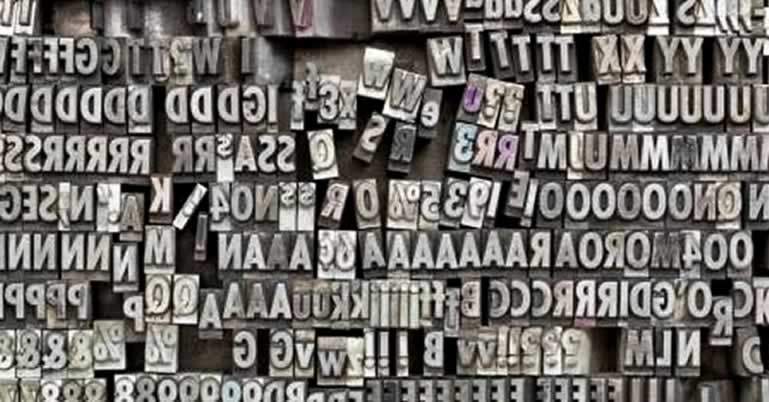
Printing type letters are made from a lead-antimony-tin alloy so they can be hard and pressure-resistant. A lead-antimony alloy is very hard but also quite brittle. It can’t withstand high pressures. Tin is added to reduce this brittleness.

The only thing “German silver,” a copper-nickel-zinc alloy, has to do with silver is that its color resembles it. (image above)
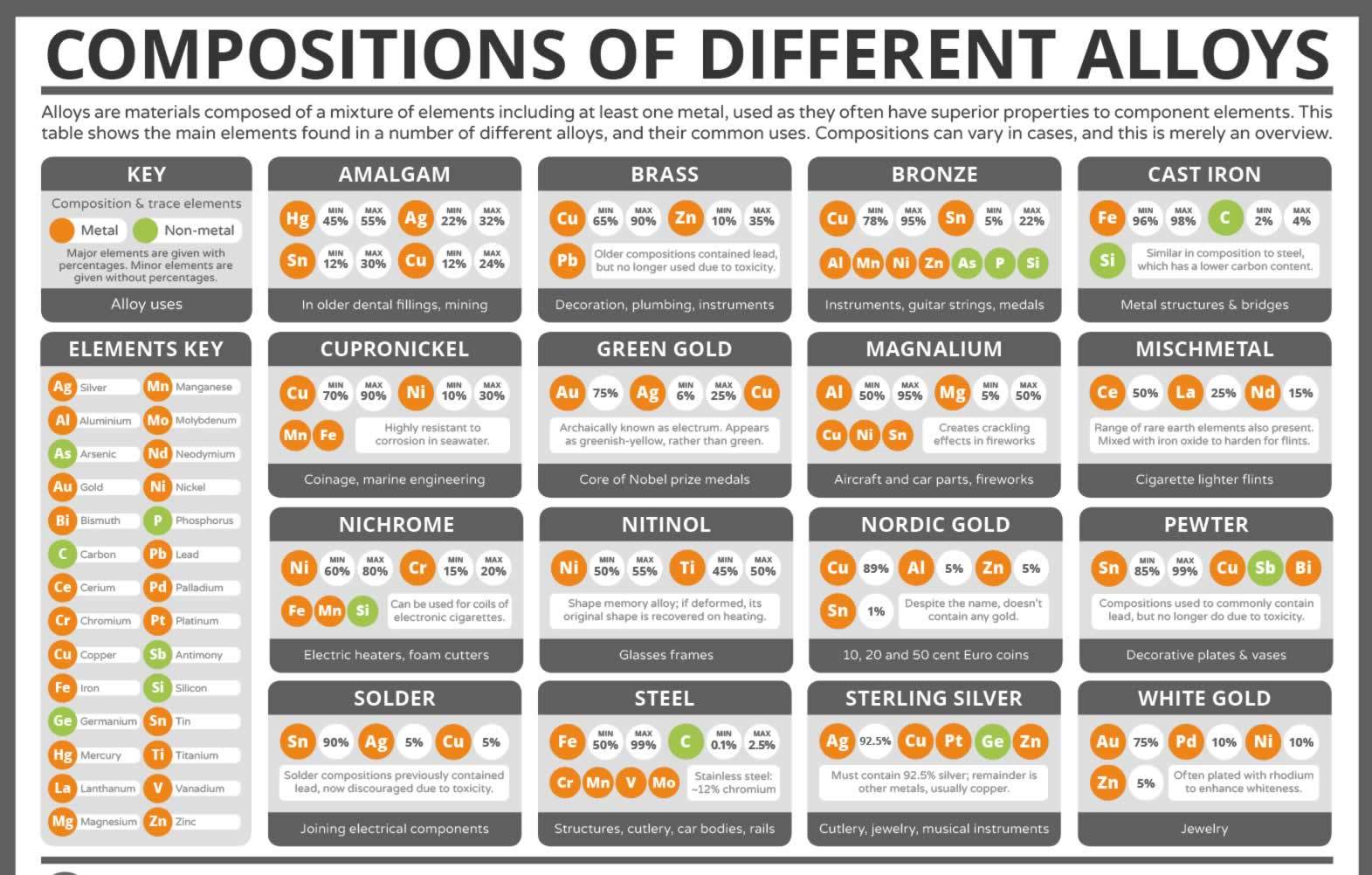
Some well-known alloy examples and their compositions. (above) You can click to enlarge.
Properties of Alloys
Any alloy has properties different from all the metals that make it up. The properties of a newly created alloy vary based on the properties and proportions of the elements that form it.
The melting point of an alloy made from two metals can be lower than, higher than, or exactly between the melting points of the two components. This property of alloys is what allows, for example, tin-lead alloys, known as solder, to be used for joining metals.
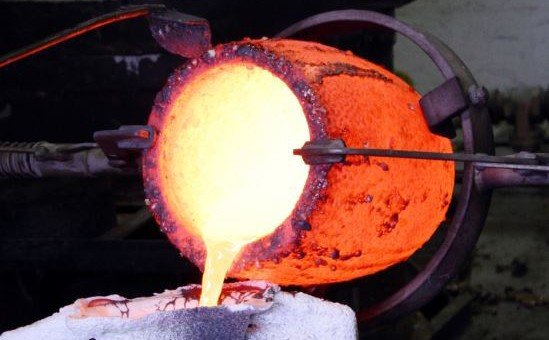
As long as the mixing proportions of the metals used in an alloy and the manufacturing technique remain unchanged, the resulting alloy’s properties will be the same each time. Even the smallest change in the mixing proportions can produce an entirely different alloy with very different properties.
Alloys melt more, and more easily, than the less-fusible metals that go into them.
In alloys, both metals are dissolved into each other, both in the solid and the liquid state.
Another property of alloys is that they’re generally harder and more durable than their components.
Special alloy steels can be produced by adding other elements to iron alongside carbon.
One of the most important differences separating alloys from pure materials is that, unlike pure metals, they don’t solidify or melt at a single temperature. Under equilibrium conditions (that is, when cooled or heated very slowly), all metals solidify or melt at a single temperature. An alloy’s solidification and melting, however, happen somewhere between two temperature values. If we heat an alloy to a point between these two temperature values and hold it there, we can give it a mud-like consistency, neither fully solid nor fully liquid.
Why Are Metals Alloyed?
1. To produce more suitable materials by changing the physical and mechanical properties of the material.
2. To meet needs by developing a large number of metals with different properties.
3. To produce metals suitable for heat treatment.
4. To lower the cost of the material.
5. To protect the material from wear and the damaging effects of outside conditions.
In this article, we’ve tried to answer the questions of what an alloy is and how an alloy forms, covered the properties of alloys, and given some examples of alloys. We hope to see you in our new publications.
Related Questions
The copper and tin that make up bronze have relatively low melting points. This low melting point made it possible to melt and combine these two metals, even with the limited heating technology of ancient times.
Pure metals generally don’t provide sufficient hardness, durability, or corrosion resistance for engineering purposes. Alloying combines the properties of different metals to produce an improved material better suited to its intended use.
Related Posts
 Properties and Applications of Stainless Steel
  Classification of Steels
  Classification of Steels According to the DIN Standard
  What Is a Composite Material? Types and Applications
  Rockwell Hardness Testing Method
  Aluminum Production. How Is Aluminum Produced
  Brinell Hardness Testing Method
  Metal Hardening Methods