

In the materials science category, this article’s topic will be metal hardening methods. We’ll examine how flame surface hardening, quenching (water hardening), induction current surface hardening, and case hardening, nitriding, and laser surface hardening are done.
Hardening is a heating and cooling process done to increase a steel’s hardness and tensile strength, raise its wear and deformation resistance, and refine its grain structure.
The steel material to be hardened is heated to a suitable temperature and then rapidly cooled. At the end of this process, the material becomes hardened. This way, the steel’s hardness and tensile strength are increased, and its wear and deformation resistance is raised. The material’s grain structure is also refined.
Steels have a specific hardening temperature depending on their carbon content.
Even though various systems and machines exist for hardening steel, the process of hardening metals in small workshops is generally done as shown in the video above.
Now, what are the metal hardening methods? Let’s take a look.
Hardening by Quenching (Water Hardening)
First, let’s note; in the quench hardening method, besides water, some other coolants are also used. For example, oil and air.
If steel is heated to roughly 30°C above the GSK line on the heat-treatment temperature diagram given below for steels, and then rapidly cooled in any quenching medium, it hardens.

In quench hardening, the inside of the material hardens as well. But the core (middle) becomes softer than the outer part.
For quenching, coolants with good thermal conductivity are used, such as water, aqueous solutions, soapy water, molten salt, certain minerals, oils, and air; in practice, water, oil, and air are the most commonly used quenching media.
Flame Surface Hardening
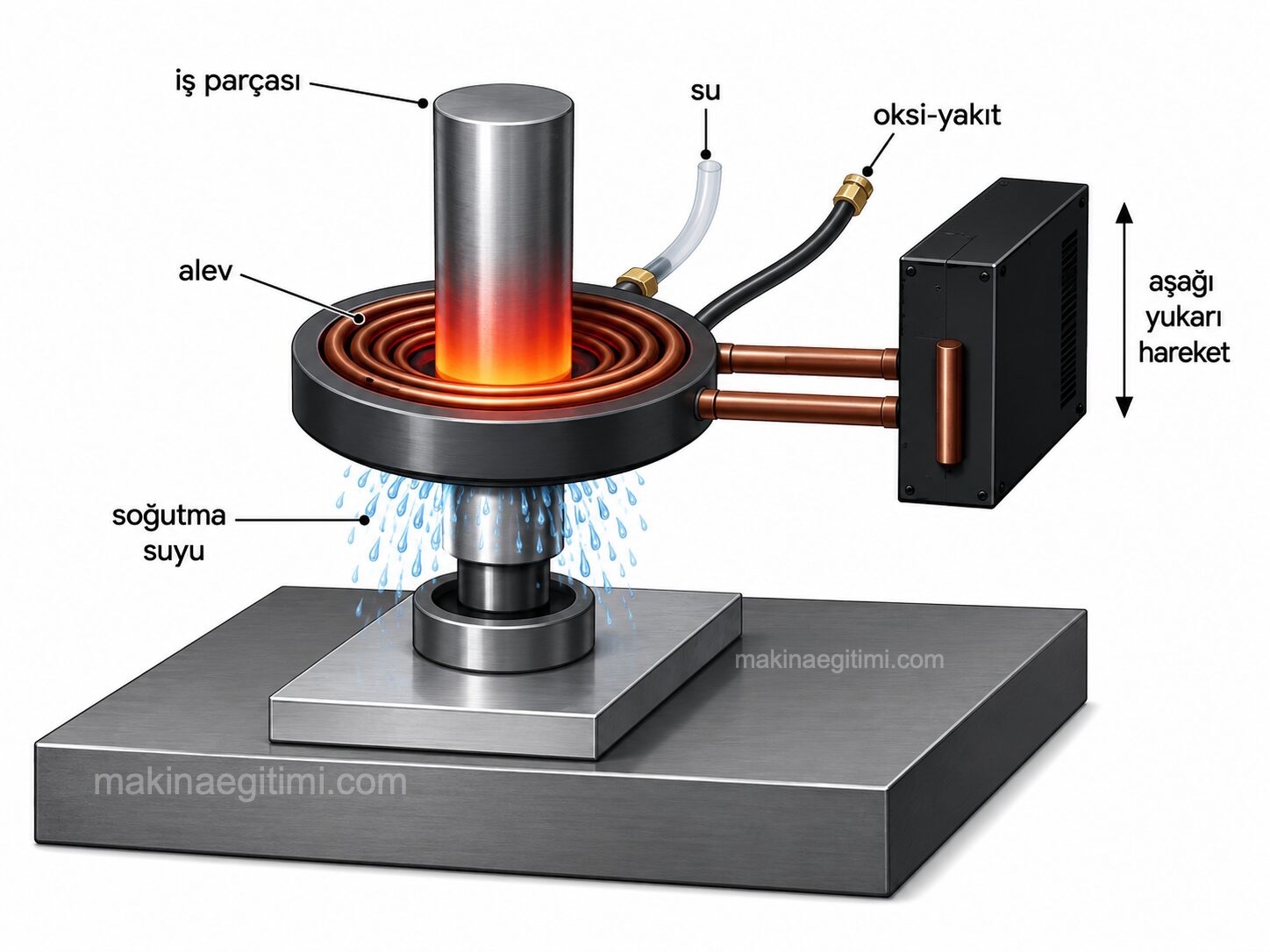
Flame hardening is a surface hardening method. The surface to be hardened is heated with the flame of an oxygen-fueled gas torch up to quenching temperature (Table 1). Immediately after heating, it’s rapidly cooled.

With this type of hardening, the surface of the part becomes hard while its core stays soft. The thickness of the hardened surface layer is about 2-3 mm. This thickness allows a thin chip to be removed from the part’s surface without losing its hardness.
How is flame surface hardening done?
Acetylene and town gas (coal gas) are used in flame hardening.

The nozzles of the flame sprayer are adjusted to match the shape of the part to be hardened. Flame hardening can also be done by rotating the part on a lathe and spraying flame and quenching fluid onto it.
In which cases is flame surface hardening applied?
Flame hardening is used for hardening automobile axles and similar parts, especially very large parts and gear wheels that don’t fit into a furnace.

Induction Current Surface Hardening
This is a surface hardening method similar to flame hardening. In this method, the surface of the steel, placed between coils carrying a current with a frequency ranging from 10,000-100,000 Hz, heats up to quenching temperature within a few seconds.

The heated areas are immediately cooled, just as in flame hardening, by spraying quenching fluid or immersing in quenching fluid. This makes it possible to harden the part to a depth ranging anywhere from 0.01 mm to a few mm.

Induction current surface hardening, one of the surface hardening techniques, is applied, for example, to the bearing-journal sections of crankshafts, giving them wear resistance.
Quenching Speed
In quench hardening, rapidly cooling the material provides high hardness, but also increases the risk of cracking.
Speed of Induction Hardening
Induction current hardening provides precise hardening by heating only the desired surface area within seconds.
Precision of Laser Hardening
Laser surface hardening allows hardening in very narrow and precise areas without risk of deformation.
Case Hardening (Carburizing) Surface Hardening
This is one of the methods that comes to mind when talking about metal hardening methods. Case hardening is also a surface hardening method. In this method, the chemical composition of the surface is changed. Low-carbon steels (containing 0.2% carbon or less) are given a certain amount of carbon on their surface and subjected to heat treatment, hardening their surfaces. But the inner part of the part stays soft, unhardened.
The Case Hardening Process
Using charcoal, coke, or lignite as the carburizing agent, the workpiece is buried inside an open metal box.
The box is sealed with a lid and placed in a furnace, and heated up to 900°C.

The box is left in the furnace for between 15 minutes and 1 hour, depending on the size of the workpiece being carburized. This way, the steel can absorb carbon up to a depth of 0.4 mm.
The workpiece is removed from the box and hardened by quenching in water. Only the outer surface hardens; the core stays soft.
In which cases is case hardening applied?
This process is applied to parts that need to withstand wear and sudden impact, such as hammer heads, piston pins, and gear wheels. If the workpiece will later be ground, surface hardening should not be done. Because the thin hardened layer can be removed by grinding.
Nitriding Surface Hardening
What is nitriding: Nitriding is also a surface hardening method. It’s generally applied to alloy (chromium- and molybdenum-containing) steels. These steels are called nitriding steels.
How is nitriding done?
If the parts to be nitrided are left for a certain time in a stream of ammonia gas at a temperature of 500°C-550°C, a very hard nitride layer forms on their surfaces. The thickness of this layer increases very slowly with nitriding time (for example, 0.25 mm in 10 hours, 0.35 mm in 20 hours).
What’s the difference between nitriding and case hardening?
In this hardening method, there’s no need to quench the workpiece. Because the nitride layer is inherently hard. For this reason, unlike case-hardened parts, nitrided parts don’t develop internal stresses.
Laser Surface Hardening
This is a method that has been becoming more widespread among metal hardening methods in recent times. The video below shows a laser surface hardening machine in operation.
How laser surface hardening is done (above)
Related Questions
Heating brings the steel’s internal structure to a state suitable for hardening, while rapid cooling “locks in” this structure as it is. If cooled slowly, the steel could revert to its original soft structure, so rapid cooling is essential.
Each method offers different advantages for parts of different sizes, or for hardening only a specific area of a part. For example, laser is suitable for small and precise areas, while flame hardening can be more practical for large surfaces.
Related Posts
 The Siemens Martin Steel Production Method
  Cast Irons and Types of Cast Iron
  Steel Standard Production Size Tables
  Materials Used in 3D Printing
  Forces Acting on the Piston and Piston Material
  Ductile (Spheroidal Graphite) Cast Iron
  Material Types and Their Properties (per DIN Standard)
  The Effect of Alloying Elements in Cast Iron