
In this materials-science article, our topic is what cast iron is. What elements it’s made of. The internal structure, strengths, and weaknesses of cast irons. We’ll also cover the types of cast iron.
Cast Irons
What is cast iron? Cast iron is a casting made from an alloy of iron and carbon. Its carbon content ranges from 2.5% to 4.5%. It also contains small amounts of manganese, phosphorus, sulfur, and silicon. This last element is the most important.
Cast irons make excellent casting alloys, with a wide range of strengths and hardnesses. They’re also easy to machine. When properly alloyed, they show great resistance to wear, scratching, and oxidation.
Their widespread use depends on their lower price and their machinability. Despite the competition posed by newer materials, cast irons have proven themselves to be economical materials suited to thousands of engineering applications.
Why Cast Iron Was Needed
Pig iron, obtained from a blast furnace, can’t be used directly because of the substances in its internal structure. The most important substance that hinders its use is the excess carbon element in its internal structure. Pig iron, the product of a blast furnace, contains 2.5-4.5% carbon in its internal structure. This excess carbon makes pig iron brittle and hard. Reducing this carbon to an acceptable level is the prerequisite for iron to be used in industry.
There are two main production areas where pig iron produced in a blast furnace is used after its carbon content has been reduced. One is steel production, and the other is its use as cast iron.
How Is Cast Iron Made?
If pig iron produced in a blast furnace is to be used as cast iron, it must go through certain processes. These processes are generally carried out in what are called cupola furnaces. In cupola furnaces, the carbon in the pig iron’s internal structure is reduced to between 1.7% and 3.5%. On the other hand, scrap steel alloys are also added, which is what makes cast iron economical.
Producing cast iron by reducing carbon alone isn’t sufficient to meet industry’s needs. For this reason, other alloying elements are added as well, producing cast irons usable for various different purposes.
Strengths and Weaknesses of Cast Iron
The general properties of cast iron are as follows;
1. Low melting temperature,
2. Low cost,
3. Suitability for casting,
4. High compressive strength,
5. Wear resistance.
The 5 items listed above should be understood as the strengths of cast iron. On the other hand, cast irons not being suitable for forging is a disadvantage.
Cast iron has good compressive strength but low tensile strength. Unless specially alloyed, it can’t be forged at any temperature and can’t be properly worked that way.
Cast iron with a very low carbon content is called semi-steel or low-alloy steel, because its mechanical and physical properties are closer to steel than to iron.
Cast iron is highly fluid when molten, and can be easily cast even into the most complex molds.
While steels can be shaped hot, and some types even cold, cast iron’s inability to be forged even when hot comes from its lack of plastic deformability while transitioning from a liquid to a solid state. Cast irons pass from a molten liquid state to a solid state all at once. Cast irons are liquid above 1147°C, and solid at lower temperatures. Because of this property, the plastic consistency needed for forging never forms.
Gray Cast Iron
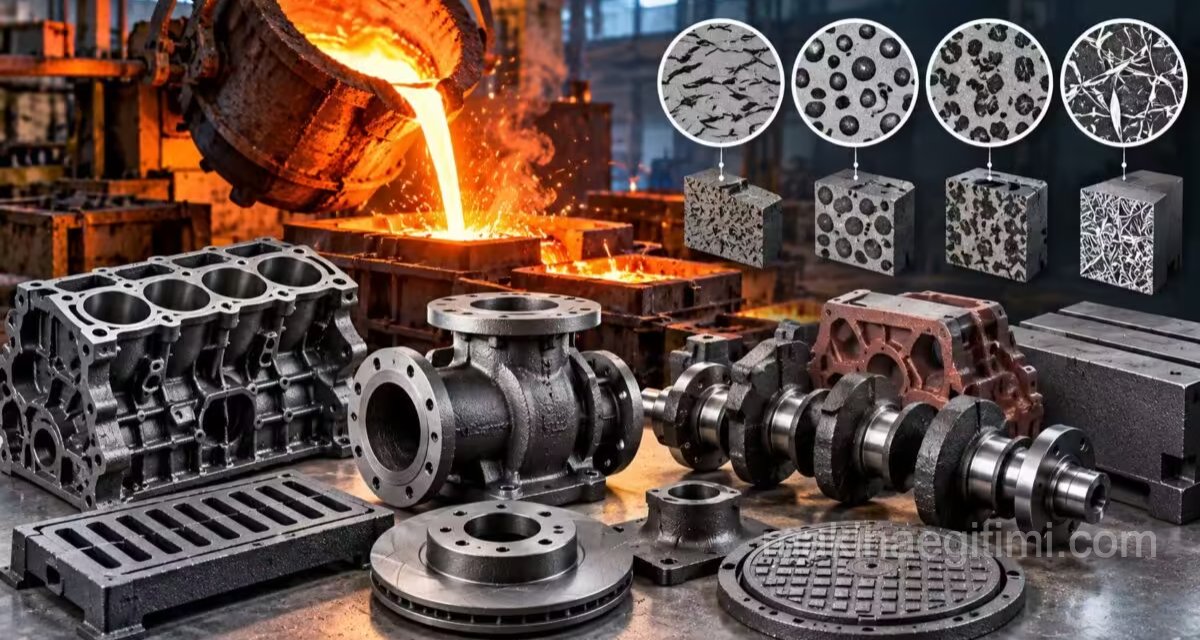
Gray cast iron has good vibration-damping properties thanks to the graphite flakes it contains.
Ductile (Nodular) Cast Iron
Spheroidal (ductile) cast iron offers much higher strength and ductility thanks to the spherical structure of its graphite.
White Cast Iron
White cast iron is preferred for manufacturing wear-resistant parts thanks to its high hardness.
Types of Cast Iron
Cast irons are generally classified according to the material’s fracture surface. The types of cast iron are given below.
White cast irons: Nearly all of the carbon in the alloy is in the form of iron carbide (cementite). This material is hard and brittle. For more details, see: White Cast Irons
Gray cast irons: Gives a gray fracture surface. This material is soft. Most of the carbon in its structure is in the form of soft graphite. Its melting temperature is higher than white cast iron types. It’s the most widely used type of cast iron. For more details, see: Gray Cast Irons

Malleable cast iron: Falls between the two main types above in terms of fracture surface and properties. Because the carbon in malleable cast iron is in a spheroidal form rather than in flakes, it has a certain amount of ductility. For more details, see: Malleable Cast Iron
Ductile cast iron (nodular cast iron): Also known as spheroidal graphite cast iron. It’s a fairly new manufacturing material, developed by the British Cast Iron Research Association in England. It’s obtained by treating molten iron with cerium or magnesium. By turning the graphite flakes in its structure into a spherical form, its tensile strength, yield strength, and elongation values are increased. For more details, see: Ductile (Spheroidal Graphite) Cast Iron

Among the types of cast iron, we see ductile (spheroidal graphite) cast iron used especially in cast parts that have heating and cooling channels. (image above)
Related Questions
Pig iron coming out of the blast furnace contains too much carbon, which makes it hard to machine and use. By reducing and adjusting this carbon content in a controlled way, cast iron with usable properties is obtained.
This material is also easy to machine, and when alloyed, shows good resistance to wear and scratching. Combining these practical properties with low cost makes cast iron attractive for thousands of engineering applications.
Related Posts
 Electrodes Used for Welding Stainless Steels
 Applications of Plastics
 The Relationship Between Laser Cutting Quality and Material Composition
 Gray Cast Iron
 Factors That Make Welding Stainless Steel Difficult
 Aluminum Alloys and Their Properties
 Forces Acting on the Crankshaft. Crankshaft Material
 Properties of Aluminum. Information About Aluminum