

How did Napoleon Bonaparte go from an ordinary artillery officer to an emperor, and how did he collapse in the snows of Russia? We tell the story through its chain of cause and effect.
Today we’re going to tell you the story of how a young man from an ordinary family shook an entire continent, and eventually became a victim of his own ambition. Napoleon Bonaparte’s story is also one born out of the chaos of the French Revolution, which we told in our previous article.
Napoleon was not from a noble family of France, but the child of a modest family from the island of Corsica. Yet by the time he was thirty-five, he stood at the head of one of the greatest empires history has ever seen.
An Opportunity Born From the Chaos of the Revolution
As we told in our previous article, after the French Revolution toppled the monarchy, it was dragged into the Reign of Terror, and then into great political uncertainty. The country was grappling with chaos at home and attacks from neighboring monarchies abroad. It was precisely this uncertain environment that offered a young artillery officer a unique opportunity to shine.

Related Post Fransız Devrimi: Bir Krallığın Yıkılışı, Bir Çağın Doğuşu
Bastille'den giyotine, Genel Meclis'ten Terör dönemine: Fransız Devrimi'nin çarpıcı hikayesini neden sonuç ilişkileriyle anlatıyoruz.
Napoleon made a name for himself with the military genius he displayed at the Siege of Toulon in 1793, and in 1795 he won favor with the government by putting down an uprising in Paris with artillery fire. The vacuum of authority created by the Revolution was the perfect ground for a disciplined and ambitious military leader.
From a General to an Emperor
With his successes in the Italian and Egyptian campaigns, Napoleon became something of a hero in the eyes of the public. In 1799, taking advantage of the government’s weakness, he seized power in a coup and declared himself “First Consul.” Five years later, in 1804, he went a step further and declared himself “Emperor of the French.”

There’s an interesting detail here: at the coronation ceremony, instead of waiting for the Pope to place the crown on his head, he placed it on his own head with his own hands. This gesture was meant to show everyone that the source of his power came not from the church or the old noble order, but from his own achievements.
Victories That Shook Europe
Napoleon’s military genius was proven through a string of consecutive victories. In particular, the Battle of Austerlitz in 1805 was a tactical masterpiece still taught as a lesson in military history today. Despite being outnumbered, he defeated the combined armies of Russia and Austria through a masterful maneuver.
This series of victories gave Napoleon the power to directly or indirectly control nearly all of Europe. A vast area stretching from Spain to Poland was either under direct French rule or under kingdoms allied with Napoleon.
The Russian Campaign: Why Did He Go In, and How Did It Unfold?
So why did Napoleon, who already dominated most of Europe, attempt to invade a territory as vast and difficult as Russia? The answer had to do with an economic weapon he himself had created: the Continental Blockade.
Napoleon had tried an economic, rather than military, path to bring England to its knees. He had imposed a ban on trade with England on all European countries under his control or allied with him. The goal was to collapse England’s economy and force its surrender without fighting.
But the weakest link in this blockade was Russia; the Russian economy was heavily dependent on selling grain and raw materials to England. In 1810, Tsar Alexander I effectively abandoned this blockade, which was strangling his own economy, and allowed trade with England to resume.

For Napoleon, this was both the collapse of his economic plan and an open challenge to his own authority. To punish this betrayal and bring Russia back under his control, in 1812 a massive army of about 600,000 men, the “Grande Armée,” crossed the Russian border.
But the Russians did not engage in a great pitched battle head-on as Napoleon expected. As they retreated, Russian generals applied a “scorched earth” tactic, leaving nothing behind: fields, villages, and supply depots were burned before the French army could reach them. As it advanced, Napoleon’s army began to struggle with hunger and exhaustion.
In September 1812, just a few days from Moscow, one of the bloodiest single-day battles in history took place at Borodino. Tens of thousands of soldiers on both sides were killed or wounded, but there was no decisive victor. The Russians continued to retreat, and Napoleon soon entered Moscow. But he found the city almost completely evacuated, with a large part of it reduced to ashes by arson. The peace offer he waited months for never came.
What If Napoleon Had Never Entered Russia?
Now let’s imagine for a moment. In 1812, Napoleon decided to invade Russia with a massive army of 600,000 men. But the Russians avoided direct confrontation, retreated, and burned the land, leaving nothing behind. When Napoleon reached Moscow, he found the city nearly empty and reduced to ashes.
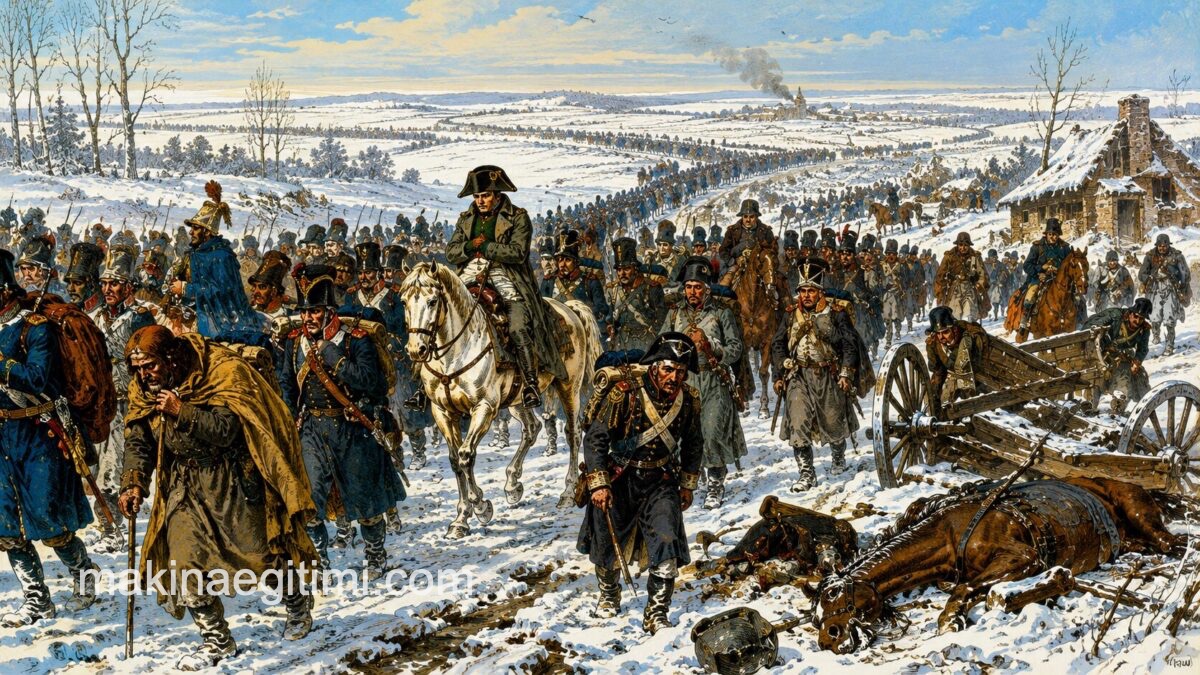
If Napoleon had abandoned this campaign, or decided to retreat earlier, before winter set in, he might not have lost such a large part of his army. But indecision and pride condemned his army to linger in Russia’s merciless winter. Hundreds of thousands of soldiers died not in battle, but from hunger and cold. This campaign became the turning point where Napoleon’s image of invincibility was shattered.
Collapse: Waterloo and Its Aftermath
After the disaster in Russia, the powers of Europe united against Napoleon once again. In 1814 he was dethroned for the first time and exiled to the island of Elba. But he did not give up; he soon escaped and returned to France, coming back to power for a brief period known as the “Hundred Days.”

This return ended at the Battle of Waterloo in 1815. His decisive defeat at the hands of the British and Prussian forces was the end of Napoleon’s political life. This time he was exiled to a much more distant place, the island of Saint Helena in the Atlantic Ocean, where he died six years later.
Chain of Cause and Effect: From One Island to Another
- The vacuum of authority created by the French Revolution offered an opportunity to a disciplined military leader.
- Napoleon’s military successes increased his public support and political power.
- The 1799 coup and the 1804 coronation made him an absolute emperor.
- A string of consecutive victories brought nearly all of Europe under French influence.
- Excessive ambition and pride in the Russian campaign dragged the army into disaster.
- This disaster led the powers of Europe to unite again and led to Napoleon’s downfall.
- The defeat at Waterloo sent him to one of history’s most remote exiles, Saint Helena.
Interestingly, about 130 years later, another leader, Adolf Hitler, would fall into a similar mistake against Russia and share the same fate.
A Little-Known Fact
During his exile on Saint Helena, Napoleon spent much of his days dictating his memoirs. When these memoirs were published after his death, they created a “Napoleon legend” in Europe, reshaping him less as a defeated despot and more as a tragic hero.
In other words, even though Napoleon lost on the battlefield, he managed to control the telling of his own story right up to the very end.
Related Videos

Napolyon Bonapart'ın İnanılmaz Yükseliş Hikayesi!

Fransız Devrimi (4. Bölüm): Napolyon Bonapart'ın Yükselişi (Dünya Tarihi / Orta ve Modern Çağ)

Hitler ve Napolyon'un Ortak Kaderi | TRT Belgesel
Frequently Asked Questions
He came from a modest, non-noble family of Italian descent on the island of Corsica.
In 1804, he declared himself “Emperor of the French” and placed the crown on his own head with his own hands.
The 1812 Russian campaign caused him to lose most of his army to the cold and hunger of winter. This was the turning point where his image of invincibility was shattered.
He died in 1821 on the island of Saint Helena, where he had been exiled after his defeat at Waterloo.
Napoleon invaded Russia because Russia stopped complying with the Continental Blockade he himself had established (the economic blockade banning trade with England).
Tsar Alexander I had allowed trade with England to resume in 1810 because the blockade was strangling the Russian economy. Napoleon saw this both as the collapse of his economic plan and an open challenge to his own authority, and set out on a campaign in 1812 with an army of 600,000 to punish and re-subjugate Russia.
Related Posts
 The Financial Origins of the French Revolution: How a Kingdom Collapsed Into Bankruptcy
 The Sarajevo Assassination: How One Bullet Dragged the World Into War
 The Fall of Constantinople: A City’s Downfall, an Era’s Dawn
 The October Revolution: How a Tsardom Fell Overnight
 The Battle of Waterloo: The Afternoon That Decided Europe’s Fate
 Berlin Streets After World War II. July 1945
 How Was the Enigma Code Cracked? Alan Turing and the Bombe Machine Explained
 The Boston Tea Party: How a Crate of Tea Gave Birth to a Nation