

Dear readers, today we’re going to tell you the story of how a single flower came to be worth as much as an Amsterdam house. This story refers to an event that historians and economists have dubbed ‘the world’s first recorded financial bubble’, and it is still cited as a reference when discussing stock market crashes today.
In the Netherlands of the 1630s, an ordinary merchant could own a tulip bulb worth far more than the rent on his house. So how did this incredible situation come about?
How Did an Ottoman Flower Find Its Way to Europe?
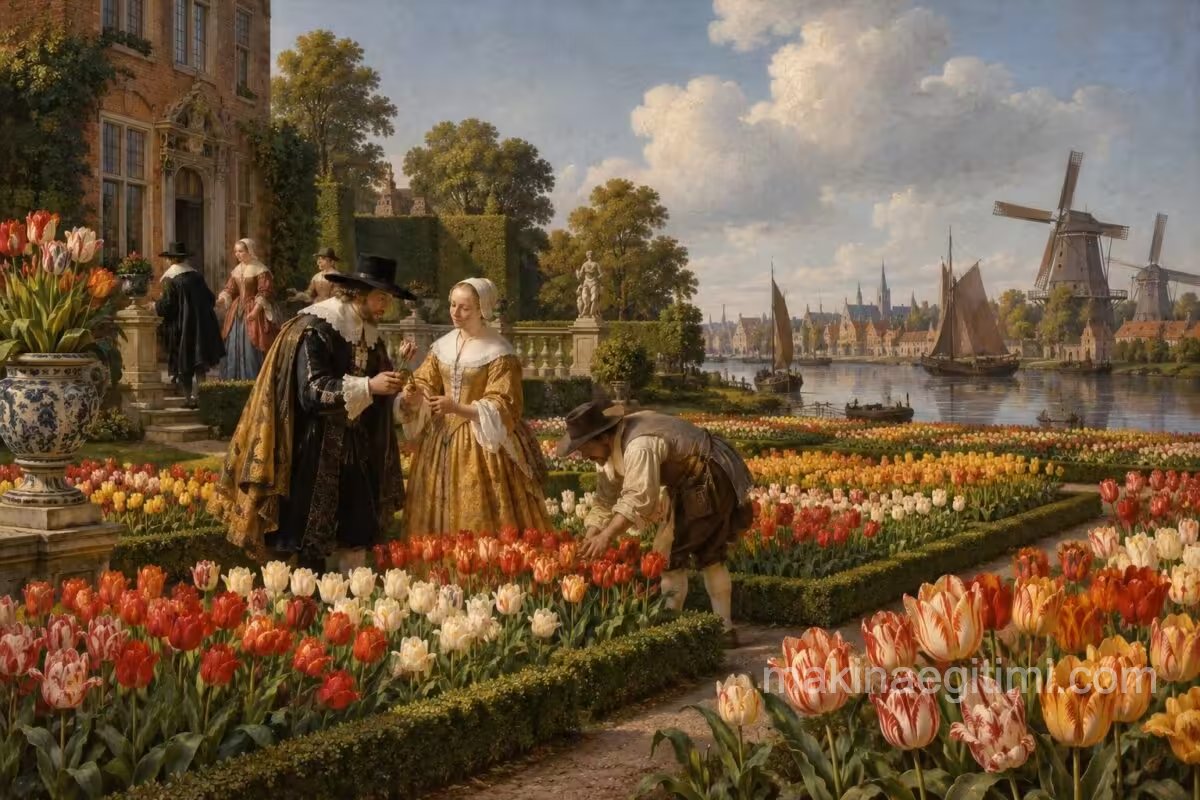
The tulip was, in fact, a flower native to Central Asia and had been cultivated with great affection in the Ottoman Empire for centuries. In the mid-16th century (during the reign of Sultan Suleiman the Magnificent), tulip bulbs were transported to Europe, particularly the Netherlands, via a European diplomat in Istanbul.
The soil and climate of the Netherlands were extremely favourable for tulip cultivation. Within a short space of time, the tulip became a status symbol amongst both botany enthusiasts and wealthy merchants. In particular, rare varieties with vibrant, fiery-coloured patterns—caused by a virus—began to be in incredible demand.
The Dutch Golden Age: The Groundwork
The outbreak of the tulip mania was no coincidence. In the first half of the 17th century, the Netherlands was experiencing a period known in history as the ‘Dutch Golden Age’. Thanks to maritime trade, vast sums of money were flowing into the country, and a new class of wealthy merchants was emerging. These people were seeking new status symbols with which to display their wealth.
Furthermore, the Netherlands had a financial infrastructure (stock exchange, futures contracts) that was considerably more developed than that of other European countries at the time. These two factors—namely, an abundance of money and a sophisticated financial system—laid the perfect groundwork for transforming the tulip from a garden flower into an investment asset.

Prices Taking Off
From 1634 onwards, the price of tulip bulbs—particularly rare and showy varieties—began to rise at an astonishing rate. People were no longer buying tulips because they liked them, but because they believed the price would rise even further. This was a classic cycle of speculation (buying on the expectation of further price rises).
The interesting thing was that a large proportion of this trade was conducted on onions that were still growing in the ground – in other words, through ‘forward contracts’. In other words, people were buying and selling onions they did not even have in their possession yet, with a view to taking delivery at a future date. By 1637, a single onion of certain rare varieties had begun to be worth as much as a luxury house in Amsterdam.
What if that sale at the meyhane had never taken place?
Let’s pause for a moment and think. In February 1637, a tulip auction was held in Haarlem, just as usual. But this time, the buyers were unwilling to pay the expected prices. Perhaps on that day, some people had begun to think, ‘Perhaps these prices aren’t realistic.’ This slight hesitation triggered a wave of panic selling.
If a few more buyers had bid higher at that day’s auction, the crash might have been delayed for a few more weeks. But sooner or later, it was inevitable that these prices, which had become detached from their true value, would collapse at some point. Sometimes it is not a major event that bursts a bubble, but simply a few people having second thoughts at the same time.

The Collapse: A Dream That Ended in a Day
News of the failed auction in Haarlem spread rapidly, and panic swept across the whole country. Prices plummeted by over ninety per cent within days. Onions that had been worth a fortune just yesterday suddenly became almost worthless. Thousands of people found themselves in debt for onions they had not yet taken delivery of but for which they had signed contracts at high prices.
Interestingly, according to many historians, the actual impact of this collapse on the Netherlands’ economy as a whole was not as great as is often thought. This is because the bulk of trade took place within a narrow speculative sphere, separate from the country’s real productive economy (maritime trade, textiles, agriculture).
The Chain of Cause and Effect: From a Flower to a Lesson in Economics
- The tulip, which originated in the Ottoman Empire, found a home in the Netherlands’ favourable climate and became popular.
- The prosperity and advanced financial system brought about by the Dutch Golden Age created a favourable environment for speculation.
- Demand for rare varieties has driven prices away from their true value, trapping them in a cycle of ever-rising speculation.
- Trading in futures contracts further increased the risk.
- The failure to find a buyer at an auction triggered a loss of confidence.
- Panic spread rapidly and prices collapsed within days.
- This event became the first historical example to which economists referred when defining the concept of a ‘speculative bubble’ in subsequent centuries.
A Little-Known Fact
During the Tulip Mania, some rare varieties of tulip bulbs were so valuable that, according to historical records, a merchant had acquired a single bulb of the legendary ‘Semper Augustus’ variety in exchange for a canal house in Amsterdam’s most sought-after district, several acres of land and a hoard of gold coins. Today, a bulb of the same variety is no longer even considered rare from a botanical point of view; for what actually drove its value so high was, in fact, a random pattern caused by a virus on the leaves.
Tulip Mania: The First Economic Bubble

Tulip Mania 1637: The First Financial Bubble Explained: History, FOMO, and Economic Lessons

The World's First Financial Bubble? Tulip Mania! | European History | Extra History Complete
Frequently Asked Questions
It took place in the Dutch Republic between 1634 and 1637 and came to an end in February 1637.
Varieties with rare and striking colour patterns, when combined with the pursuit of wealth and status brought about by the Dutch Golden Age, became the subject of speculation, detached from their true value.
No. According to most historians, this speculation was confined to a narrow sector of the economy and did not cause any lasting damage to the Netherlands’ overall economic strength.
For it is the first comprehensive historical record of the phenomenon whereby the price of an asset becomes completely detached from its true value, rises solely on the expectation that it will rise further in the future, and then suddenly collapses.
Related Posts
 The History of Hagia Sophia: One of the Most Enduring and Controversial Structures in Human History
  The Sarajevo Assassination: How One Bullet Dragged the World Into War
  The Fall of Constantinople: A City’s Downfall, an Era’s Dawn
  Genghis Khan: From an Abandoned Child to History’s Greatest Emperor
  The Battle of Gallipoli: How One Front Changed a Nation’s Fate
  The Public Debt Administration: How an Empire Became a Foreigner in Its Own Country
  How Was the Enigma Code Cracked? Alan Turing and the Bombe Machine Explained
  The French Revolution: The Fall of a Kingdom, the Birth of an Age