Close Menu
  • MAKİNELER ve İMALAT
    • Tools & Equipment
    • Computer-Aided Drawing
    • CAD/CAM Education
    • CNC Machine Programming
    • Casting Technologies
    • Electrical & Electronics Technologies
    • Hydraulics & Pneumatics
    • Manufacturing Processes
    • Manufacturing Technologies
    • Occupational Safety
    • Mold & Die Design
    • Solid Modeling
    • Welding Technology
    • Machine Elements
    • Mechanical Trade Drawing
    • Materials Science
    • Automotive & Vehicle Technologies
    • Robotics Technologies
    • Health Technologies
    • Defense & Aerospace Technologies
    • Descriptive Geometry
    • Technical Drawing
    • Software & Hardware Technologies
    • Innovative Manufacturing Methods
  • TEKNOLOJİ ve YAŞAM
    • OTOMOBİLLER ve TAŞIT
      • Vehicle & Engine Knowledge
      • Safe Driving
      • Sürüş Destek Sistemleri
    • Genel Kültür
      • Movies & TV Shows
      • Görsel ve Grafik Sanat
      • Books & Literature
      • Music
      • Sports
      • History
      • History of Technology
    • GÜNDELİK YAŞAM TEKNOLOJİLERİ
    • Hobbies & Entertainment
    • Internet Technologies
    • Health
    • Mobile Technologies
Makine Eğitimi
  • Machines & Manufacturing
    Machine Elements
    Hydraulics & Pneumatics
    Technical Drawing
    Computer-Aided Design & Manufacturing
    Basic Manufacturing Processes
    Manufacturing Processes
    Industry Technologies
    Other Technical Courses
    Motion & Power Transmission
    Simple Machines
    Chains & Sprockets
    Shafts & Journals
    Gears
    Cams
    Couplings
    Belts & Pulleys
    Springs
    Bearings
    Keys
    Fastening Joining
    Retaining Rings
    Screws, Bolts & Nuts
    Cotter Pins
    Flanges
    Welding
    Rivets
    Pins & Bolts
    Washers
    Calculators
    Gear Ratio Calculator
    Spring Constant Calculator
    Belt Pulley Ratio Calculator
    Other Machine Elements
    Slides & Linear Guides
    Brakes
    Flywheels
    Clamps
    Shock Absorbers
    Gaskets & O-Rings
    Seals & Sealing Elements
    Hydraulics
    Introduction to Hydraulics & Principles
    Hydraulic Systems & Applications
    Accumulators
    Filters
    Motors
    Pumps
    Valves
    Pneumatics
    Introduction to Pneumatics & Principles
    Pneumatic Systems & Applications
    Pneumatic Circuit Components
    Valves
    Cylinders
    Silencers
    Motors
    Compressors
    Dryers
    Conditioning Units
    Common Topics & Maintenance
    Hydraulic & Pneumatic Maintenance
    Study Notes, Exams & Tests
    Technical Drawing
    Introduction to Technical Drawing
    Geometric Drawings
    Perspective & Projection
    Orthographic Views
    Dimensioning
    Sectioning
    Assembly & Detail Drawings
    Tolerances
    Surface Finish Symbols
    Mechanical Engineering Drawing
    Screws, Bolts & Nuts
    Pulley Drawings
    Gear Drawings
    Shafts & Journals
    Bearing Drawings
    Pins & Bolts
    Spring Drawings
    Welds in Technical Drawing
    Washers
    Cotter Pins
    Technical Drawing Exercises
    Mechanical Drawing Exercises
    Gear Exercises
    View Extraction Exercises
    Pulley Exercises
    Pin & Bolt Exercises
    Threaded Fastening Exercises
    Descriptive Geometry
    Computer-Aided Drawing
    AutoCAD Drawing Lessons
    Solid Modeling & Animation
    Solid Model Drawing Files
    Solid Model Assembly Examples
    Solid Model Drawing Lessons
    3D CAD Software Reviews
    Solid Modeling Exercises
    CNC Programming
    CAM
    Measurement & Inspection
    Dial Indicators
    Calipers
    Gauges
    Micrometers
    Materials Science
    Steels
    Cast Iron
    Aluminum
    Plastics
    Material Testing & Hardness Measurement
    Occupational Safety
    Workshop Safety
    Safety When Working With Electricity
    Machine Safety Rules
    Hand Operations
    Filing
    Marking
    Cutting Operations
    Reaming
    Tapping
    Threading With a Die
    Drill Bit Sharpening
    Working With Machines
    Basic Turning Operations
    Basic Milling Operations
    Shaper Machine
    Machining
    Turning
    Milling
    Grinding
    Innovative Manufacturing Methods
    EDM (Electrical Discharge Machining)
    Laser Machining
    Waterjet Machining
    3D Printing
    3D Scanners
    Welding
    Rolling
    Casting
    Mold & Die Design
    Mechanical & Hydraulic Presses
    Blanking & Piercing Dies
    Bending Dies
    Drawing Dies
    Plastic Injection Molds
    Extrusion Dies
    Compound Dies
    Progressive Dies
    Blow Molds
    Spinning Dies
    Spray Molds
    Manufacturing of Machine Parts
    Automotive & Vehicle Technologies
    Motor Vehicle Manufacturing
    Raw Material Production
    History of Technology
    Health & Medical Technologies
    Defense & Aerospace
    Robotics Technologies
    Software & Hardware Technologies
    Mechanics - Strength of Materials
    Physics Topics
  • Technology & Life
    Hobbies & Entertainment
    Sports
    Music
    Vehicle & Engine Knowledge
    Vehicle Maintenance & Repair
    Safe Driving
    Driver Assistance Systems
    History
    Movies & TV Shows
    Books & Literature
    Computers & Internet
    Computer Tips
    Software Reviews
    Hardware & Peripherals
    Practical & Safe Internet Use
    Visual & Graphic Art
    Mobile Technologies
    Travel
    Science
    Health
    First Aid Knowledge
    Everyday Technologies
Makine Eğitimi
Home»Manufacturing Processes»Universal Milling Machine Accessories
30 August 2026

Universal Milling Machine Accessories

Universal Milling Machine Accessories

In this article in the milling section, we’ll examine what milling machine accessories are. We’ll go one by one over what accessories such as the rotary table, clamping shoe, T-nut, vise, linear indexing attachment, dedicated fixtures, milling heads, and magnetic table are used for, and how they’re used.

  • Rotary Tables
  • Bolts and Clamping Shoes
    • Bolts
    • Clamping Shoes and Their Supports
  • Vises
    • Clamping Parts in the Vise
  • Dedicated Clamping Fixtures
    • Magnetic Tables
    • Milling Heads
    • Linear Indexing Attachment
  • Related Questions

Rotary Tables

What is a rotary table used for? Rotary tables are generally used for the peripheral milling of internal and external surfaces, machining cams by marking out their periphery or surfaces, and cutting large-diameter internal and external spur gears. Rotary tables come in horizontal and vertical types depending on the job at hand.

Horizontal rotary table

Horizontal rotary table

Vertical rotary table

Vertical rotary table

machining with a chuck mounted on a rotary table

Machining on a milling machine with a chuck mounted on the rotary table

Bolts and Clamping Shoes

These are parts frequently used among milling machine accessories. Workpieces too large or oddly shaped to be held with a vise are clamped using bolts and clamping shoes. Manufactured in various sizes and shapes, these fixtures allow parts to be clamped safely and easily.

Bolts

This consists of a bolt sized to fit the T-slots on the milling table, and a nut. The head of the bolt that goes into the T-slot is made to a size and shape that keeps it from turning within the slot. It’s also called a “T-nut.”

t-nut and stud bolt

Using a T-nut and stud bolt together

Clamping Shoes and Their Supports

These are parts used for clamping down, with a bolt and nut, workpieces too large for a vise or that are not geometric in shape. They are manufactured in various shapes and sizes. They are either drilled through the middle to let the bolt pass, or relieved in the shape of a slot for practicality during clamping and unclamping.

types of clamping shoes

Clamping shoes are among the most commonly used milling machine accessories.
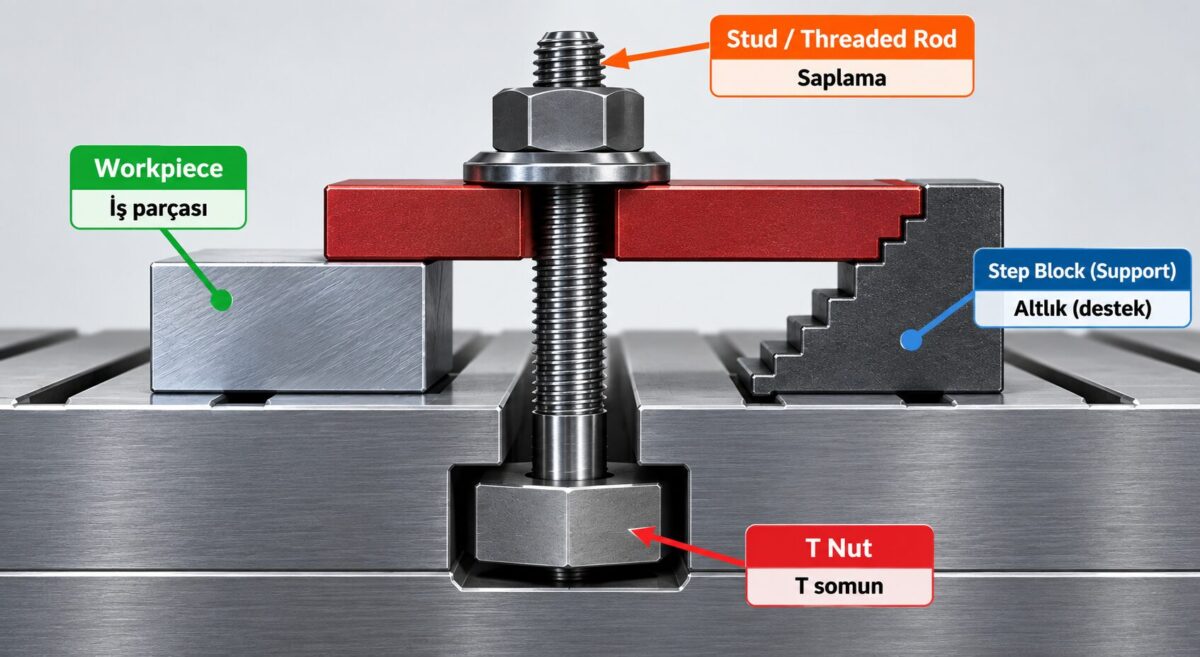
bağlama pabucu t somun kullanımı

Clamping a workpiece with a T-nut, stud support, and clamping shoe

use of clamping shoe

Examples of clamping with a clamping shoe

side-clamping fixture

Clamping with side-clamping shoes

Vises

Vises used to clamp workpieces on a milling machine have parallel jaws, one of which is fixed to the body while the other is positioned on the body via a bed and slide system, allowing it to move.

angle table for the vise

Machine vise and angle table for the vise

Vises are attached to the machine table using bolts or clamping shoes. When clamping, it’s very important that the vise jaws be set parallel to the machine body. For this, parallelism is achieved using a dial indicator. Also, since the keys under the vise are made to fit exactly into the table’s T-slots, parallel mounting is made easier.

Clamping Parts in the Vise

When clamping with a vise, it is very important that the part be clamped without any gap. For this, parallel-ground supports must be used during clamping.
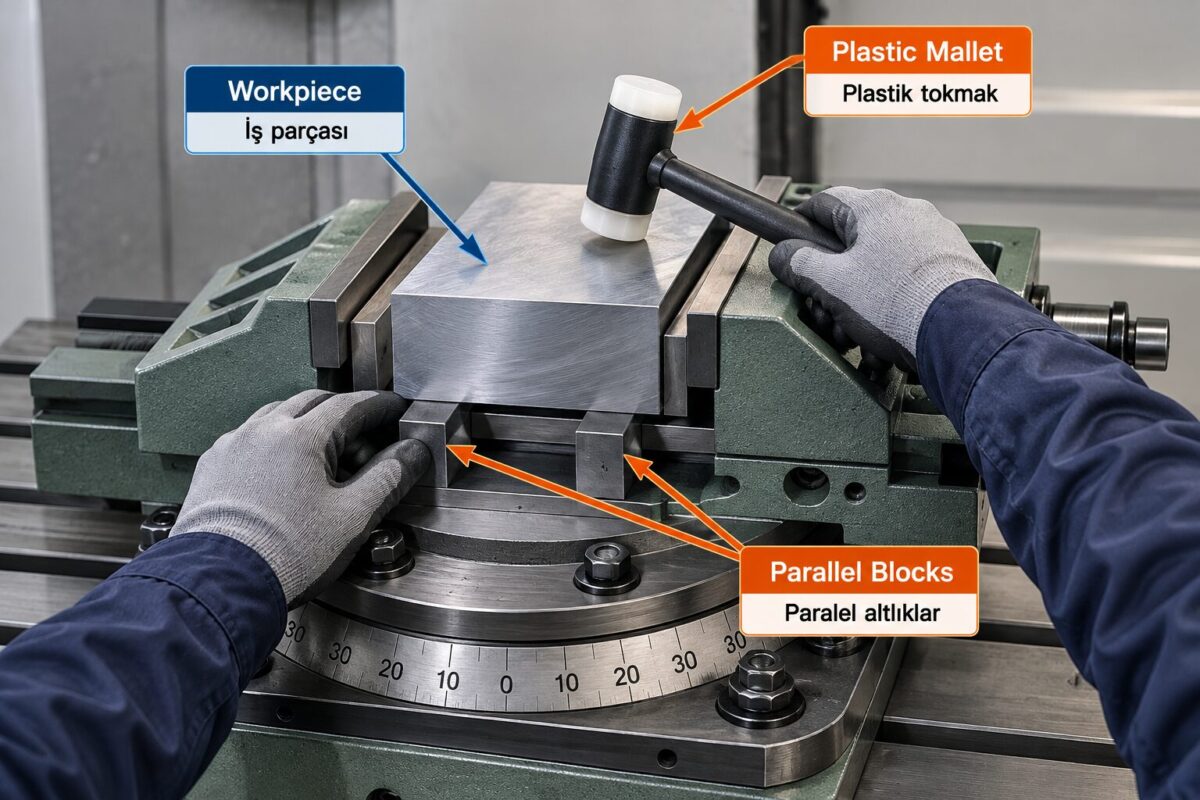
clamping a workpiece in a vise

After the parallel supports are placed in the vise, the workpiece is set on top of them, and while the vise is being tightened, the part is tapped with a brass hammer or plastic mallet to ensure it seats fully.
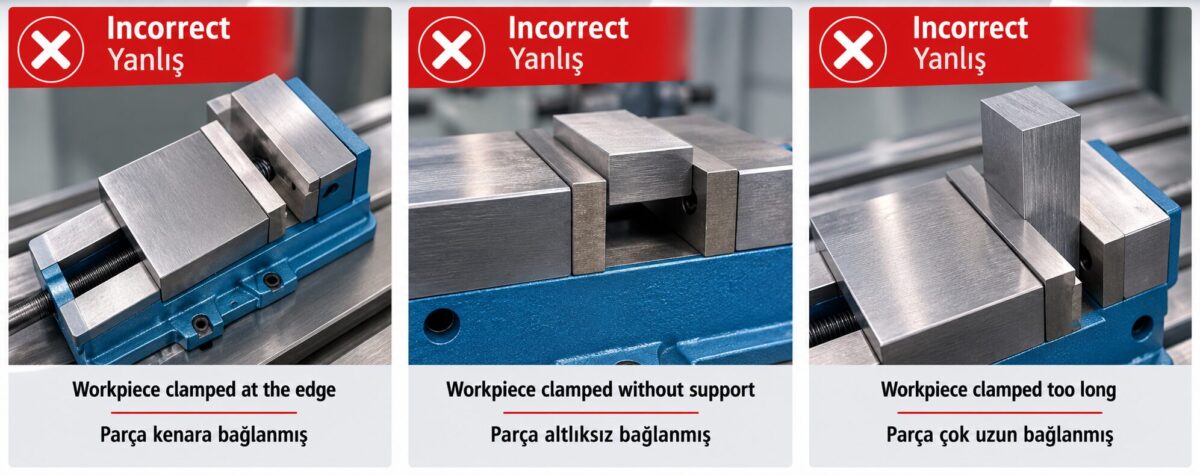
mengeneye yanlış bağlama şekilleri

Incorrect ways of clamping in a vise

Dedicated Clamping Fixtures

Specially made clamping fixtures are used for producing identical workpieces in series. In serial milling, removing and clamping each part individually and constantly repeating these operations wastes time. It also causes strain and fatigue for the worker. The workflow slows down, and production decreases due to the time lost.
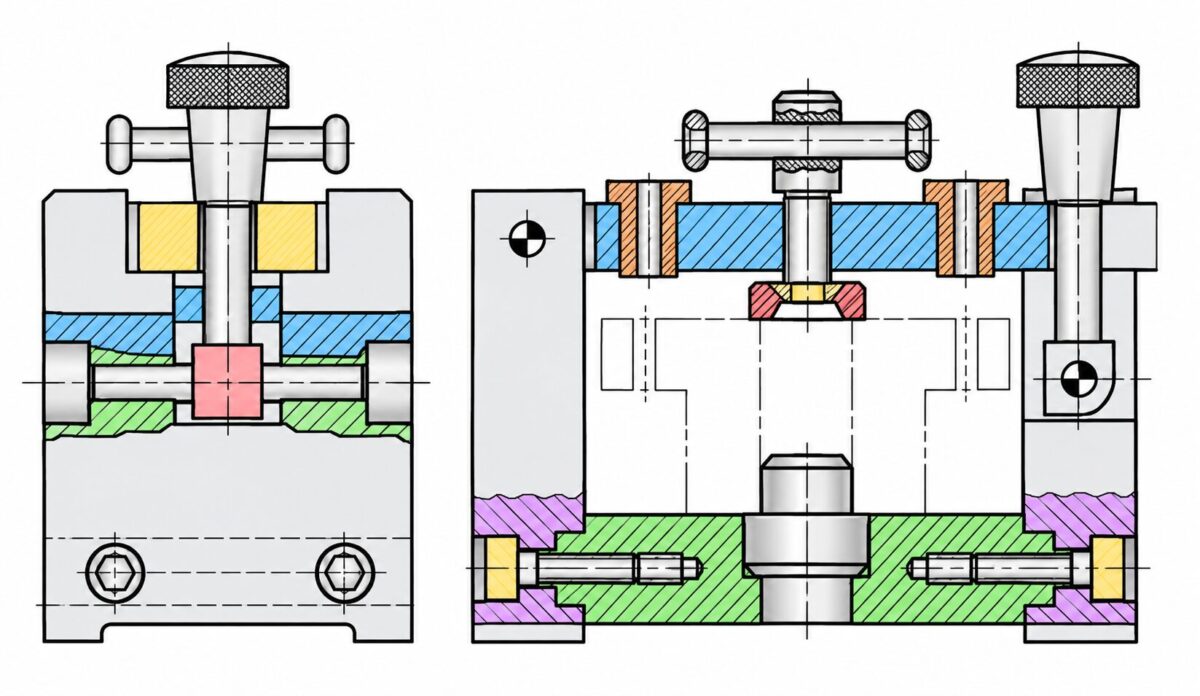
drilling fixture

When designing clamping fixtures, attention is paid to whether it’s a multiple or single clamping situation, and to performing the removal and clamping operations in the shortest possible time. It’s also important for the fixture’s cost to be low. An expensive fixture will do more harm than good.

In clamping fixtures, it’s also very important that removing or clamping operations be practical. That is, the removal or clamping operation should be achieved with a single motion. Also, taking parts out of the fixture or placing them in should be easy and practical. A fixture being very complex does not mean it’s very good.

Magnetic Tables

Workpieces that cannot be clamped with a vise or clamping shoes, or where a clean surface is desired at high speed, are machined with the help of a magnetic table mounted on the machine table.

Magnetic table

The most important thing to pay attention to when milling with magnetic tables is not to take too heavy a chip. Otherwise, the workpiece may break free from the magnetic table, which can cause accidents.

Milling Heads
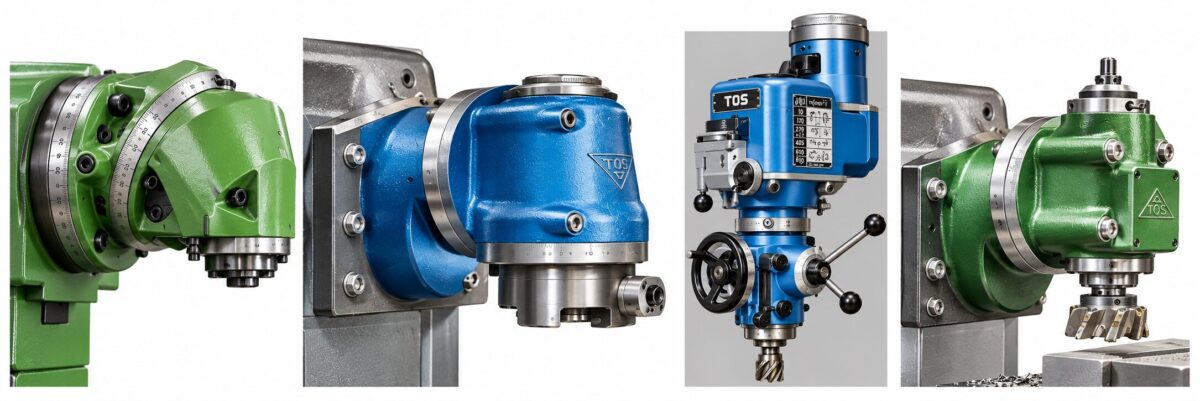
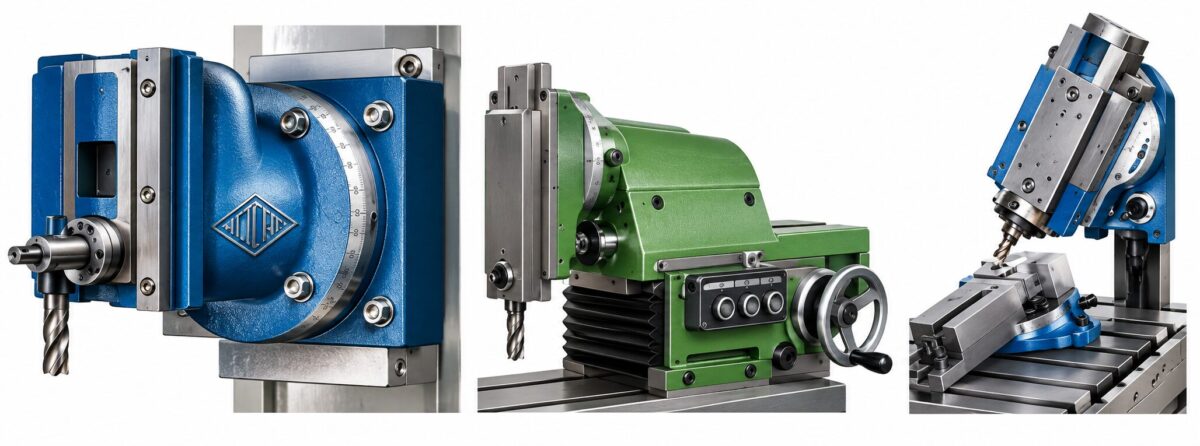
milling machine universal vertical head

Universal vertical head and vertical head

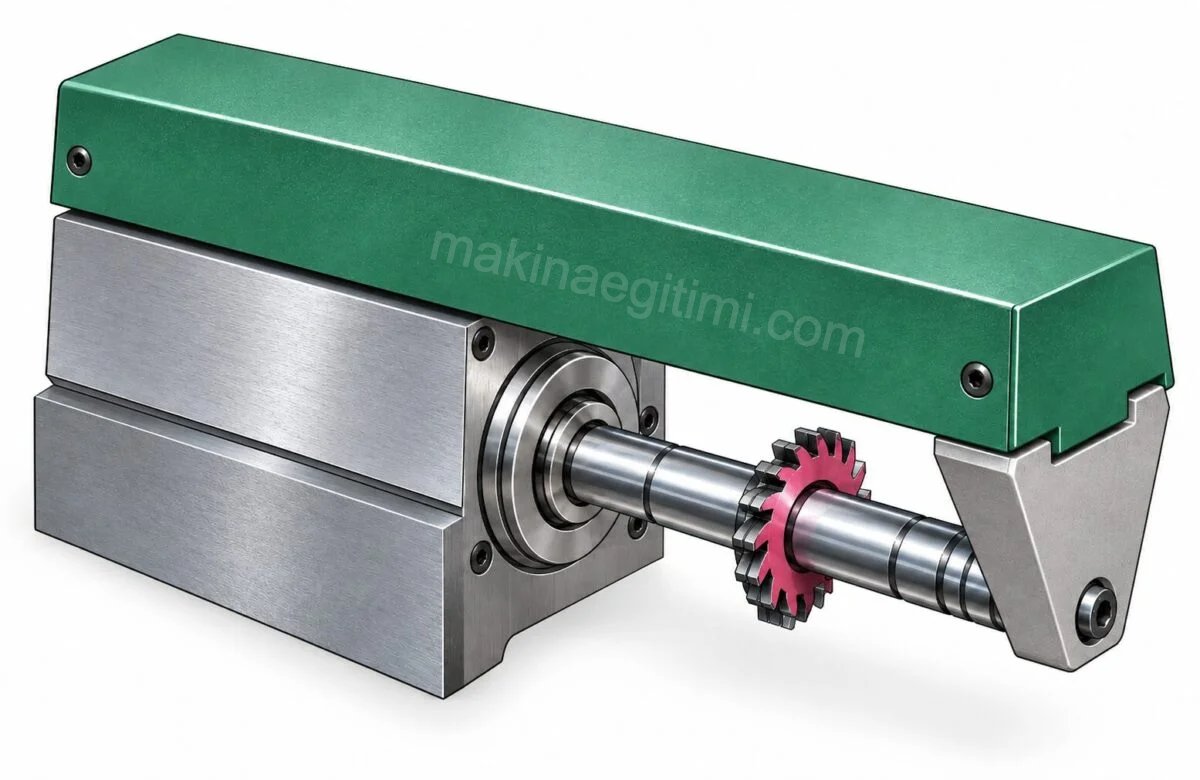
These are the elements used on milling machines to attach and position the cutters, together with auxiliary tooling, needed to machine workpieces. Although similar to one another, milling heads are classified as follows based on the operations they can perform:

Vertical head
Horizontal head
Universal vertical head
Eccentric head
freze yatay başlık
milling machine horizontal head

horizontal head

Video (above) of mounting a cutting tool onto the horizontal head with the help of an arbor
milling machine eccentric head

Eccentric head

Linear Indexing Attachment

The linear indexing attachment is one of the auxiliary parts of a universal milling machine, and is used only on the machine it belongs to.

The attachment consists of a perforated disc mounted on the table lead screw shaft, two gears fitted on the perforated disc’s shaft, and mounting parts. The attachment is mounted at the front of the machine table, and generally on the left side.

milling linear indexing attachment
Linear indexing attachment

In this article, we covered universal milling machine accessories. We briefly touched on the areas of use for accessories such as the rotary table, vise, clamping shoe, milling heads, and clamping fixtures. Looking forward to seeing you in new publications.

download lecture notes ppt slides

Related Questions

Operations such as cutting large-diameter internal or external gears, or milling a circular surface, require the part to be rotated in a controlled way. The rotary table makes these kinds of operations possible by providing that rotation at precise angles.

These parts are attached directly to the table using special bolts and clamping shoes that fit into the T-slots on the table. This method offers a secure clamping alternative for parts too large or irregularly shaped for a vise to grip.


Related Posts

Drilling and Boring on a Lathe Drilling and Boring on a Lathe Turning with the Aid of a Mandrel Turning with the Aid of a Mandrel Komparatör nedir nasıl kullanılır What Is a Dial Indicator? How to Use It Parts of a Lathe Parts of a Lathe, Illustrated reamer types Reamer Types Tornada Ölçme ve Kontrol Measurement and Inspection on the Lathe Kesme Sıvısı Ne İşe Yarar? What Do Cooling / Cutting Fluids Do? Their Functions Lathe Tool Angles and Their Effect on Surface Quality Lathe Tool Angles and Their Effect on Surface Quality
Milling Takım Tezgahları Basic Milling Operations
Share. Facebook Twitter WhatsApp Tumblr Email Telegram Copy Link

Leave A Reply Cancel Reply

Why Do Electric Cars Use a Single Gear?
5 Tips for Cleaning Pet Hair
  • Contact
  • Terms of Service
  • Privacy & Cookie Policy

Type above and press Enter to search. Press Esc to cancel.