Reamer Types by Cutting-Edge Profile
Reamer types can be listed as follows:
Cylindrical Reamers
These reamers are used for reaming cylindrical surfaces. For the cutting edges to remove chips well, they must contact the hole surface with a narrow section. A narrow strip is left along the full length of the cutting edge, and the backs are ground away.
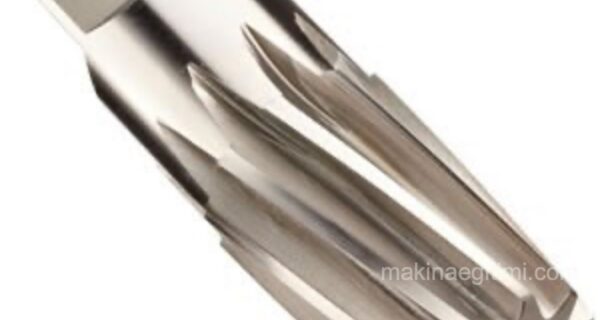
Reamers are used to ream holes that are smaller than their own diameter by the reaming allowance. For this reason, reamer tips are made conical. This is called the starting cutting tip. This part does the actual cutting. The lands on the cylindrical section guide the reamer.
The length of the starting cutting tip varies depending on the type of hole and the hardness of the material being machined. The starting cutting tip should be short for blind holes and for reaming soft material, and long for through holes and hard material.
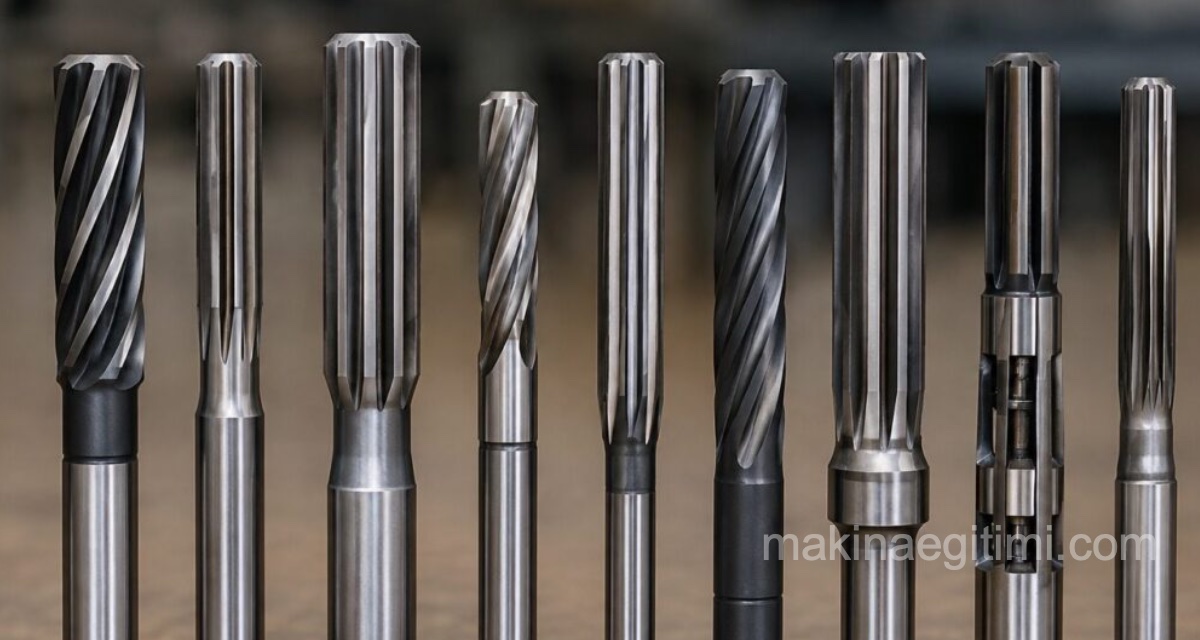
Machine reamers also have short starting cutting tips. The flutes on the cylindrical body may be straight or helical; to be able to turn the reamers, the ends of their shanks are made square.
Taper Reamers
These are reamers used for reaming tapered holes. These reamers are made in all standard sizes for both roughing and finishing. Since the chips do not come out easily, the taper reamer should be withdrawn and cleaned frequently. To be able to turn the reamer, the reamer shank is made square.
The cutting edges may be straight or helical. Helical-edged (fluted) reamers should be preferred so that chatter does not occur on the hole surfaces. The cutting edges of taper reamers used for roughing are notched so they are not overloaded along their full length. Roughing reamers are used where a large amount of material must be removed.
Finishing reamers are used to obtain a clean surface and to bring holes to size. Taper reamers are widely used in making tapered pin holes, Morse sleeves, and tapered bushings.

Taper reamer types:
Morse taper reamer, taper 1/20
Pin reamer, taper 1/50
Tap reamer, taper 1/10 – 1/15
Adjustable Reamers
The most efficient reamers are the adjustable ones. They can be adjusted to the desired diameter within a sufficient range above and below their nominal size. This is a feature often sought for reaming operations.

The insertable-blade design of these adjustable reamers used for reaming allows them to be set to the desired diameter through an adjustment. On adjustable reamers, the cutting edges (blades) sit in tapered slots cut into the body. Nuts on either side of the slot hold these blades in place. When adjusting — for example, if the diameter needs to be increased — the nut on the shank side is turned toward the end of the screw, and the blades are then clamped tight with the nut at the tip. To reduce the diameter, the reverse of this process is done.
Adjustment is achieved with the help of a bushing or a hole of known size. Their price is higher than other reamers. Being easy to sharpen, adjustable to the desired diameter, and long-lasting makes them an efficient tool.
These reamers are made in all standard diameters for hand or machine use. They come as a set inside a box.
Hand Reamers
Since hand reamers are used mainly for fine machining and finishing, their edges are ground nearly straight along their full length. To let the reamer enter the hole easily during reaming, its tip is made conical.
The backs of the edges are relieved to leave a small clearance. The end of the shank is made square to fit a tap wrench. When pulling a reamer through, care must be taken to feed it straight and keep the reamer on the hole’s axis. Sometimes the reamer must also be centered using the lathe’s tailstock center or a center fitted in the drill press spindle.
Hand-reaming this way gives good results and is recommended. No more than 0.125 mm of stock should be left for a hand reamer.

Machine Reamers
Machine reamers come in two types: taper-tip and straight-tip. On taper-tip reamers, the edges are chamfered at the face and given a clearance angle there. Only the edges at the tip do the cutting. The width of the lands is close to the width of the flutes and is not relieved backward — that is, no clearance angle is given. The flutes let chips escape and let cutting fluid reach the cutting zone during reaming.
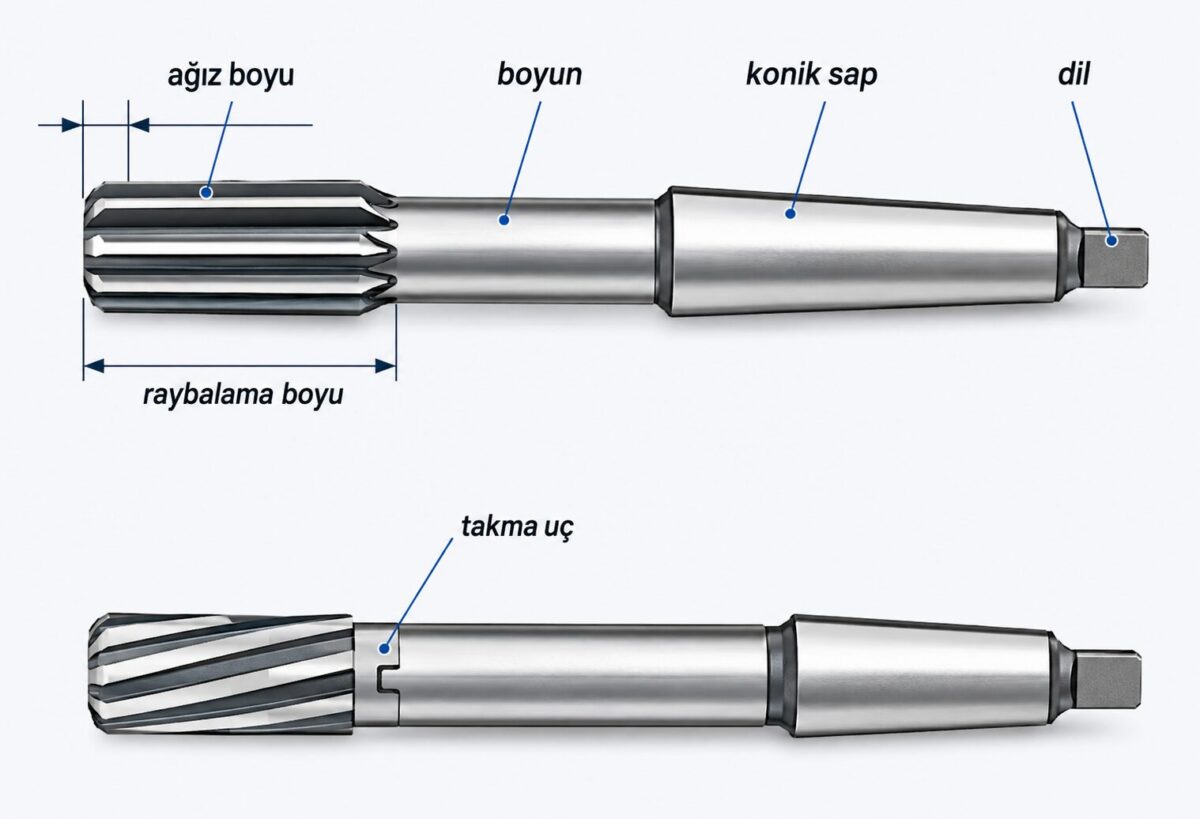
The taper-tip reamer is made slightly tapered or stepped down toward the shank so it does not rub and gall. The taper is roughly 0.025 mm over a 25 mm length. These reamers do not produce a very true hole.
For this reason, taper-tip reamers are usually made 0.075–0.125 mm smaller than their nominal size. This extra stock is then removed with a hand reamer to obtain a clean, true hole. A straight-tip (peripheral-cutting) reamer of a given diameter has more teeth than a taper-tip reamer of the same diameter. Its lands are narrower, with clearance along the full length.
The starting tips of the edges are also tapered or rounded and given a clearance angle. It is a good finishing reamer when a very precise size is not required.
Both types of machine reamer are also made with cylindrical and tapered shanks. Because they are costly, it is not advisable to buy taper shanks for reamers smaller than 12 mm. Likewise, because of the difficulty of clamping them, cylindrical shanks are not preferred for reamers larger than 25 mm.
Expansion Reamers
The body of these reamers expands. For this, the inside is bored tapered and the sides are slit. Expansion is achieved with a tapered piece that has a screw at one end and a wrench flat at the other. Since this is not an adjustable reamer, increasing the diameter is not really the point. The purpose here is to extend the life of a reamer used for finishing holes of standard size by making it expandable, so it can be resharpened as it dulls.
Reamer Types by Flute and Shank
- Cylindrical-shank reamers
- Taper-shank reamers
- Straight-fluted reamers
- Helical-fluted reamers
Cylindrical-Shank Reamers
Cylindrical-shank reamers are mostly pulled through by hand. This type of reamer is also used for reaming on a machine. Some machine reamers are also made with a cylindrical shank. The end of the cylindrical shank on these reamers is made square so it can be turned.
Taper-Shank Reamers

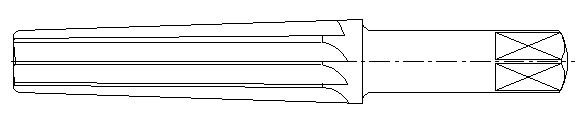
Large-diameter machine reamers are made with taper shanks. Compared to straight shanks, they are both easier and more secure to mount. Taper shanks keep the reamer from turning in the spindle and allow easy removal. Taper-shank reamers are mounted either directly or with the help of Morse sleeves.
Straight-Fluted Reamers
These reamers have flutes cut parallel to the axis. Straight-fluted reamers cannot be pulled through holes that contain a keyway. This is because the straight cutting edges easily catch on the edge of the keyway (channel), causing damage to the hole and breaking the edges.
Helical-Fluted Reamers
These have flutes cut at an angle to the reamer’s axis. This type of reamer is used to ream holes that have a keyway. Here, since the cutting edges follow the helix — that is, run at an angle to the reamer’s axis — it is not possible for them to catch on the edge of the keyway.
Related Posts