
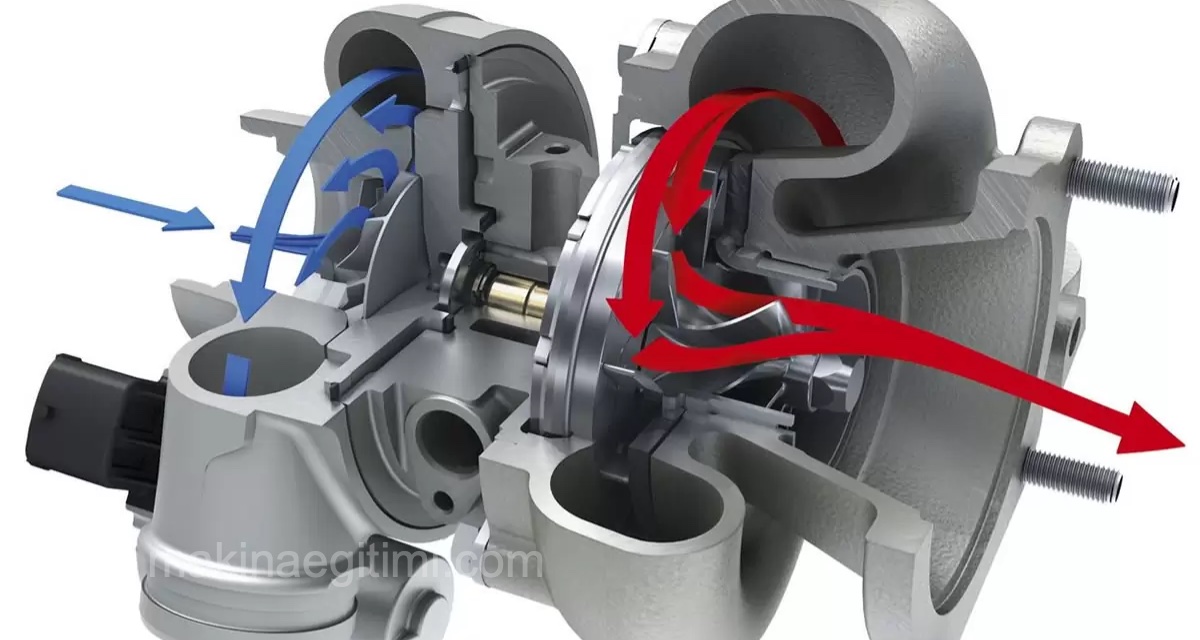
Machines that compress atmospheric air, much like compressing a spring, to produce compressed air are called compressors. There are many types of compressors, depending on how they draw in atmospheric air and the construction of their components. Commonly used compressor types:
Piston (Reciprocating) Compressors
As the piston moving inside a cylinder cavity moves downward, a vacuum forms inside the cylinder and the intake valve opens. Air drawn from the atmosphere passes through a filter and fills the cylinder. The intake function continues throughout the piston’s travel to bottom dead center. When the piston starts moving upward, both the intake and exhaust valves are closed. The air trapped inside the cylinder begins to be compressed. Compression continues until the desired ratio is reached. Then the exhaust valve opens and sends the compressed air into the system.

Piston compressors aren’t a top preference due to their noisy operation and their tendency to develop problems frequently. Their most important selling point is their low price; for this reason, they’re preferred in small and medium-sized businesses.
Screw Compressors
Screw compressors use rotating components called the “screw set”. These rotating components are called “screw compressors” because they have helical grooves resembling a screw thread. As the screw set rotates, a vacuum forms at the intake port. Air is carried through the screw cavity all the way to the outlet port. Once the desired compression ratio is reached, the air is sent into the system.
See also, for the related topic and details: Piston Compressors and Their Working Principle

The components in the screw set rotate without touching each other. For this, gears are used at the ends of the screws. Since there’s no friction, there’s no wear. Screw compressors are a compressor type known for quiet operation and few maintenance problems. They’re used very heavily in large and medium-scale businesses.
See also, for the related topic and details: Screw Compressors: Construction, Types, Strengths, and Weaknesses
Piston Compressor Efficiency
Piston compressors offer a low-cost, reliable solution for small and medium-scale applications.
Screw Compressor Continuity
Screw compressors are preferred in industrial settings to meet continuous, high-volume air demand.
Turbo Compressor Capacity
Turbo (centrifugal) compressors are used in large-scale industrial facilities that require very high air flow rates.
Rotary Compressors
The rotating components inside this type of compressor are called “rotors”. The rotors consist of components with different cross-sectional profiles.
While one rotor turns with the motion it receives from an electric motor, the other rotor turns freely. As the rotors turn, air is drawn in through the intake port and carried toward the outlet port. At the outlet port, the compressed air is sent into the system.
Turbo Compressors
Piston, screw, and rotary compressor types produce compressed air by compressing air at specific ratios. In dynamic compressors, on the other hand, kinetic energy is imparted to the air; then, as the air’s kinetic energy is reduced, that kinetic energy is converted into pressure energy. Turbo compressors are generally used in applications that require high flow rate and low pressure.

Air is compressed as it passes between the blades. This type of compressor can be built as a single stage or as multiple stages.
Related Questions
These compressors are quite noisy while operating and tend to break down more frequently over time. However, their low cost can make these downsides worth accepting, especially for small businesses.
While the piston performs its compression stroke, both valves are kept closed so the air can be fully compressed without escaping. The valves only open when it’s their turn — that is, at the moment of intake or discharge.
Related Posts
 Advantages of Hydraulic Systems
 Pneumatic Application Examples, Sample Circuits
 Pneumatic Cylinders and Their Types
 Hydraulic Filter Selection
 Screw Compressors: Construction, Types, Strengths, and Weaknesses
 What Is Pascal’s Principle? Where It Is Used
 What Is an Orifice in Flow Control Valves?
 Pneumatic Motors. Their Features and Working System