
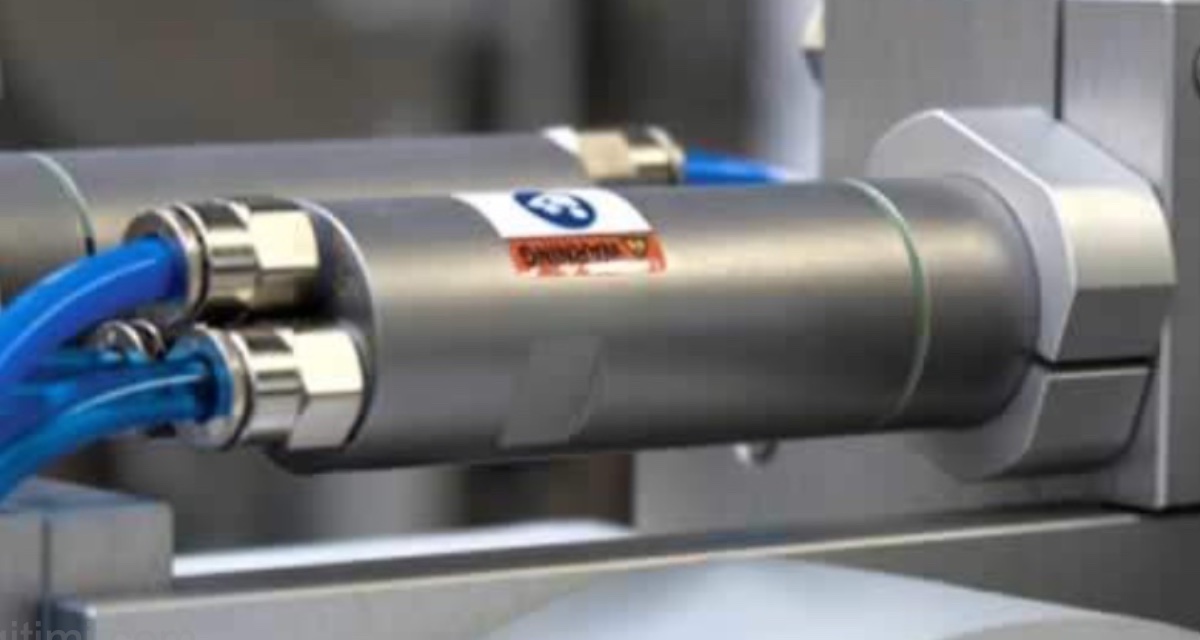
The subject of this article will be pneumatic motors — their working system, and their features and advantages.
Pneumatic motors and their working system
Pneumatic circuit elements that convert the energy of compressed air into rotary motion in pneumatic systems are called pneumatic motors.
More specifically, in a pneumatic motor the kinetic energy of compressed air is converted into the kinetic energy of a rotating shaft. The output shaft is the point where the motor is connected to the machine or device it will drive.

Its operating principle is the exact opposite of a compressor. A compressor first converts electrical energy into mechanical energy, then converts that mechanical energy into pressure energy. A motor, on the other hand, uses this pressure energy to produce mechanical energy.
The pressure of the compressed air entering the motor determines the force or output torque that can be obtained from the motor.
The flow rate of the air determines the motor speed. Pressure and flow rate together determine the motor’s output power.
The general structure of pneumatic motors resembles that of some hydraulic motors and pumps. However, certain modifications made to pneumatic motors allow them to operate more efficiently with compressed air.
To allow an air compressor to deliver as much compressed air as possible to the system, its volumetric efficiency is generally very high. This is because the piston, rotor, and other parts have a very tight-fitting construction, which provides maximum output capacity.

To give a motor as large a mechanical output power as possible, motors are designed to achieve the highest possible mechanical and overall efficiency values. This means the motor can deliver a large amount of work or torque, but this comes at the cost of using a greater amount of air.
Operation with Compressed Air
Pneumatic motors operate by converting the energy of compressed air into rotary motion.
Explosion-Risk-Free Environments
Because pneumatic motors do not generate sparks, they can be used safely in environments containing explosive gases.
Overload Tolerance
Pneumatic motors can stall under overload without burning out, and resume operating once the load is removed.
Properties of Pneumatic Motors
- Rotational speeds are very high (up to 500,000 rpm)
- Speed control is unlimited
- Direction of rotation can be changed while the motor is still running
- Inexpensive and easy to maintain
- Can be easily used in any environment (dusty, dirty, humid, hot, cold, or with vibration). They slow down or stop when overloaded
- Small in size and lightweight
- Can operate in different positions.
Pneumatic motors provide high torque at low speeds. As the rotational speed obtained from pneumatic motors increases, torque decreases. This is why they can withstand large forces at high speeds. A pneumatic motor stalling or reversing under excessive loads causes no damage to the motor.

This has made pneumatic motors more widely used in industry. The ability to achieve very high speeds in very small pneumatic motors has also enabled their use in medicine and dentistry. In dentistry, pencil-sized pneumatic motors running at 400,000 rpm are used (image above).
Advantages of pneumatic motors
Pneumatic motors have very high rotational speeds (up to 500,000 rpm).
They are compact, lightweight, and take up little space.

They offer easy direction reversal — the direction of rotation can be changed instantly while the motor is still running.
They are easy to maintain.
Pneumatic motors are safe against excessive and sudden loading. When overloaded, they simply slow down or stop.
Pneumatic motors can be used comfortably in any environment (dirty, dusty, humid, flammable). They are unaffected by weather conditions.
Their circuit components are inexpensive.
They can operate in different positions.
These are the advantages of pneumatic motors.

Using a pneumatic motor together with a directional control valve in a pneumatic circuit. This allows the pneumatic motor to rotate in both directions (image above).
Related Questions
Yes. While a compressor converts mechanical energy into compressed air, a pneumatic motor does the opposite — it takes compressed air and converts it into mechanical rotary motion. This inverse relationship makes the two devices complementary to each other.
Pressure determines the force (torque) the motor can produce, while flow rate (the amount of air flow) determines how fast the motor will turn. Since power depends on the product of the two, increasing only one may not provide sufficient performance gains.
Related Posts
 Time Delay Valve Explanation and Applications
 Types of Pneumatic Motors
 Hydraulic Oil Selection and Properties Required in Hydraulic Oils
 How Hydraulic Brakes Work
 Screw Compressors: Construction, Types, Strengths, and Weaknesses
 Contamination in Hydraulic Systems and Its Causes
 Pneumatic Motor Selection
 The Importance and Applications of Hydraulics and Pneumatics