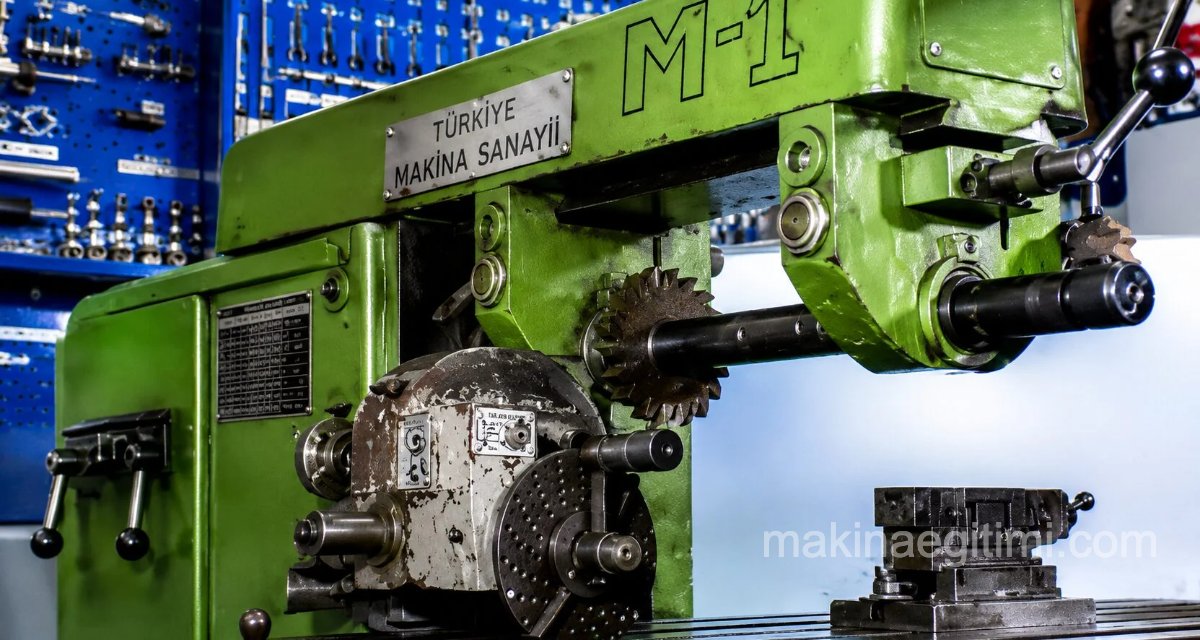
The types of milling machines are as follows:
Vertical Milling Machine
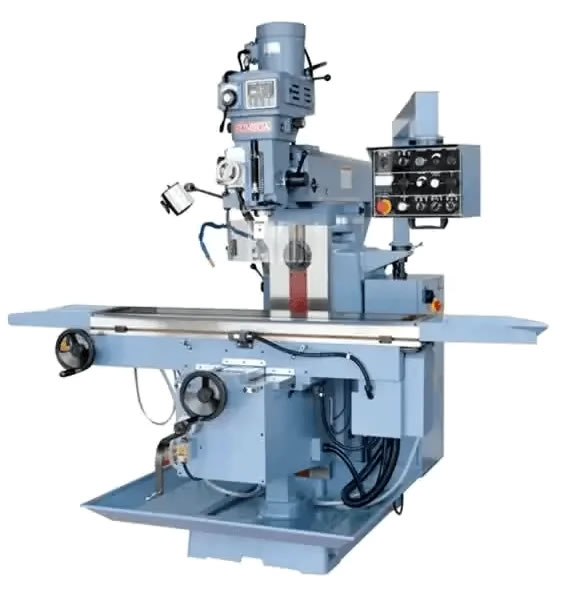
On these machines, the axis of the spindle to which the milling cutter is mounted is perpendicular to the machine table.
Parts can be machined with the axis of the milling cutter perpendicular, as well as by tilting the head to any desired angle.
The table of these machines stays along a fixed axis and cannot be angled by rotating it right or left.

Universal Milling Machine
These are combined forms of horizontal and vertical milling machines, made to get more use out of a milling machine and to use it for various operations.
As a result, more versatile machines have been created.
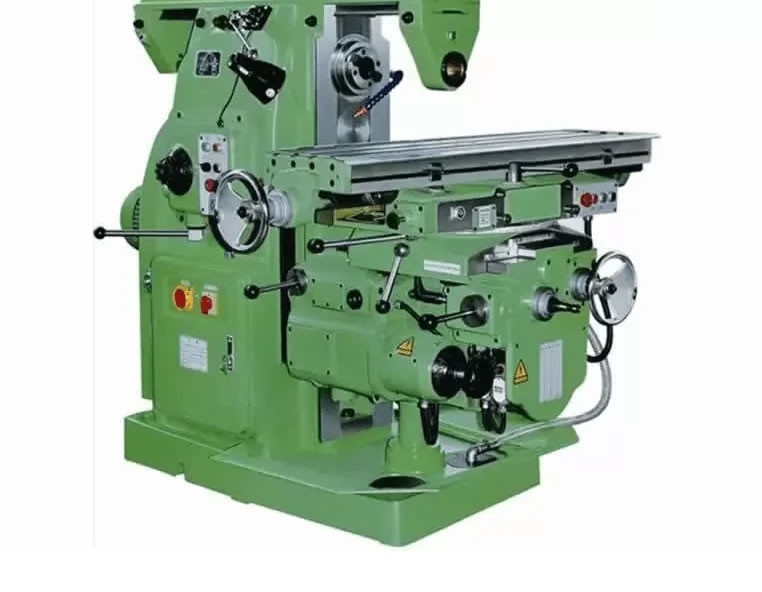
The machine table can be rotated up to 45° to the right and left relative to the milling spindle. Being able to machine various helical grooves in the desired direction, either by hand or with the help of automatic feed, is one of the machine’s most important features. Additionally, when the machine is equipped with accessory attachments such as a dividing head, tailstock, vertical and universal heads, shaping attachment, etc., it becomes possible to mill all or part of the operations of both horizontal and vertical milling — flat surfaces, various grooves, holes and features inside holes, and angled surfaces.
Vertical Mill Use
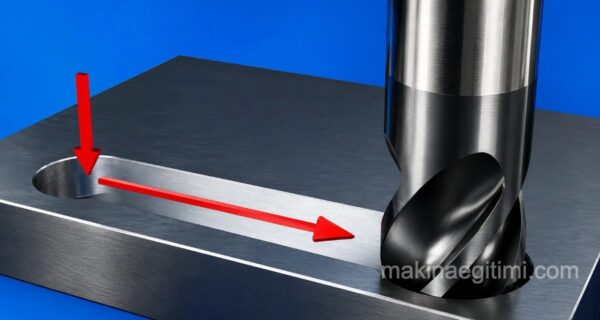
Vertical milling machines are commonly used for surfacing and pocketing operations, thanks to the spindle being positioned perpendicular to the table.
Universal Mill Flexibility
Universal milling machines allow complex geometries such as helical gears, thanks to the table’s ability to rotate at an angle.
CNC Milling Automation
CNC milling machines can precisely machine complex 3D surfaces without human intervention, using G-code programs.
Die-Sinking (Toolroom) Milling Machine
Copy (Tracer) Milling Machine
What sets copy (tracer) milling machines apart from other mills is that they carry out material removal according to a template called a “master” (mastar). For this, a scaled-down (or otherwise proportional) master or template is made from an inexpensive material for the part to be produced. This prepared master or template pattern is traced on the machine table using a special “tracer stylus” or “electronic eye” tip, and the shape is copied. In the machine’s construction, the tracer stylus (a pin or similar device) and the milling cutter are mounted at matching positions on the table relative to the workpiece and the template. The pin and the milling cutter are fixed to two separate spindles on the machine.
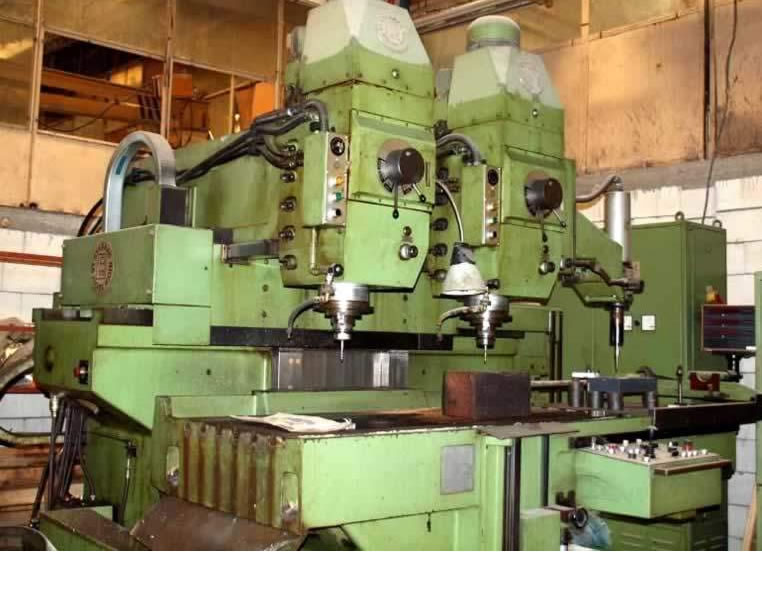
Here, the milling cutter reproduces the straight and curved paths that the pin follows on the master or template, cutting the same shape onto the workpiece. In industry, these machines are especially useful for manufacturing small, irregularly shaped parts in mold making.
CNC Milling Machine

These are advanced machines with data processing and evaluation capabilities. The part is fixed to the machine, and its reference points are registered to the machine using a precision sensing tip called a probe (part zeroing). This way, the machine learns the raw dimensions of the part to be machined and its position on the machine.
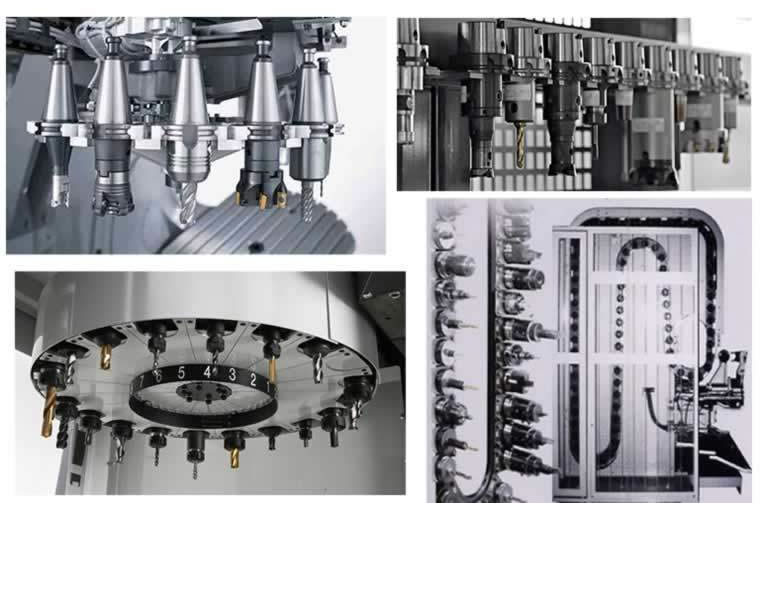
Then, a pre-prepared program for machining the part is entered into the machine through a data-entry screen (control panel), or by methods such as a memory card or an RS232 interface cable. The machine interprets the entered program (which cutting tool to send where and when, in what order and at what speed) and machines the part by fully carrying out the tasks in the entered program.
CNC milling machines are also known as vertical machining centers. Depending on how advanced their motion capabilities are, they come in types such as 3-axis, 5-axis, and 7-axis.
Related Questions
On a vertical mill, the table stays on a fixed axis and cannot be angled. On a universal mill, the table can be rotated up to 45 degrees, which allows angled operations like cutting helical grooves.
A universal milling machine combines the features of horizontal and vertical mills. This allows a wide variety of operations — such as flat surfacing, slotting, gear cutting, and angled work — to be done on a single machine.
Related Posts