Drill Presses
In this article, we’ll look at what a drill press is and provide information about drill presses. We’ll focus on drill presses and their types. We’ll also give the operating instructions for a drill press at the end of the article.
There are various machines used for drilling operations. Drill presses are designed according to need, and multi-purpose ones are generally preferred.
Hand Drills
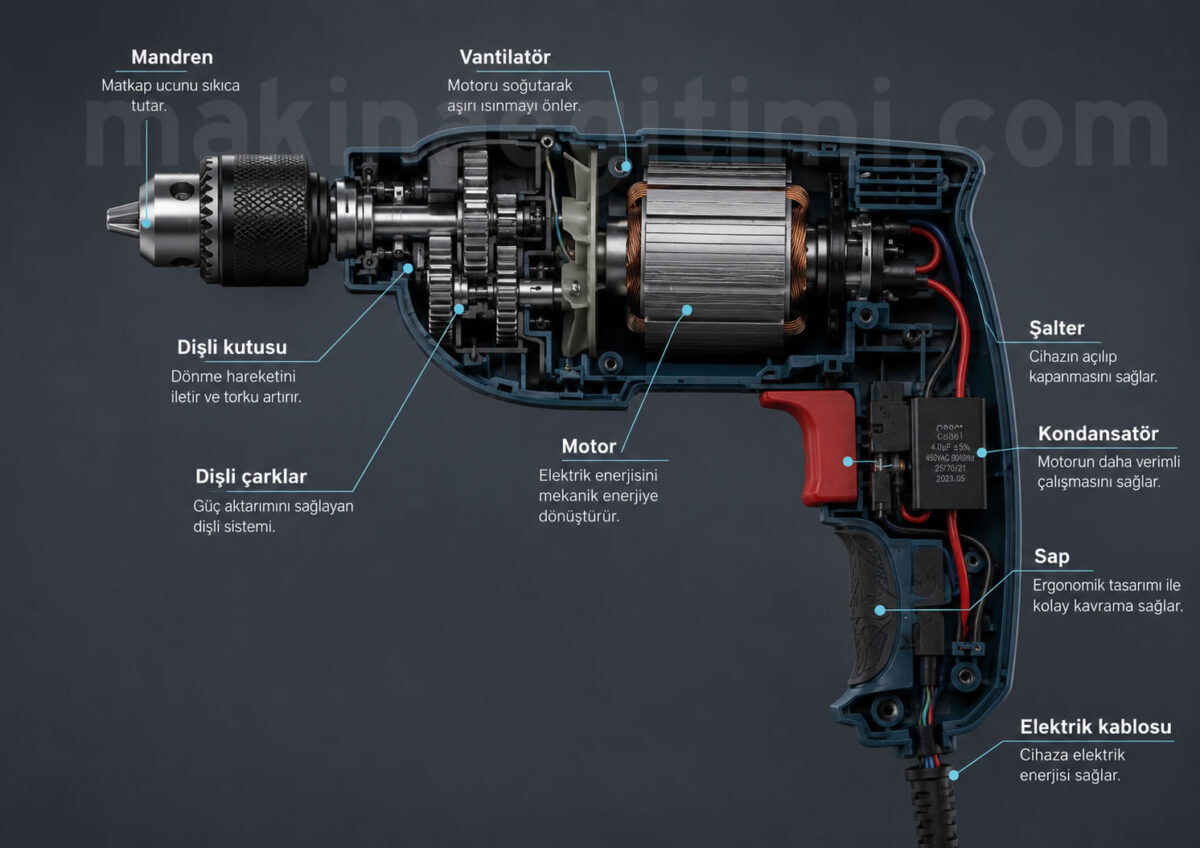
These are drilling machines with small bodies, made in various types weighing between 2.5-8 kg. Because hand drills are lightweight, they are used in almost every field due to important advantages such as being usable in any working position and having steplessly adjustable speeds. They have very wide use, especially in assembly and maintenance-repair work.
Although hand drills are small in weight and size, they can drill holes up to 13mm in diameter in metal and up to 16mm in diameter in concrete and stone.
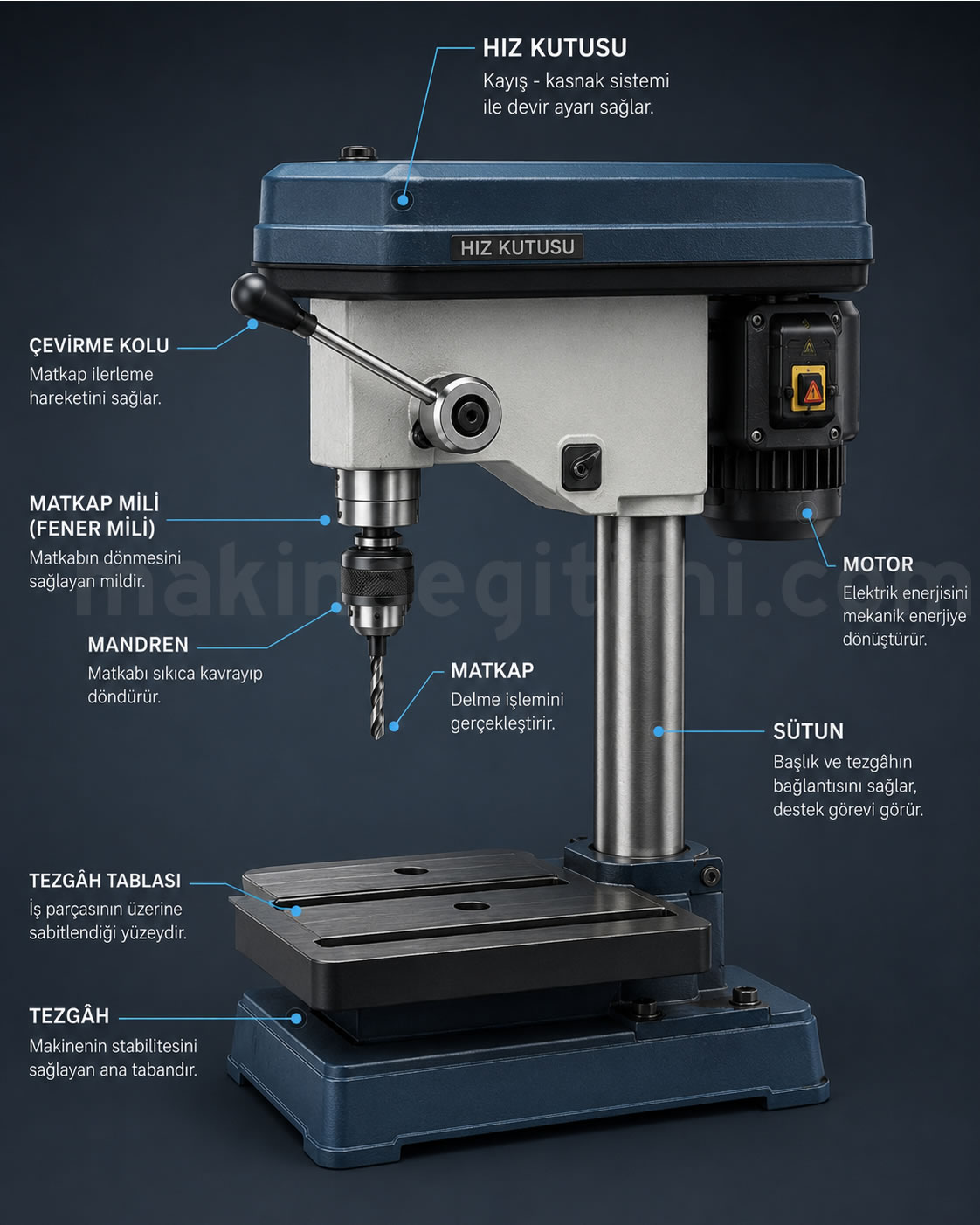
Bench Drill Press
There are two types of these drills. One has a belt-pulley system, the other has a gearbox. Changing the speed on belt-pulley machines takes more time than on gearbox machines. Since bench drills are used for small-diameter drilling operations, their speeds are staged between 400-3000 rpm.
Because of their small build, they are operated by being mounted on a bench or a stand. Bench drills can drill holes up to 16mm in steel materials and up to 20mm in light metals.
Column (Pillar) Drill Presses
These are drill presses frequently used in manufacturing operations. On column drill presses, the part holding the drill spindle and the work table can be rotated around the column axis to reach the desired position. This makes it possible to drill holes on large workpieces in various positions. However, the fact that the work table is movable causes the machine’s precision to degrade quickly.
The column drill press operates with either a belt-pulley system or a semi belt-pulley system.
Column drill presses are suitable for drilling small and medium-sized workpieces at different heights.
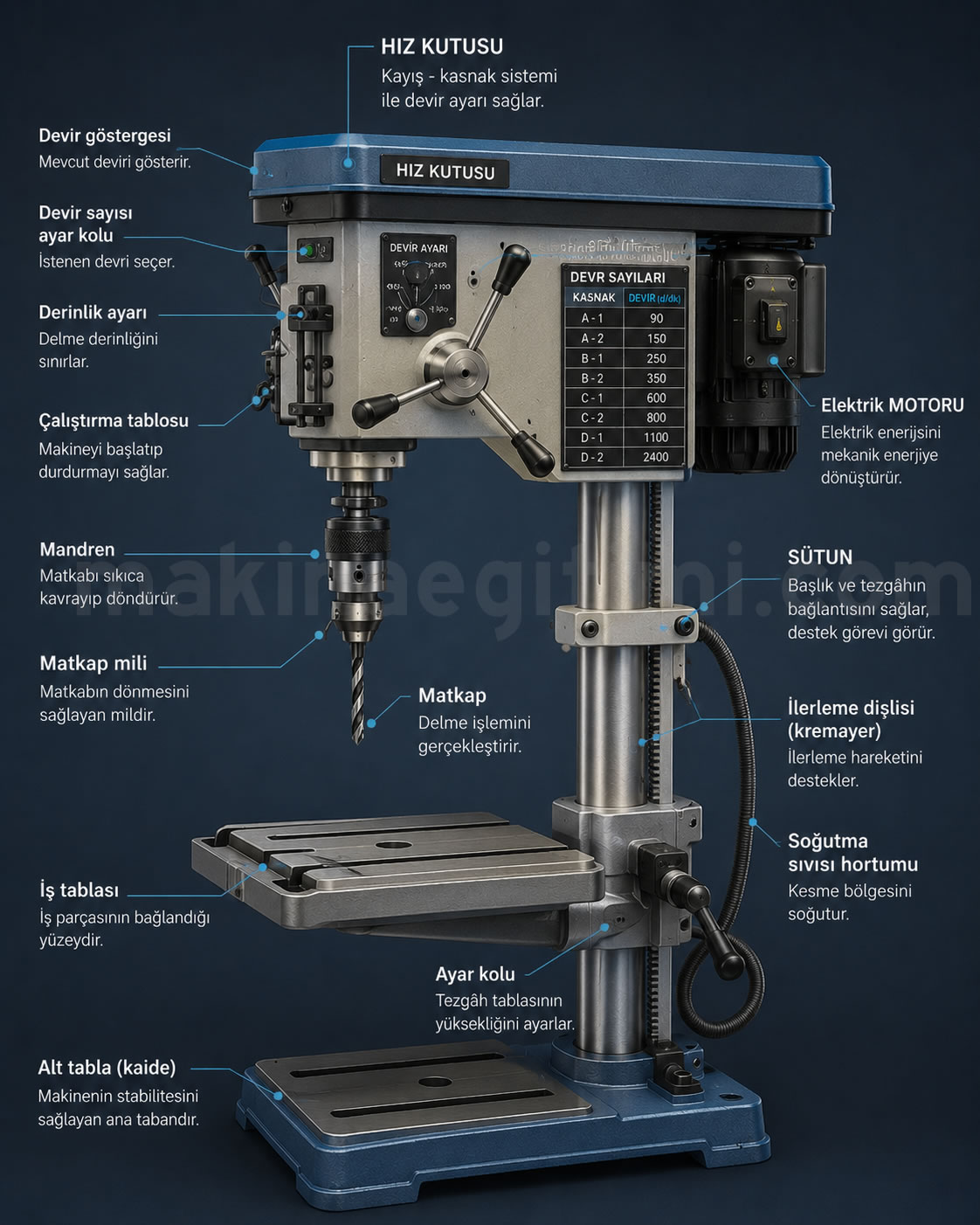
These machines consist of a drill spindle whose speed can generally be adjusted steplessly, a column, a base, and a drill table that can be swiveled left and right and whose height can be adjusted; feed is obtained through a gear mechanism that operates independently of the drill spindle.

Frame-Type Drill Presses (Console Drill Presses)
On frame-type drill presses, the part to which the drill spindle and work table are attached is generally shaped as a body made of cast iron, and the drill spindle block and work table are attached to this body via a dovetail rail-slide system.
The work table and spindle can only move in the vertical position. Therefore, the working capacity of frame-type drill presses is lower than that of column drill presses. However, since these machines have a thick and sizable body, they are more stable, more rigid, and more precise.
The frame-type drill press, also known as the console drill press, is similar in construction to column drills. The most notable difference between them is that the machine table is supported from below by a console. In addition, bringing the workpiece closer to the machine spindle is achieved by moving the console. Drilling is performed either manually with a feed handle or automatically.
Radial Drill Presses
For very large manufacturing jobs, machines with console bodies reaching up to 3 meters have been built. Their most important feature is that they provide the best way to perform operations at various positions on a workpiece in a single setup. Since the drill head can also be angled, the working capacity of these machines is increased.
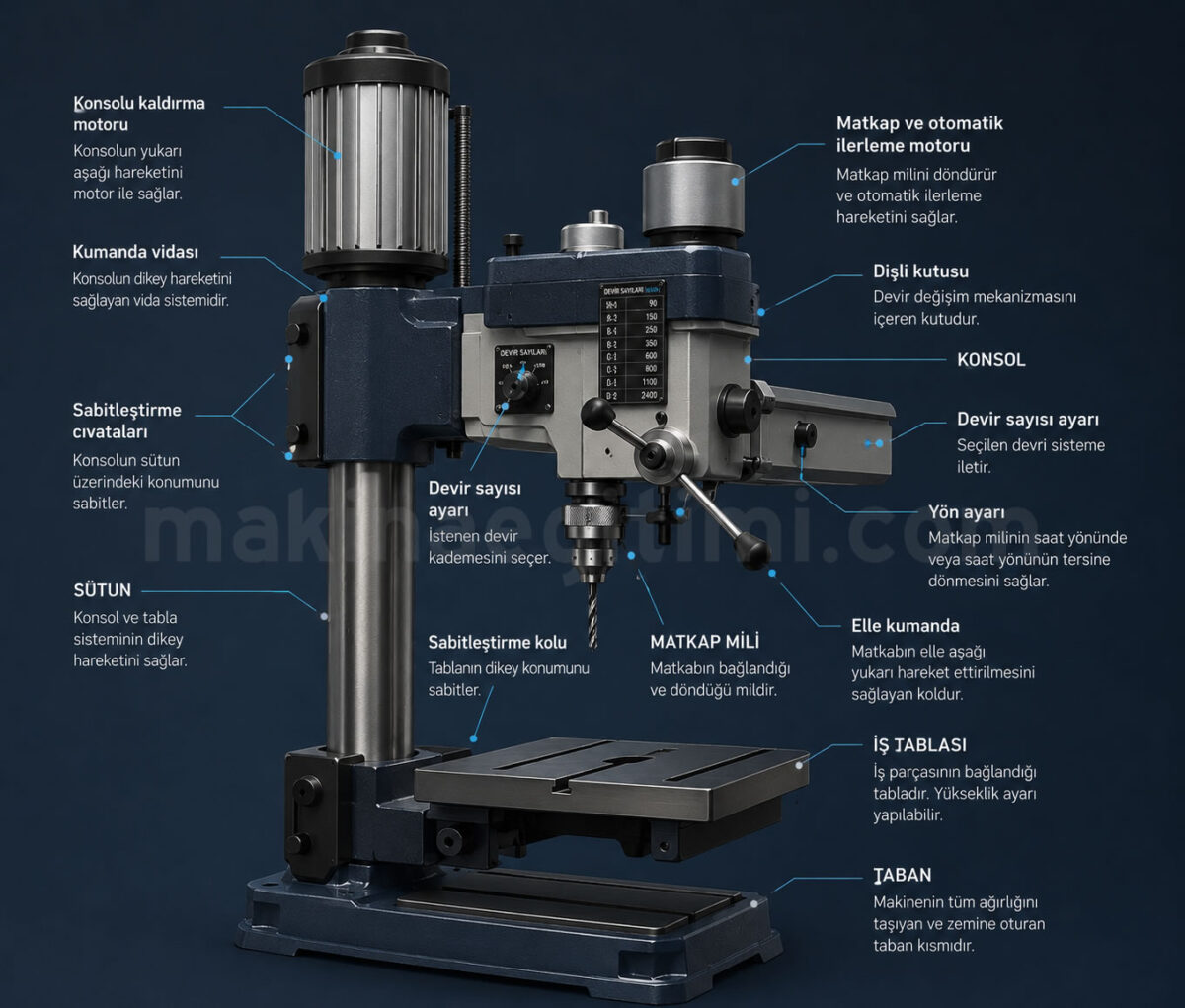
Radial drill presses are used for drilling operations on very large and heavy parts. Radial drill presses have a body that can rotate 360 degrees around the column. The block containing the drill spindle is located on this body, and the drill block is adjusted according to the position of the workpiece by moving it back and forth on the radial body.
Very large workpieces are placed directly on the machine’s base/foot. These machines have no work table. Because the workpiece is very heavy, it is too large and heavy to be attached to a work table and vise. For this reason, there is no work table. Workpieces with a geometric shape that cannot be attached to the machine base are mounted on specially designed and manufactured prisms or angle blocks.
A prism is an auxiliary element of the machine, used to attach the workpiece to it. On the other hand, other prisms can be made depending on the job, or work fixtures prepared for the serial production of workpieces can also be attached to such prisms, shortening machining time and helping produce higher-quality work.

Boring Mill (Bohrwerk) Drill Presses
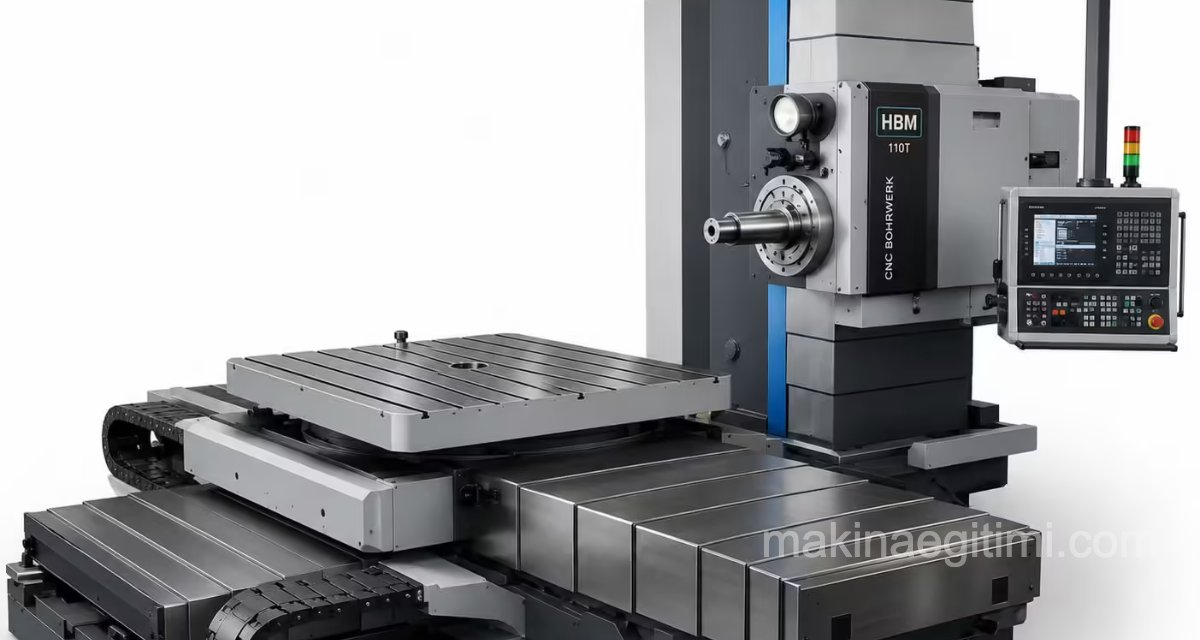
These are used for machining parts too large to be machined on lathes and milling machines. They have both turning and milling capability, and are even more functional than those machines. The workpiece is fixed, and the tool is movable. Via the chuck, it can bore internal and external faces at very large diameters. The table has 360° rotation capability. This means there’s no need to remove and reattach the part for operations on different surfaces. In addition, the table can move back and forth, and the chuck can move left and right. It has the ability to work on 3 axes (x, y, z).
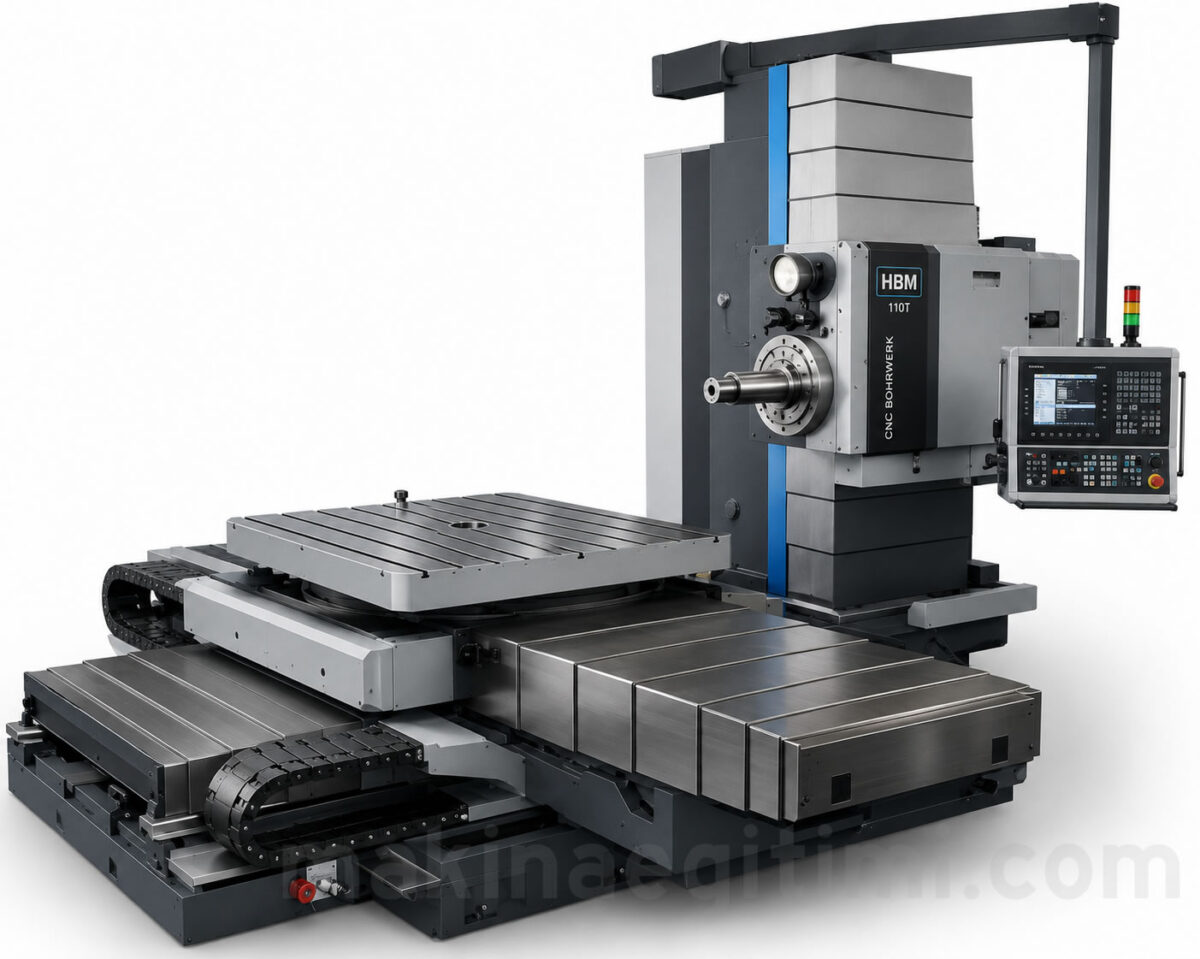
These are special machines built for drilling holes of various diameters and positions on large machine bodies and for milling their surfaces. On these machines, slotting, thread cutting, and flat surface milling operations are also performed.
In the manufacturing sector, pricing generally increases not linearly but logarithmically as part sizes grow. Since parts machined on a boring mill weigh tons and serial production is difficult, we can say this is the machine that earns its owner the most.
Since the machine’s work table is built to rotate 360 degrees, surfaces on the workpiece that are parallel to the horizontal plane but at an angle to other planes can be machined in a single setup. Although its name is Bohrwerk, it is commonly known colloquially as a “borvek.”
Gang (Multi-Spindle) Drill Presses
These consist of column drill presses with a shared table, mounted side by side, each rotatable left and right, and with adjustable height.
With these machines, various machining methods such as drilling, countersinking, and tapping can be applied to a workpiece in succession. Gang drill presses are used in batch (mass) serial production. In the market, they are also known as multi-head drill presses or gang drill presses.

Related Questions
Desktop (bench), radial, and CNC drill presses are the most commonly used types of drill presses.
-They have both turning and milling capability.
-The workpiece is fixed, and the tool is movable.
-Via the chuck, it can bore internal and external faces at very large diameters.
-The table has 360° rotation capability. This means there’s no need to remove and reattach the part for operations on different surfaces. In addition, the table can move back and forth, and the chuck can move left and right.
-It has the ability to work on 3 axes (x, y, z).
Radial drill presses are used for drilling operations on very large and heavy parts.
CNC drill presses allow numerous holes to be drilled automatically and consistently thanks to programmable precision.
In this article, we covered what a drill press is, what it’s used for, and drill presses and their types. You can find related topics in the section below.
Recommended Videos About Drill Presses

Animation of drill press parts

Building a bench-type drill press
Desktop (Bench) Drill Presses
Designed for small, precise drilling jobs, bench drill presses are widely used in workshops.
Flexibility of the Radial Drill Press
Radial drill presses have a rotatable arm to drill holes at different points on large, heavy parts.
CNC Drilling Automation
CNC drill presses allow numerous holes to be drilled automatically and consistently thanks to programmable precision.
Related Posts