

If we want to classify valves by their construction, we can classify them in two ways: seat valves and spool valves.
Seat Valves
In seat valves, a ball, a conical element, or, less commonly, a disc, is pressed against the seating surface as the closing element.
This type of valve has a tight sealing characteristic. Due to the seating principle, at most three ports can be opened or closed by a single control element.

Here, the overlap is negative. This means that a valve with more than three ports needs to have more than one control element.
A 4/2 directional valve designed on the seating principle is internally made up of two 3/2 directional valves.

Seat Valve Sealing
Seat valves offer high sealing performance, providing near-zero internal leakage in the fully closed position.
Spool Valve Speed
Spool valves are preferred in applications requiring fast switching, thanks to the low friction of their moving parts.
Effect of Spool Overlap
Spool overlap determines how abrupt the flow transition will be during valve switching.
Spool Valves
Spool valves are divided into two types: axial spool valves and rotary spool valves. A rotary spool valve consists of one or more pistons rotating within a cylindrical housing. An axial spool valve consists of one or more pistons, arranged in a certain order relative to each other, that can be slid axially within a cylindrical housing.
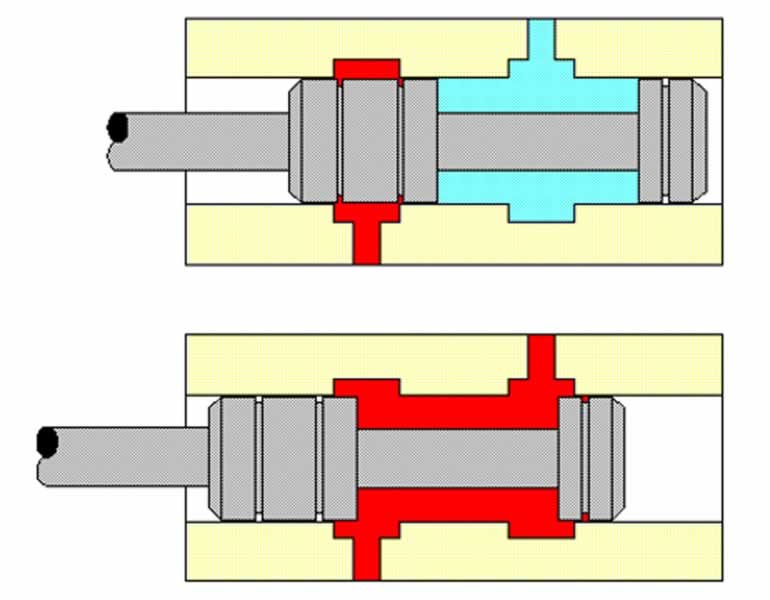
In spool valves, as the pistons slide axially, multiple connection ports can be opened, connected to each other, or closed as desired.
Depending on the application, the shape of the spool overlap can be set differently for each control edge of the piston.
To prevent the piston from being pressed against the cylinder’s inner surface, the piston’s outer surface is fitted with circular grooves. This way, only fluid friction occurs during the piston’s motion.
If the hydraulic oil becomes contaminated, contaminant particles settle between the piston and the cylinder’s inner wall. Here, they act like an abrasive, causing the cylinder’s inner diameter to enlarge and, as a result, increasing oil leakage.
Comparing Spool Valves and Seat Valves
Spool Valve
-Leakage oil flow
-Sensitive to backpressure
-Simple construction
-Pressure-balanced
-Long control travel
Seat Valves
Leak-tight closing
-Multi-position valves are quite difficult and costly to build
-Pressure balance needs to be ensured
-Short control travel
Spool Overlap
A valve’s behavior when closing or opening is determined by spool overlap. Spool overlap is evaluated as positive, negative, or zero. Each control edge of a piston can have a different overlap.
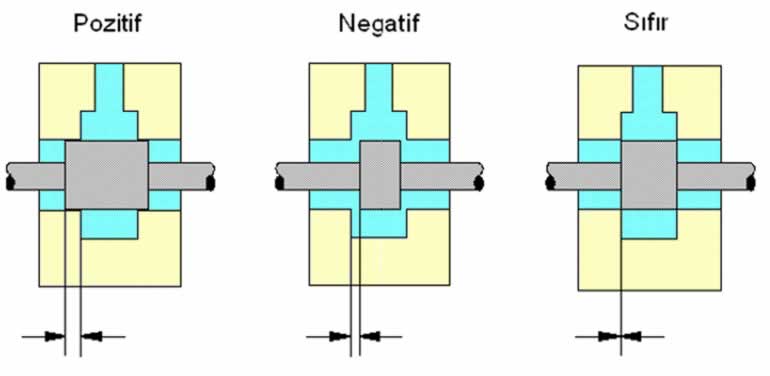
Spool overlap determines the tolerance between the piston and cylinder, and, related to this, the amount of leakage oil. The overlap effect is important for achieving various advantages. Depending on the application, the appropriate overlap type is chosen.
Positive Spool Overlap
During position change, all ports are disconnected from each other for a short time; there’s no pressure surge. There is a sudden pressure rise causing an abrupt transition and a hard start-up.

Negative Overlap
During position change, all ports are connected to each other briefly; pressure drops for a short time.

Tank-first opening: During position change, the connection between the actuator outlet and the tank is established before the connection between the actuator inlet and the pump.
Zero overlap: Refers to an edge-to-edge overlap condition. This is important for fast position changes in valves, and the switching travel is short.
Pump-first opening: During position change, the connection between the pump and the actuator is established first, followed by the connection between the actuator outlet and the tank.
In multi-position valves, different spool overlaps can exist within the same valve depending on the intended use.
In seat valves, the desired spool overlap is achieved by staggering when the valves engage at different times. When needed, the overlap can be reconfigured as desired by changing the timing of when the valves engage.
Related Questions
In a seat valve, the ball or conical element is pressed directly and tightly against the seating surface. This full contact ensures there’s almost no leakage in the closed position; in spool valves, on the other hand, small clearances between moving parts can lead to leakage.
The moving parts of spool valves slide with less friction, allowing the valve to switch from one position to another faster. This speed advantage stands out in applications requiring frequent and rapid direction changes.
Related Posts
 What Is a Hydraulic Flow Divider? What Does It Do?
  What Is Pascal’s Principle? Where It Is Used
  Flow Control (Speed Control) Valves
  Hydraulic System Applications in Machine Tools
  Hydraulic Pump Maintenance
  What Is a Suction Filter? SUCTION LINE FILTERS
  What Is a Check Valve. How Does It Work, What Is Its Function
  Hydraulic Applications – Pressure Reducing Valve