
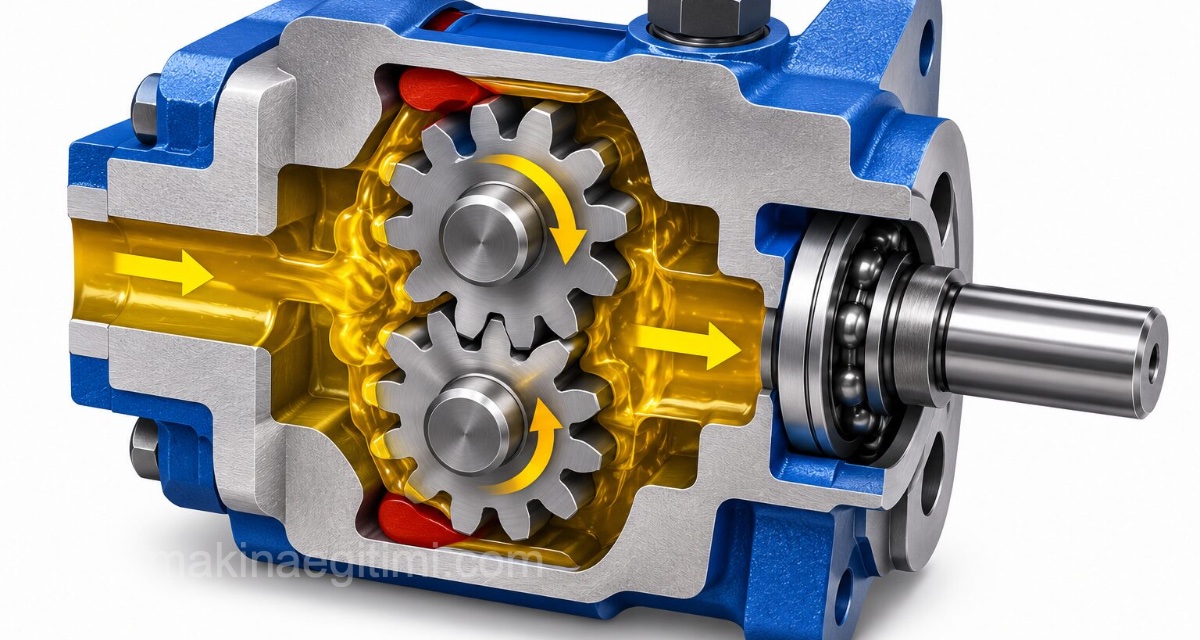
In this article, we’ll start with the definition of a hydraulic pump and find answers to questions like what a hydraulic pump is for and how it works. We’ll also give information about flow rate and hydraulic pump-fluid compatibility. Our topics are as follows:
What Is a Hydraulic Pump?
A power machine that draws in fluid and delivers it under pressure, using the mechanical energy it receives from a motor, is called a hydraulic pump. Hydraulic pumps produce hydraulic working energy by giving the fluid pressure.
The pressure and flow rate of the fluid a pump delivers to the hydraulic circuit it supplies must be at an adequate value. If the pump can’t provide sufficient pressure and flow, the hydraulic circuit can’t perform its functions.

Mechanical-to-Hydraulic Conversion
A hydraulic pump converts the motor’s mechanical energy into the hydraulic fluid’s pressure energy.
Its Job Is Producing Flow
The pump’s fundamental job isn’t to produce pressure — it’s to supply the fluid flow rate the system needs to operate.
Fixed- and Variable-Displacement Types
Hydraulic pumps can be built as fixed-displacement, or as variable-displacement, adjusting flow to the system’s needs.
How Does a Hydraulic Pump Work
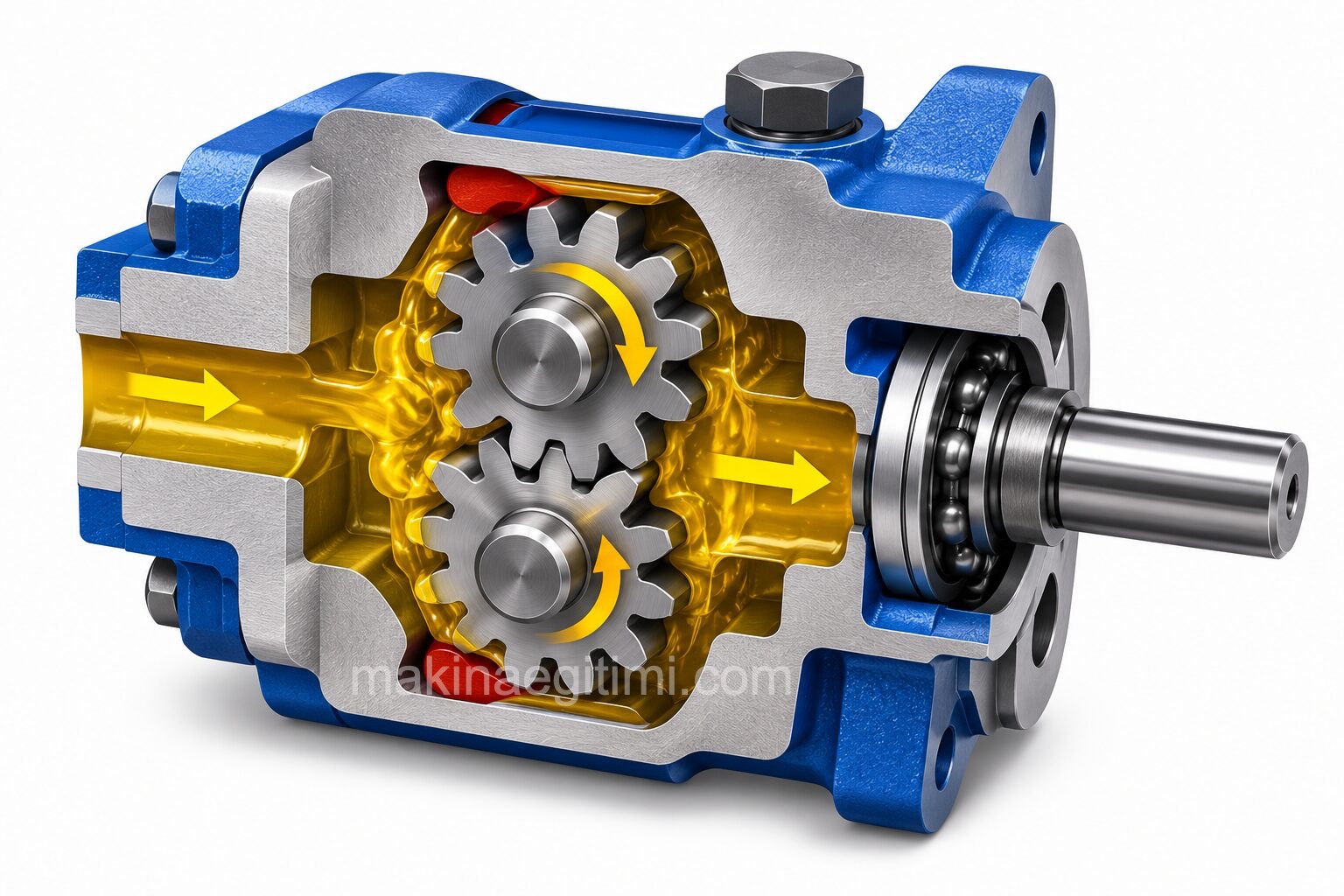
A hydraulic pump’s operating principle: Pumps work on the principle of increasing pressure by expanding volume on the suction side and reducing volume on the discharge side.
It pumps the fluid via positive displacement by creating an increasing volume (suction chamber) at the inlet port and a decreasing volume (compression) at the outlet port. This way, if there’s resistance ahead of the fluid the pump discharges, pressure is also generated. The hydraulic pump acts as the power source in the circuit.
The hydraulic pump provides hydraulic power transmission by pushing the fluid to a certain point. The power the pump provides depends on the fluid’s pressure as well as its quantity. If the cross-sectional area the fluid passes through is A and the flow speed is v, then the flow rate (the amount of fluid flowing per unit time), Q, equals A . v.
For a hydraulic pump to push the fluid, it needs to apply a force of F = p . A to the flow’s cross-section. If the fluid reaches speed v under the applied pumping force, the resulting transmission power is P = F . v = p . A . v. Since Q = A . v, the pump’s power becomes P = p . Q. As a result, the pump’s power is directly proportional to the pressure it provides and its flow rate. Pressure is expressed in bar, flow rate in l/min, and taking the pump’s overall efficiency (η1) into account, the power of the motor needed to drive the pump is:
Pm= P.Q / 450.η1 = ……..hp or
P = P.Q / 600.η1 = ………kw.
Definition of Flow Rate. What Is Flow Rate?
The volume of liquid flowing through a cross-section per unit time is called flow rate. For this reason, flow rate (Q) is directly proportional to the flow cross-section (A) and speed (v). At a given power, if a pump is to deliver a high flow rate, the pressure will be low. To achieve high pressure, the flow rate will be low.
As long as the pump operates at the same flow rate, the fluid:
flows according to the rule Q = A1.V1 = A2.V2 = … = An.Vn. Even with the same flow rate, the flow cross-sections and speeds can vary inversely.
Hydraulic Pump and Fluid Compatibility
Getting the desired efficiency from a pump depends on the hydraulic oil used in the system. If the oil’s viscosity doesn’t have the desired properties, the pump’s efficiency will drop. We can list the properties to look for in the oil needed for a hydraulic pump as follows.
1— Its viscosity (resistance to flow) should be of the desired quality.
2— It should have sufficient film strength.
3— It should be able to prevent rust and oxidation that could occur inside the pump.
4— It should be able to provide the cooling needed for the system and the pump. 5— It should have properties suitable for transmitting power.
6— It should be pressure-resistant and able to maintain its stability without losing its properties over a long period.
Related Questions
A hydraulic pump is a device that converts a motor’s mechanical energy into the pressure energy of a hydraulic fluid.
The pump’s fundamental job isn’t to produce pressure — it’s to supply the fluid flow rate the system needs to operate.
Hydraulic pumps can be built as fixed-displacement, or as variable-displacement, adjusting flow to the system’s needs.
Related Posts
 Hydraulic Accumulator Applications
 What Is a Suction Filter? SUCTION LINE FILTERS
 What Is a Hydraulic Return Filter. Return Line Filters
 What Is a Hydraulic Flow Divider? What Does It Do?
 4-Way 3-Position Directional Control Valves
 Pneumatic Application Examples, Sample Circuits
 Directional Control Valves
 Hydraulic Pump Maintenance