

One of the prerequisites for a hydraulic system to run without interruption is filtering both the fluid and the air that comes into contact with the tank. The contaminants removed by filters are ambient dust entering the hydraulic system through fill plugs and cover gaskets. Most malfunctions occurring in hydraulic systems are caused by contaminated fluids.
Hydraulic Pressure Filter
The hydraulic pressure filter is used to ensure the safe operation of components downstream of the pump. For this reason, these filters should be connected as close as possible to the components that need to be protected.

Symbol of a pressure line filter without a bypass valve
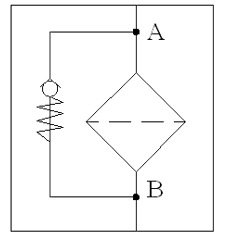
Symbol of a pressure line filter with a bypass valve
Functions of the Hydraulic Pressure Filter
Working filters
Providing protection against wear on components
Ensuring the continuity of the desired fluid cleanliness class
Safety filters
Preserving the functionality of components
Safety filters can only be used together with working filters,
Pressure line filters should always be used together with contamination indicators.
The filter housing must be rated to withstand the maximum system pressure.
When Is a Pressure Line Filter Used?
The following points should be considered when deciding whether to use a pressure line filter in a system:
– Does the system contain components that are especially sensitive to contamination (e.g. servo valves and control valves), or that are important to the system’s operation?
– Does the system contain especially expensive components (e.g. large cylinders, servo valves, hydraulic motors) that are quite important for the system’s safety?
– Is the system’s downtime cost quite high?
– Pressure line filters can be used as a safety filter and/or a working filter.
Characteristics of the Pressure Line Filter
Operating pressure: up to 420 bar
Flow rate: up to 330 l/min
Filter fineness: 3-5 µm
Permissible pressure differential ∆p: up to 200 bar, depending on the filter’s construction

Advantages and Disadvantages of Pressure Line Filters
Advantages:
Can be connected directly upstream of sensitive components.
Pressure line filters allow for very fine filtration.
Pressure line filters are easy to maintain.
Can be supported with a contamination indicator.
Long service life.
No pump cavitation
Disadvantages:
—Power is converted to heat depending on fluid resistance.
Must be built sturdy (weight)
—The component must be designed for a high pressure differential
Related Posts
 Reciprocating Compressor | Working Principle, Parts, Types
  2-Way 2-Position Directional Control Valves
  Cushioning in Pneumatic Cylinders
  Maintenance of Pneumatic Systems
  Basic Components of Pneumatic Systems
  Contamination in Hydraulic Systems and Its Causes
  Safety Rules for Workers on Hydraulic and Pneumatic Machines
  Hydraulic Oils and Their Properties