

This article’s topic is pressure gauges. We’ll cover the working principle of pressure gauges and the types of pressure gauges. We’ll examine the types of pressure gauges and their operating systems in detail.
Pressure Gauge
A pressure gauge is used to measure the pressure of the air used in pneumatic (air-pressure-operated) systems.
Working principle of the pressure gauge
A tube that can lengthen and shorten depending on the pressure of the air flowing inside it moves the needle through the linkage system it’s connected to. The tube flexes like a spring, and this helps it display different pressure values. The up-and-down movement resulting from the flexing of this tube-shaped spring is converted into rotational movement by a gear system, causing deflections in the needle. The pressure value is read as the value the needle points to on the scale.

Parts and operating system of the pressure gauge. (above)
By placing the pressure gauge at any desired point of the circuit, the pressure at that point is determined. The pressure shown by the pressure gauge is the effective (gauge) pressure.
With this device, the working pressure in the system is measured relative to atmospheric pressure. Measurements are made with a Bourdon tube or a diaphragm. When measuring pressure at test points under high dynamic load — with frequent and rapid load changes, pressure spikes, vibration, and shock — these devices are filled with a damping fluid (usually glycerin). If pressure gauges are to be used for controlling a hydraulic system, they can be connected with electrical contacts.
Bourdon Tube Principle
The most common gauge type operates on the movement of a curved tube (Bourdon tube) that changes shape under pressure.
Diaphragm Pressure Gauges
Diaphragm pressure gauges use a flexible membrane to measure the pressure of abrasive or viscous fluids.
Digital Pressure Sensors
Modern digital pressure gauges measure pressure with electronic sensors, offering much higher precision.
Types of Pressure Gauges
When examining the types of pressure gauges, we’ll define them according to their operating system and the type of area they’re used in. There are three types of pressure gauges by operating system: Bourdon tube pressure gauges, diaphragm pressure gauges, and differential pressure gauges.
Bourdon Tube Pressure Gauges

This type of gauge is used for measuring pressure in both liquid and gas fluid environments. However, they’re not used in environments with high viscosity, environments that crystallize, or fluid environments that react with copper alloys.
Allowed application range:
Upper limit for static load: 3/4 of full-scale value
Upper limit for fluctuating load: 2/3 of full-scale value
Can briefly reach the full-scale value.
Structure and Working Principle of the Bourdon-Type Pressure Gauge

The open end of the Bourdon tube takes a value based on the difference between the pressure in the tube of the spring measuring element (1) and atmospheric pressure. Linear measurement is pushed as motion through the connecting link (2) that touches it, and reflects the actual value on the display scale (4).
Diaphragm Pressure Gauges
Compared to Bourdon tube gauges, this type of gauge is more resistant to vibration. They’re also more suitable for gaseous, rusted, uncleaned, or highly viscous environments.

Where diaphragm pressure gauges are used:
Diaphragm pressure gauges are used in concrete and cement pumps, coking plants, sludge pumps, mine locomotives, and road construction machinery.
Structure and Working Principle of the Diaphragm Pressure Gauge

A concentric diaphragm (1), stretched between two flanges, divides the pressurized chamber into two separate sections. The pressure chamber (2) is connected to the outside and is pressurized with atmospheric pressure. Chamber (3), in the measuring position, is pressurized with the working pressure and forms the measuring section. The differential pressure between the pressure in chamber (2) and the pressure in the measuring chamber (3) causes deformation of the diaphragm in one direction. This deformation is transmitted through a push rod (5) to the display mechanism, and to a
needle that indicates the correct position on the scale. (4)
Differential Pressure Gauges
This device measures the pressure difference between two working pressures. This measurement is made with either a Bourdon tube gauge or a diaphragm gauge. When measuring pressure at test points under high dynamic load with shock and vibration, these devices are filled with a damping fluid (usually glycerin). Additionally, if these devices are used for controlling a hydraulic system, they can be connected with electrical or pneumatic switches.
Bourdon Tube Differential Pressure Gauges
These gauges are used for measuring pressure differences between fluids and gases that don’t have high viscosity and don’t crystallize.
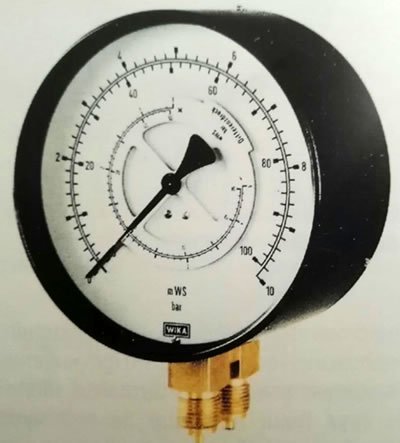
This pressure measuring device has two independently operating Bourdon-tube measuring systems. The movements of the measuring element (arising from pressurization) are transmitted to the gauge in proportion to the measured pressure and shown on the scale.
Diaphragm Differential Pressure Gauge
These devices are suitable for differential pressure measurements of liquids and gases. They’re generally used to measure the pressure drop occurring between pipelines and a filter system.

Related Questions
This tube flexes and changes shape depending on the pressure of the air passing through it. This flexing motion is converted into rotation of the needle by a gear mechanism, making the pressure value readable on the scale.
In everyday life and industrial applications, what actually matters is how much more pressurized the system is compared to atmospheric pressure. For this reason, pressure gauges are designed to show effective (gauge) pressure — the difference relative to atmospheric pressure — rather than absolute pressure.
Related Posts
 2-Way 2-Position Directional Control Valves
  What Is a Hydraulic Return Filter. Return Line Filters
  General Safety Rules for Hydraulic Technicians
  Basic Physics and Laws for Pneumatics
  What Is a Hydraulic Accumulator Used For
  Hydraulic Pump Selection Criteria
  Pneumatic Cylinders and Their Types
  3-Way, 2-Position (3/2) Directional Control Valves